The predictive value of polygenic risk scores for depression in gene-environment interaction studies: a systematic review
Sabrina Illius, Julian Eder, Susanne Vogel, Nina Alexander

TL;DR
This review examines how polygenic risk scores for depression interact with environmental factors in predicting depression, finding mixed evidence for gene-environment interactions.
Contribution
This is the first systematic review of polygenic risk score-based gene-environment interaction studies for depression.
Findings
Most studies found significant main effects of polygenic risk scores and environmental factors on depression.
Significant gene-environment interactions were mostly observed in large cohorts with over 40,000 participants.
Environmental factors were often found to correlate with an individual's polygenic risk score.
Abstract
According to the diathesis-stress model, genetic liability and environmental exposures interact in the pathogenesis of depression. Polygenic risk scores for depression (PRSD) based on large-scale genome-wide association studies have opened new avenues for investigating gene-environment interaction (GxE) beyond candidate gene studies. To the best of our knowledge, this is the first systematic review of studies that have taken a polygenic score approach to study GxE interaction effects on depression phenotypes. Based on a preregistered, systematic literature search according to PRISMA guidelines, 56 studies were considered for qualitative analysis. Respective studies investigated a broad range of adverse and protective environmental exposures across the lifespan, e.g., trauma, stressful life events, social environments and (un)healthy lifestyle factors, using cross-sectional and…
Genes, proteins, chemicals, diseases, species, mutations and cell lines named across the full text — each resolved to its canonical identifier and authoritative record.
Click any figure to enlarge with its caption.
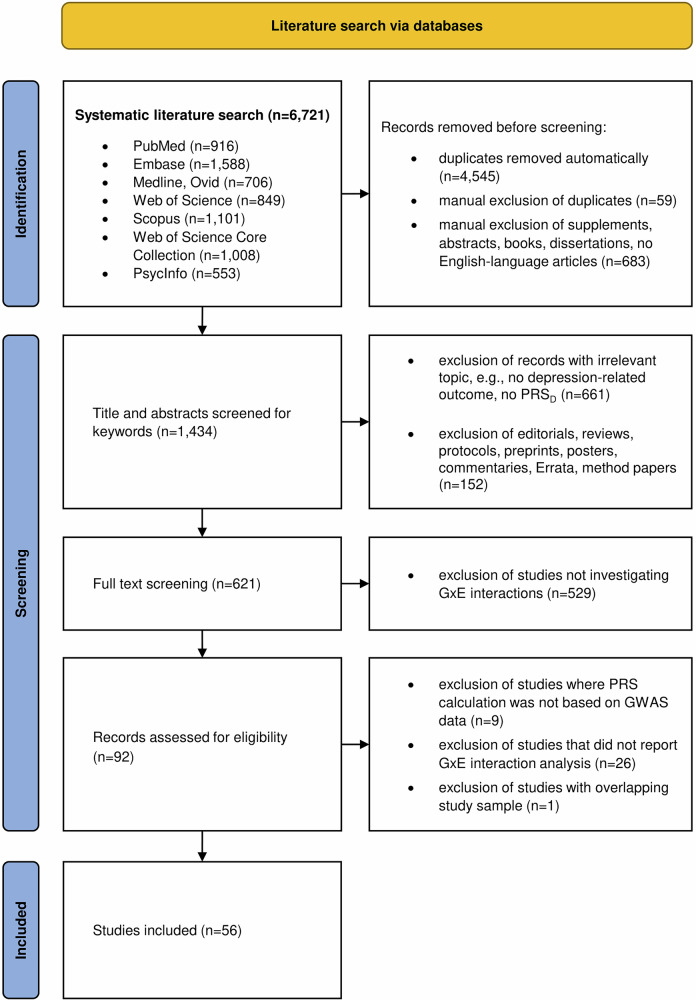 Figure 1
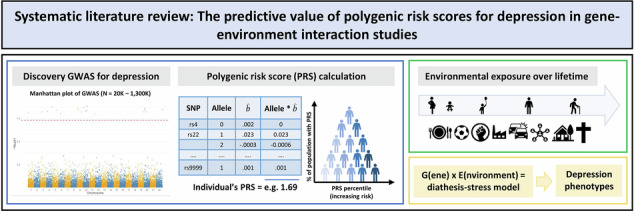 Figure 2
Peer Reviews
No public reviews on file for this paper yet. If you reviewed it on a platform where reviews are public (OpenReview, ICLR, NeurIPS, ICML), you can paste yours below so the community can read it here.
Videos
No videos yet. Explain this paper in a talk, walkthrough, or lecture? Add one.
Taxonomy
TopicsGenetic Associations and Epidemiology · Mental Health Research Topics · Advanced Causal Inference Techniques