Exploring LCME’s New USMLE Norms of Accomplishment: Medical School Self-Reflection to Support Continuous Quality Improvement
Mark Grichanik, Rivka C. Stone

TL;DR
This paper introduces a new self-reflection tool to help medical schools improve USMLE performance using continuous quality improvement strategies.
Contribution
The novelty lies in the development of a self-reflection tool based on the Ishikawa method to address USMLE performance issues systematically.
Findings
New USMLE norms require strategic approaches to improvement.
A self-reflection tool was developed to identify root causes of below-target performance.
The tool supports medical schools in coordinating resources and systems for quality improvement.
Abstract
The Liaison Committee on Medical Education has introduced new norms for United States Medical Licensing Examination (USMLE) performance. Improving USMLE outcomes is a complex intervention that requires careful deliberation of tradeoffs, the coordination of many people and systems, and the marshalling of significant resources, so it is important that any increased attention to USMLE processes is approached strategically through a continuous quality improvement lens. We explore the potential implications of these new standards and present a self-reflection tool, inspired by the Ishikawa method, designed to help schools guide their USMLE-related initiatives by systematically considering possible root causes of below-target USMLE performance.
Click any figure to enlarge with its caption.
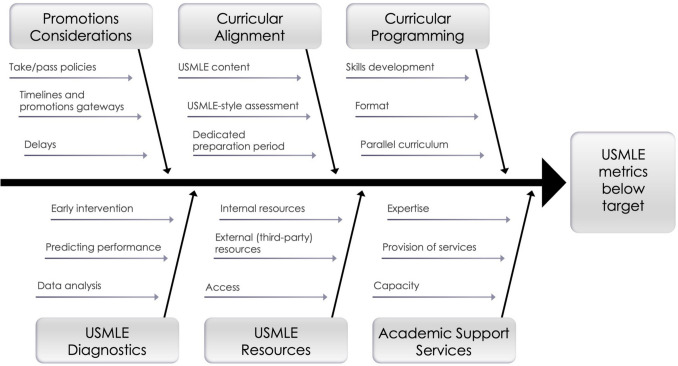 Figure 1
Peer Reviews
No public reviews on file for this paper yet. If you reviewed it on a platform where reviews are public (OpenReview, ICLR, NeurIPS, ICML), you can paste yours below so the community can read it here.
Videos
No videos yet. Explain this paper in a talk, walkthrough, or lecture? Add one.
Taxonomy
TopicsInnovations in Medical Education · Medical Education and Admissions · Global Health Workforce Issues