Editorial: Unlocking the microbial code: potential role in sarcoidosis pathogenesis and treatment
Claudio Tana, Nicol Bernardinello, Paolo Spagnolo

Abstract
Genes, proteins, chemicals, diseases, species, mutations and cell lines named across the full text — each resolved to its canonical identifier and authoritative record.
Click any figure to enlarge with its caption.
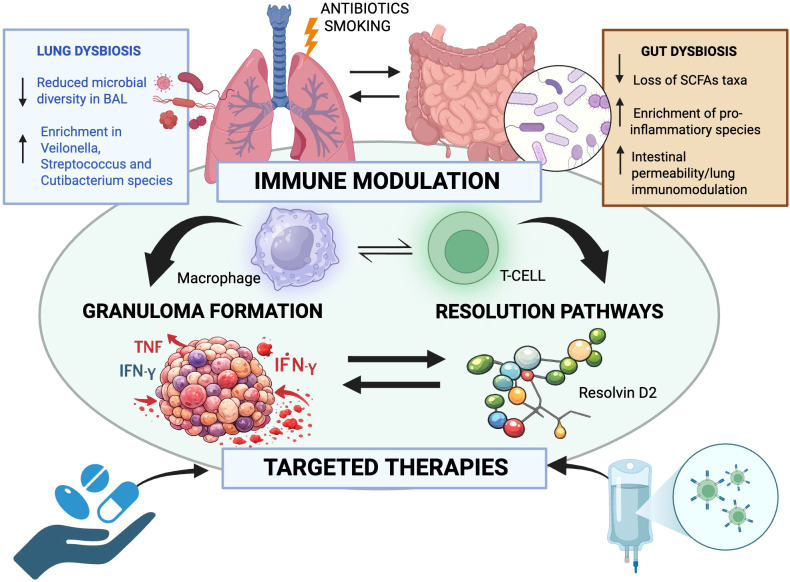 Figure 1
Peer Reviews
No public reviews on file for this paper yet. If you reviewed it on a platform where reviews are public (OpenReview, ICLR, NeurIPS, ICML), you can paste yours below so the community can read it here.
Videos
No videos yet. Explain this paper in a talk, walkthrough, or lecture? Add one.
Taxonomy
TopicsSarcoidosis and Beryllium Toxicity Research · Cancer Research and Treatments · Tuberculosis Research and Epidemiology
Sarcoidosis remains one of the most compelling unresolved clinical challenges. It is defined by non-caseating granulomatous inflammation and remarkable clinical heterogeneity (1, 2), but still lacks a unifying pathogenic framework (3). Despite substantial advances in immunology, purely immune-centered models have failed to fully explain why granulomatous inflammation emerges, persists, or resolves across patients and organs (3).
The Research Topic “Unlocking the Microbial Code: Potential Role in Sarcoidosis Pathogenesis and Treatment” was conceived to explore a converging line of evidence suggesting that sarcoidosis may arise from a dynamic and context-dependent interaction between the immune system and microbial ecosystems (4). The contributions gathered herein collectively point toward the microbiota—both intestinal and pulmonary—as an active immunological modulator capable of shaping macrophage behavior, T-cell polarization, and cytokine networks that underpin granuloma formation (5).
In this framework, the comprehensive review by Rizzi et al. critically integrates emerging metagenomic and immunological data, proposing that dysbiosis may represent a biologically meaningful component of disease susceptibility, phenotype, and progression rather than a secondary epiphenomenon.
From a translational perspective, the contribution by Ucciferri et al. further defines this paradigm by highlighting how antibiotic exposure can induce long-lasting perturbations of the host microbiota with potential downstream consequences for immune balance and inflammatory trajectories, raising timely and clinically relevant questions regarding antimicrobial stewardship in sarcoidosis.
At the tissue level, original research comparing lung granulomas in sarcoidosis and tuberculosis provides a crucial mechanistic bridge, revealing that sarcoid granulomas possess a distinct immune architecture and spatial organization despite histological similarities, underscoring that granulomatous inflammation is not a uniform endpoint but a finely tuned, context-specific immune structure. Complementary experimental evidence on pro-resolving mediators such as resolvin D2, although not disease-specific, reinforces the importance of resolution pathways in restoring immune homeostasis and suggests that failure to engage these mechanisms may contribute to persistent granulomatous inflammation.
Taken together, the studies in this Research Topic converge toward a more integrated and biologically nuanced model in which sarcoidosis might result, at least in a subset of patients, from the interplay between microbial signals, immune regulation, and tissue microenvironments (6). This conceptual evolution is closely aligned with recent advances emphasizing the need for a multidisciplinary approach to management and the integration of novel technologies in sarcoidosis care, where immunology, imaging, clinical phenotyping, and systems-based approaches converge to address several aspects of this complex disease (7).
In particular, emerging frameworks that incorporate advanced imaging modalities and refined therapeutic strategies—especially in high-risk organ involvement such as the heart, nervous system, and eye—underscore how deeper pathobiological insight can inform precision-oriented clinical decision-making (8–12). An overview of the key mechanisms, working hypotheses, and representative studies discussed by the articles included in this special issue is illustrated in Figure 1.
By bringing microbiome science into the core of sarcoidosis research and embedding it within a broader multidisciplinary and technology-driven perspective, this topic supports a shift from empiric, broad immunosuppression to targeted strategies aimed at restoring immune–microbial homeostasis and redefining how this complex and heterogeneous disease is understood and managed.
The reference list from the paper itself. Each links out to its DOI / PubMed record.
- 1Drent M Russell AM Saketkoo LA Spagnolo P Veltkamp M Wells AU . Breaking barriers: holistic assessment of ability to work in patients with sarcoidosis. Lancet Respir Med. (2024) 12:848–51. doi: 10.1016/S 2213-2600(24)00297-2, PMID: 39423840 · doi ↗ · pubmed ↗
- 2Tana C Schiavone C . The chameleon behavior of sarcoidosis. J Clin Med. (2021) 10:2780. doi: 10.3390/jcm 10132780, PMID: 34202837 PMC 8269299 · doi ↗ · pubmed ↗
- 3Tana C Donatiello I Caputo A Tana M Naccarelli T Mantini C . Clinical features, histopathology and differential diagnosis of sarcoidosis. Cells. (2021) 11:59. doi: 10.3390/cells 11010059, PMID: 35011621 PMC 8750978 · doi ↗ · pubmed ↗
- 4Nouvenne A Ticinesi A Tana C Prati B Catania P Miraglia C . Digestive disorders and Intestinal microbiota. Acta Bio Med. (2018) 89:47–51. doi: 10.23750/abm.v 89i 9-S.7912, PMID: 30561395 PMC 6502202 · doi ↗ · pubmed ↗
- 5Hou K Wu ZX Chen XY Wang JQ Zhang D Xiao C . Microbiota in health and diseases. Signal Transduct Target Ther. (2022) 7:135. doi: 10.1038/s 41392-022-00974-4, PMID: 35461318 PMC 9034083 · doi ↗ · pubmed ↗
- 6Becker A Vella G Galata V Rentz K Beisswenger C Herr C . The composition of the pulmonary microbiota in sarcoidosis - an observational study. Respir Res. (2019) 20:46. doi: 10.1186/s 12931-019-1013-2, PMID: 30819175 PMC 6396534 · doi ↗ · pubmed ↗
- 7Tana C Drent M Obi ON Cinetto F Bernardinello N Moffa L . Multidisciplinary strategies and new technologies in the management of sarcoidosis. Eur J Intern Med. (2025) 1:106576. doi: 10.1016/j.ejim.2025.106576, PMID: 41176424 · doi ↗ · pubmed ↗
- 8Tana C Kouranos V Bernardinello N Mantini C Scarpa R Cinetto F . Redefining cardiac sarcoidosis with advanced imaging and therapeutic strategies. Am J Cardiovasc Drugs. (2025). doi: 10.1007/s 40256-025-00783-4, PMID: 41474488 · doi ↗ · pubmed ↗