Emergence of Tigecycline‐Resistant Pseudomonas aeruginosa Harbouring tmexC6D6‐toprJ1b From Hospital Sewage in Japan
Shotaro Maehana, Masato Suzuki, Naoko Ishimura, Hiroki Izawa, Ryotaro Eda, Masaki Nakamura, Mohan Amarasiri, Takashi Furukawa, Fumiaki Kojima, Kazunari Sei, Makoto Kubo

TL;DR
A new drug-resistant strain of Pseudomonas aeruginosa was found in hospital sewage in Japan, highlighting the spread of antibiotic resistance.
Contribution
First identification of tmexC6D6-toprJ1b in Pseudomonas aeruginosa from hospital sewage in Japan.
Findings
Isolated strain KAM950 showed reduced susceptibility to tigecycline and carbapenems.
The tmexC6D6-toprJ1b gene cluster was found on the chromosome near tnfxB6 and IS5/IS1182 transposase.
IS4-mediated disruption of oprD gene may contribute to carbapenem resistance.
Abstract
The mobile tmexCD‐toprJ gene clusters encode resistance‐nodulation‐division (RND)‐type multidrug efflux pumps which confer resistance to multiple antimicrobials, including tigecycline. Here we report the first identification of tmexCD‐toprJ‐harbouring Pseudomonas aeruginosa strain KAM950, isolated from hospital sewage in Japan in 2022. The isolate exhibited reduced susceptibility to tigecycline and carbapenems. Complete genome sequence analysis showed that KAM950 belongs to sequence type 244 (ST244) according to multilocus sequence typing, an internationally recognised epidemic clone, and harbours multiple antimicrobial resistance genes, including the tmexCD‐toprJ variant, tmexC6D6‐toprJ1b. Notably, the tmexC6D6‐toprJ1b gene cluster was located on the chromosome, adjacent to the transcriptional regulator gene tnfxB6 and an IS5/IS1182 family transposase gene. Furthermore, an…
Genes, proteins, chemicals, diseases, species, mutations and cell lines named across the full text — each resolved to its canonical identifier and authoritative record.
Click any figure to enlarge with its caption.
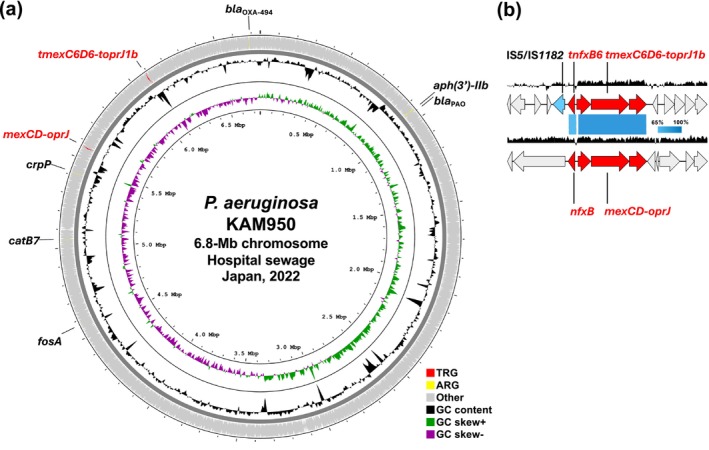 FIGURE 1
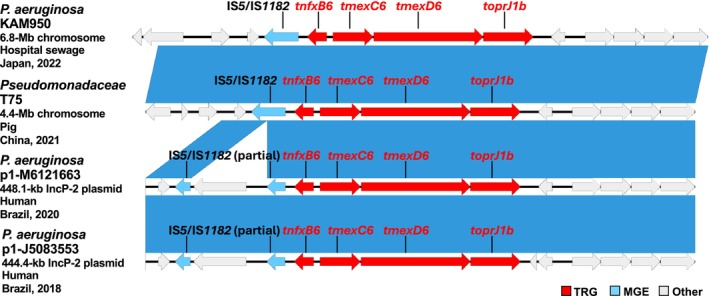 FIGURE 2
- —Japan Agency for Medical Research and Development10.13039/100009619
- —Ministry of Education, Culture, Sports, Science and Technology10.13039/501100001700
- —Environmental Restoration and Conservation Agency10.13039/100014423
Peer Reviews
No public reviews on file for this paper yet. If you reviewed it on a platform where reviews are public (OpenReview, ICLR, NeurIPS, ICML), you can paste yours below so the community can read it here.
Videos
No videos yet. Explain this paper in a talk, walkthrough, or lecture? Add one.
Taxonomy
TopicsAntibiotic Resistance in Bacteria · Pharmaceutical and Antibiotic Environmental Impacts · Infections and bacterial resistance
Introduction
1
A third‐generation tetracycline of the glycylcycline class, tigecycline was developed in the 1990s from minocycline to overcome tetracycline resistance (Zhanel et al. 2004). It exhibits broad‐spectrum activity against both gram‐positive and gram‐negative bacteria, including strains resistant to multiple clinically important antimicrobial classes, such as aminoglycosides, fluoroquinolones, and carbapenems, as well as tetracyclines. Employed as a salvage therapy for severe infections caused by carbapenem‐ and colistin‐resistant bacteria (Tasina et al. 2011), tigecycline demonstrates particular efficacy against extensively drug‐resistant Enterobacterales and Acinetobacter species (Brust et al. 2014). The dissemination of tigecycline resistance poses a global public health threat to treatment options. Resistance‐nodulation‐cell division (RND)‐type multidrug efflux pumps, such as MexCD‐OprJ, confer resistance to multiple antimicrobials (Du et al. 2018). The transferrable tmexCD‐toprJ gene clusters, which encode the RND‐type multidrug efflux pump TMexCD‐TOprJ, confer multidrug resistance, including resistance to tetracyclines and tigecycline. These gene clusters are believed to have originated from the chromosomal mexCD‐oprJ efflux pump gene cluster homologue in Pseudomonas species (Lv et al. 2020; Peng et al. 2024).
tmexCD‐toprJ gene clusters have been identified in gram‐negative bacteria from humans, animals, and various environmental sources, and have globally dispersed via mobile genetic elements, such as plasmids (Anyanwu et al. 2022). Most variants of tmexCD‐toprJ, including tmexCD1‐toprJ1, have been reported mainly in Enterobacterales (Anyanwu et al. 2022), whereas the tmexC6D6‐toprJ1b variant appears to be primarily associated with Pseudomonas species (Wang et al. 2023). To date, only two Klebsiella pneumoniae clinical isolates that harbour the tmexCD1‐toprJ1 gene cluster on the IncFIB(K) and the IncHI1B/IncFIB(K) plasmid, respectively, have been reported in Japan (Hirabayashi et al. 2025). Although the clinical use of tigecycline remains limited and the prevalence of tmexCD‐toprJ gene clusters is presumed to be extremely low in Japan, no studies have yet investigated their presence in non‐clinical settings.
This study aimed to investigate tigecycline‐resistant and multidrug‐resistant bacteria in hospital sewage in Japan as part of a One Health approach (Martinengo et al. 2025; GBD 2021). We identified a Pseudomonas aeruginosa isolate KAM950 harbouring tmexC6D6‐toprJ1b and conducted genomic and molecular characterisation.
Experimental Procedures
2
Bacterial Isolation and Identification
2.1
In 2022, screening for carbapenem‐ and tigecycline‐resistant bacteria was conducted using sewage water collected from a tertiary emergency hospital in Kanagawa Prefecture, Japan. An aliquot (0.1 mL) of the sample was pre‐cultured overnight at 37°C in MacConkey broth supplemented with 8 mg/L meropenem and 8 mg/L tigecycline. Bacterial isolates were subsequently obtained by plating on desoxycholate‐hydrogensulfide‐lactose (DHL) agar containing 8 mg/L meropenem and 8 mg/L tigecycline and incubated overnight at 37°C. A total of 90 isolates were confirmed as P. aeruginosa by the MALDI Biotyper system (Bruker), with isolate KAM950 selected for detailed analysis.
Antimicrobial Susceptibility Testing
2.2
Antimicrobial susceptibility testing (AST) for KAM950 was performed by the agar dilution method, following the Clinical and Laboratory Standards Institute (CLSI) guidelines (CLSI 2025). Briefly, antimicrobial solutions were prepared in two‐fold serial dilutions and incorporated into cation adjusted Mueller–Hinton agar (BD) using Escherichia coli ATCC 25922 as the control. Upon solidification, bacterial suspensions standardised to approximately 10^4^ CFU per spot were applied using a micro‐planter MIT‐60 (Sakuma Seisakujo). Plates were incubated at 35°C for 16–20 h under appropriate atmospheric conditions. The MIC was defined as the lowest concentration showing no visible growth. The susceptibility of the strain to antibiotics was assessed multiple times on different days. CLSI breakpoints for gentamicin, minocycline, and tigecycline were not available for Pseudomonas species.
Whole‐Genome Sequencing
2.3
Whole‐genome sequencing of KAM950 was performed using both the NovaSeq X platform (Illumina) and the MinION platform (Oxford Nanopore Technologies) equipped with an R10.4.1 flow cell. The Illumina sequencing library (paired‐end, insert size 500–900 bp) was prepared using the Nextera XT DNA Library prep kit, while the ONT sequencing library was prepared using the rapid barcoding kit (SQK‐RBK114.24). Basecalling of ONT reads was performed using Dorado v0.5.3 with the high‐accuracy model.
Genome Assembly and Annotation
2.4
Hybrid assembly of ONT and Illumina reads was performed de novo using Unicycler v0.5.0 (https://github.com/fenderglass/Flye) with the default parameters, resulting in a complete circular chromosome. Gene annotation was performed using the DFAST server (https://dfast.nig.ac.jp) with the default parameters.
Genomic Analysis
2.5
Average nucleotide identity (ANI) analysis was performed using the DFAST server (https://dfast.nig.ac.jp). MLST analysis was performed using mlst v2.16.1 (https://github.com/tseemann/mlst) with the P. aeruginosa species‐specific scheme from PubMLST, as originally developed by Curran et al. (2004). Antimicrobial resistance genes (ARGs) were identified using ResFinder v4.5.0 with the default parameters via the Center for Genomic Epidemiology (CGE) server (http://www.genomicepidemiology.org). Linear comparisons of 5‐kb upstream and downstream regions of tmexCD‐toprJ and mexCD‐oprJ were performed using BLASTn and visualised with Easyfig v2.2.2 (http://mjsull.github.io/Easyfig/).
Results and Discussion
3
A P. aeruginosa isolate, KAM950, exhibiting resistance to both carbapenems and tigecycline, was isolated from hospital sewage in Japan in 2022. Carbapenem‐resistant P. aeruginosa , one of clinically significant antimicrobial resistant bacterial pathogens, is included in the WHO priority pathogens list (Sati et al. 2025).
AST revealed that KAM950 exhibited resistant‐level MICs to piperacillin (> 256 mg/L), piperacillin/tazobactam (128 mg/L), imipenem (16 mg/L), and meropenem (32 mg/L), along with elevated MICs for gentamicin (128 mg/L), minocycline (128 mg/L), and tigecycline (128 mg/L). For comparison, the reference strain P. aeruginosa PAO1 exhibits MICs of 1 mg/L for imipenem and 16 mg/L for tigecycline. Thus, the MICs of KAM950 increased approximately 16‐fold for imipenem and 8‐fold for tigecycline compared with PAO1, indicating a marked reduction in susceptibility to these agents.
Whole‐genome sequencing analysis using both short‐ and long‐read sequencers resulted in the complete genome of KAM950 consisting of a 6.7‐Mb chromosome (accession no. AP040125). KAM950 was confirmed as P. aeruginosa based on ANI showing 97.38% identity with P. aeruginosa NBRC12689^T^. According to multilocus sequence typing, KAM950 was classified as sequence type 244 (ST244), one of the global epidemic high‐risk clones associated with multidrug resistance, including carbapenem resistance, of P. aeruginosa (Del Barrio‐Tofiño et al. 2020).
KAM950 harboured multiple ARGs on the chromosome, including aph(3′)‐IIb (aminoglycoside resistance), bla OXA‐494 and bla PAO (β‐lactam resistance), catB7 (chloramphenicol resistance), fosA (fosfomycin resistance), crpP (fluoroquinolone resistance), and tmexC6D6‐toprJ1b (multidrug resistance including tetracycline and tigecycline resistance), the tmexCD‐toprJ variant first described in China in 2023 (Wang et al. 2023), in addition to the chromosomal mexCD‐oprJ (Figure 1a). Furthermore, an insertion sequence belonging to the IS4 family was found integrated into the porin gene oprD, potentially contributing to carbapenem resistance through porin loss (Wang et al. 2025).
(a) Genomic structure of the P. aeruginosa KAM950 chromosome (accession no. AP040125) harbouring tmexC6D6‐toprJ1b, isolated from hospital sewage in Japan in 2022. Tigecycline resistance genes (TRG), other antimicrobial resistance genes (ARG), other coding sequences (CDS), mobile genetic elements (MGE), GC content, GC skew+, and GC skew– are highlighted by red, yellow, grey, light blue, black, green, and purple, respectively. (b) Structural comparison between the chromosomal regions surrounding tnfxB6‐tmexC6D6‐toprJ1b and nfxB‐mexCD‐oprJ gene clusters. Synteny blocks represent the indicated sequence identity.
The tmexC6D6‐toprJ1b gene cluster was encoded at a different location from mexCD‐oprJ (Figure 1a) and was accompanied by the adjacent regulatory gene tnfxB6 (Figure 1b). Notably, an IS5/IS1182 family transposase gene was identified upstream of tnfxB6‐tmexC6D6‐toprJ1b, suggesting the potential for the IS5/IS1182‐mediated horizontal gene transfer of this gene cluster (Figure 1b). A BLASTn analysis of the chromosomal IS5/IS1182‐tnfxB6‐tmexC6D6‐toprJ1b‐containing region of KAM950 using the NCBI nr database revealed an identical sequence in the chromosome of Pseudomonadaceae strain T75, from a pig in China in 2021 (Figure 2), and highly similar sequences in P. aeruginosa IncP‐2 megaplasmids p1‐M6121663 and p1‐J5083553, from humans in Brazil in 2020 and 2018, respectively (Figure 2). Indeed, IncP‐2 megaplasmids have been shown to be associated with clinically important ARGs, including *tmexCD‐toprJ (*Shintani et al. 2022 ).
Structural comparison between the indicated tmexC6D6‐toprJ1b–containing regions in the P. aeruginosa KAM950 chromosome (accession no. AP040125) in this study, the Pseudomonadaceae bacterium T75 chromosome (accession no. CP113226), the P. aeruginosa M6121663 plasmid p1‐M6121663 (accession no. CP166820) and the P. aeruginosa J5083553 plasmid p1‐J5083553 (accession no. CP166820). The tigecycline resistance gene (TRG), mobile gene elements (MGE), and other coding sequences (Other) are highlighted by red, light blue, and grey, respectively. Synteny blocks represent 100% sequence identity.
This study reports the first identification and characterisation of the tmexC6D6‐toprJ1b variant in Japan. tmexC6D6‐toprJ1b may be spreading globally, occasionally through IS5/IS1182‐mediated transposition, integrating into both chromosomes and plasmids particularity of Pseudomonadaceae. The acquisition of tmexCD‐toprJ gene clusters by P. aeruginosa will likely enhance its intrinsic multidrug resistance, posing a clinical threat and necessitating heightened vigilance and continuous surveillance.
Author Contributions
Hiroki Izawa: investigation, writing – review and editing. Masaki Nakamura: investigation, writing – review and editing. Shotaro Maehana: conceptualization, methodology, data curation, formal analysis, visualization, writing – original draft, writing – review and editing, project administration, supervision, investigation, validation, funding acquisition, resources. Kazunari Sei: writing – review and editing, resources, funding acquisition. Fumiaki Kojima: investigation, writing – review and editing, resources. Mohan Amarasiri: investigation, writing – review and editing. Masato Suzuki: conceptualization, data curation, formal analysis, visualization, writing – original draft, writing – review and editing, project administration, supervision, investigation, methodology, software, validation, funding acquisition, resources.
Funding
This work was supported by the Japan Agency for Medical Research and Development (JP24fk0108665, JP24fk0108683, JP24fk0108712, JP24fk0108642, JP24gm1610003, JP24wm0225029, JP24wm0225022), the Ministry of Education, Culture, Sports, Science and Technology (JP22K17354, JP23K26235, JP23H00536, JP23K06556, JP22KK0058, JP25K13531), and the Environmental Restoration and Conservation Agency (JPMEERF25S21220, JPMEERF25S21212).
Ethics Statement
The authors have nothing to report.
Conflicts of Interest
The authors declare no conflicts of interest.
The reference list from the paper itself. Each links out to its DOI / PubMed record.
- 1Anyanwu, M. U. , O. C. Nwobi , C. O. R. Okpala , and I. M. Ezeonu . 2022. “Mobile Tigecycline Resistance: An Emerging Health Catastrophe Requiring Urgent One Health Global Intervention.” Frontiers in Microbiology 13: 808744. 10.3389/fmicb.2022.808744.35979498 PMC 9376449 · doi ↗ · pubmed ↗
- 2Brust, K. , A. Evans , and R. Plemmons . 2014. “Favourable Outcome in the Treatment of Carbapenem‐Resistant Enterobacteriaceae Urinary Tract Infection With High‐Dose Tigecycline.” Journal of Antimicrobial Chemotherapy 69, no. 10: 2875–2876. 10.1093/jac/dku 185.24879666 · doi ↗ · pubmed ↗
- 3CLSI . 2025. “Performance Standards for Antimicrobial Susceptibility Testing.” CLSI Supplement M 100, ED 35.
- 4Curran, B. , D. Jonas , H. Grundmann , T. Pitt , and C. G. Dowson . 2004. “Development of a Multilocus Sequence Typing Scheme for the Opportunistic Pathogen Pseudomonas Aeruginosa.” Journal of Clinical Microbiology 42, no. 12: 5644–5649.15583294 10.1128/JCM.42.12.5644-5649.2004 PMC 535286 · doi ↗ · pubmed ↗
- 5Del Barrio‐Tofiño, E. , C. López‐Causapé , and A. Oliver . 2020. “ Pseudomonas Aeruginosa Epidemic High‐Risk Clones and Their Association With Horizontally‐Acquired β‐Lactamases: 2020 Update.” International Journal of Antimicrobial Agents 56, no. 6: 106196.33045347 10.1016/j.ijantimicag.2020.106196 · doi ↗ · pubmed ↗
- 6Du, D. , X. Wang‐Kan , A. Neuberger , et al. 2018. “Multidrug Efflux Pumps: Structure, Function and Regulation.” Nature Reviews. Microbiology 16, no. 9: 523–539. 10.1038/s 41579-018-0048-6.30002505 · doi ↗ · pubmed ↗
- 7GBD . 2021. “Antimicrobial Resistance Collaborators. Global Burden of Bacterial Antimicrobial Resistance 1990–2021: A Systematic Analysis With Forecasts to 2050.” Lancet 404, no. 10459: 1199–1226. 10.1016/S 0140-6736(24)01867-1.PMC 1171815739299261 · doi ↗ · pubmed ↗
- 8Hirabayashi, A. , H. Yano , K. Yahara , et al. 2025. “Emergence of the Mobile RND‐Type Efflux Pump Gene Cluster tmex CD 1‐topr J 1 in Klebsiella pneumoniae Clinical Isolates in Japan.” Journal of Antimicrobial Chemotherapy 80, no. 1: 192–199. 10.1093/jac/dkae 395.39504488 PMC 11695899 · doi ↗ · pubmed ↗