Human intestinal colonization by Escherichia coli ST4014 co-harboring tet(X4) and blaNDM-1 gene: a potential reservoir for antimicrobial resistance dissemination
Huiqiong Jia, Shaocong Lu, Yuanyuan Jia, Yawen Yu, Yuye Wu, Danni Bao, Yingying Zhang, Jiehong Fang, Patrick Butaye, João Pedro Rueda Furlan, Mohamed Elhadidy, Dianelys Quiñones Pérez, Qing Yang, Zhi Ruan

TL;DR
Researchers found Escherichia coli strains in healthy people with genes that make them resistant to powerful antibiotics, raising concerns about silent spread of drug resistance.
Contribution
This study reports the first E. coli ST4014 strains from healthy individuals co-harboring tet(X4) and blaNDM-1 genes on transferable plasmids.
Findings
E. coli ST4014 strains from healthy individuals carry tet(X4) and blaNDM-1 genes conferring resistance to tigecycline and carbapenems.
Both resistance genes are located on conjugative plasmids, enabling horizontal gene transfer.
Phylogenetic analysis shows limited diversity among the three strains but significant divergence from other ST4014 strains.
Abstract
This study aims to elucidate the genomic characteristics of three Escherichia coli strains isolated from stool specimens of healthy individuals co-carrying tet(X4) and blaNDM-1 gene, which confer resistance to tigecycline and carbapenems, respectively. Whole-genome sequencing (WGS) and bioinformatic analysis were conducted to identify the genomic characteristics. Fourteen E. coli strains belonging to the same sequence type (ST) 4014, comprising eleven strains retrieved from public databases and three strains from this study, were integrated into a phylogenetic analysis. Conjugation experiments were conducted to evaluate the transferability of the resistance plasmids. Three E. coli strains exhibited resistance to both tetracyclines and carbapenems, consistent with the presence of tet(X4) and blaNDM-1 genes in their genomes. All strains belonged to the rare ST 4014 and were identified in…
Genes, proteins, chemicals, diseases, species, mutations and cell lines named across the full text — each resolved to its canonical identifier and authoritative record.
Click any figure to enlarge with its caption.
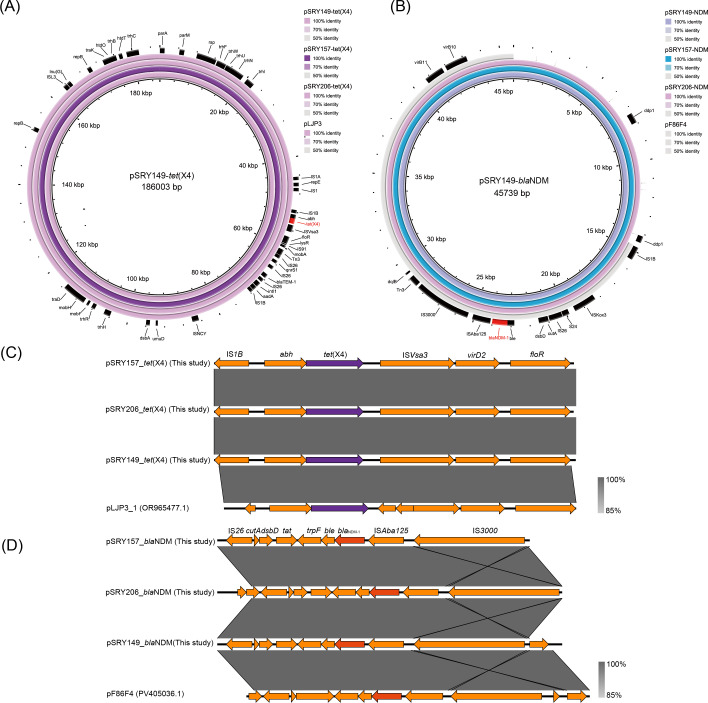 Fig 1
Fig 1- —National Key Research and Development Program of Chinahttp://dx.doi.org/10.13039/501100012166
- —National Natural Science Foundation of Chinahttp://dx.doi.org/10.13039/501100001809
- —National Natural Science Foundation of Chinahttp://dx.doi.org/10.13039/501100001809
- —"Pioneer" and "Leading Goose" R&D Program of Zhejiang Province
- —National Natural Science Foundation of Chinahttp://dx.doi.org/10.13039/501100001809
- —National Natural Science Foundation of Chinahttp://dx.doi.org/10.13039/501100001809
- —National Natural Science Foundation of Chinahttp://dx.doi.org/10.13039/501100001809
- —Natural Science Foundation of Zhejiang Provincehttp://dx.doi.org/10.13039/501100004731
- —Natural Science Foundation of Zhejiang Provincehttp://dx.doi.org/10.13039/501100004731
- —Natural Science Foundation of Zhejiang Provincehttp://dx.doi.org/10.13039/501100004731
- —Key Program of the Zhejiang Medical and Health Science and Technology Project
Peer Reviews
No public reviews on file for this paper yet. If you reviewed it on a platform where reviews are public (OpenReview, ICLR, NeurIPS, ICML), you can paste yours below so the community can read it here.
Videos
No videos yet. Explain this paper in a talk, walkthrough, or lecture? Add one.
Taxonomy
TopicsAntibiotic Resistance in Bacteria · Escherichia coli research studies · Pharmaceutical and Antibiotic Environmental Impacts
OBSERVATION
Carbapenem-resistant Escherichia coli (CREC) mainly results from the production of carbapenem-hydrolyzing enzymes, especially New Delhi metallo-β-lactamase (NDM). Although CREC is primarily associated with clinical settings, strains from healthy individuals exhibit greater lineage diversity compared to those from clinical sources, suggesting a broader dissemination in non-clinical environments (1). The widespread occurrence of blaNDM in CREC poses major challenges for antimicrobial therapy. Tetracycline derivatives, such as tigecycline, remain among the limited therapeutic options available for CREC infections (2). The discovery of mobile tigecycline resistance genes, such as tet(X) variants, in various species from clinical and environmental sources has weakened the effectiveness of this antimicrobial. In this study, we identified and characterized three E. coli strains isolated from stool specimens of healthy individuals that possess both tet(X4) and blaNDM-1 genes, demonstrating resistance to tigecycline and carbapenems.
In March 2021, strains SRY149, SRY157, and SRY206 were isolated from the stool samples of healthy individuals using Mueller-Hinton agar plates containing tigecycline (4 mg/L) at a tertiary hospital in Hangzhou, China. Strains were initially identified as E. coli using MALDI-TOF MS (Vitek MS system, bioMérieux, France) and then subjected to whole-genome sequencing. A detailed description of the materials and methods is provided in the supplemental material. In silico serotyping identified all strains as belonging to sequence type (ST) 4014 and serotype O88:H31. Strain SRY206 differed from SRY149 and SRY157 by six SNPs, whereas SRY149 and SRY157 differed by two SNPs from each other. Three strains were identified within 1 week, and the individuals carrying them exhibited a wide range of ages. No epidemiological link could be identified between the different carriers.
Antimicrobial susceptibility testing results are summarized in Table S1. The strains possess a diverse array of antimicrobial resistance genes (ARGs). Strains SRY149 and SRY157 shared nearly identical ARGs [tet(X4), tet(A), blaNDM-1, blaTEM-1B, blaCARB-2, floR, cmlA1, qnrS1, sul3, and lnu(G)], while SRY206 harbored distinct ARGs. ARGs in SRY149, SRY157, and SRY206 strains were predominantly located on plasmids. The tet(X4) and blaNDM-1 genes identified in the three strains were located on two distinct plasmids. The tet(X4)-carrying plasmids, designated pSRY149-tet(X4) (186,003 bp), pSRY157-tet(X4) (186,831 bp), and pSRY206-tet(X4) (186,003 bp), were of comparable size and classified as IncHI1A/IncHI1B/IncFIA multi-replicon plasmids. The three blaNDM-1-harboring plasmids (pSRY149-blaNDM, pSRY157-blaNDM, and pSRY206-blaNDM) shared identical features, including a size of 45,739 bp and an IncX3 replicon type. The genetic environments of the tet(X4) gene in these plasmids were identical, consisting of structure IS1B-abh-tet(X4)-ISVsa3(ΔISCR2). Various genetic contexts of tet(X4) have been previously reported, with ISCR2 or ΔISCR2 commonly associated with this gene (3). BLASTN analysis of the three tet(X4)-carrying plasmids against the NCBI RefSeq database revealed high sequence similarity with pLJP3_1 (OR965477.1), with 100% coverage and 100% identity observed for pSRY157-tet(X4) and pSRY206-tet(X4), and 100% coverage and 99.9% identity for pSRY149-tet(X4) (Fig. 1A and C). The three blaNDM-1-harboring plasmids (pSRY149-blaNDM, pSRY157-blaNDM, and pSRY206-blaNDM) were identical and carried the IS3000-ISAba125-blaNDM-1-ble-trpF resistance module. High similarity was found with other blaNDM-1-containing plasmids from multiple bacterial species, including E. coli, Klebsiella aerogenes, Klebsiella pneumoniae, Enterobacter hormaechei, and Citrobacter freundii. Our blaNDM-1-harboring plasmids were identical to pF86F4 (PV405036.1) from E. coli and pKQ23-NDM1 (OQ230790.1) from Klebsiella quasipneumoniae (Fig. 1B and D). These findings suggest widespread dissemination of this blaNDM-1-carrying plasmid type among diverse bacterial taxa.
Comparative analysis of tet(X4) or blaNDM-1-carrying plasmids identified in this study. (A) Circular map comparing the tet(X4)-carrying plasmids identified in this study with related plasmids retrieved from public databases. (B) Comparative map of blaNDM-1-carrying plasmids, showing structural similarities and variations among the plasmids analyzed. (C) Genomic context of the tet(X4) gene identified in this study. The tet(X4) gene is highlighted in purple. (D) Genomic environment of the blaNDM-1 gene. The blaNDM-1 gene is shown in red.
The tet(X4)-carrying E. coli strains have been frequently identified in livestock (particularly pigs and poultry), meat products, and related environments across multiple regions in China (4). Three E. coli strains collected from pigeons in China were found to co-harbor tet(X4), mcr-1, and blaNDM-5 genes. The genes tet(X4) and blaNDM-5 were located on transferable plasmids**,** whereas mcr-1 was encoded chromosomally (5). In this study, the conjugation frequencies of the tet(X4)-carrying plasmids ranged from 1.09 × 10^−6^ to 1.57 × 10^−4^, while those of the blaNDM-1-harboring plasmids ranged from 3.43 × 10^−7^ to 2.29 × 10^−5^. Recent research has described the first evidence of a tet(X3)-harboring plasmid capable of horizontal gene transfer across bacterial orders, specifically from Pseudomonadales (e.g., Acinetobacter spp.) to Enterobacterales (e.g., Enterobacteriaceae) (6). The emergence of multidrug-resistant E. coli strains carrying transferable plasmids with various ARGs in healthy individuals is concerning, as these strains are frequently not covered by standard surveillance systems. Particularly worrying is the occurrence of strains that carry ARGs but do not exhibit a resistant phenotype (7, 8). Such strains may contribute to the silent dissemination of ARGs and hinder antimicrobial resistance surveillance. As such, they constitute a major public health threat by facilitating the unnoticed spread of resistance within the community and hospital environments.
In this study, we report on E. coli strains co-harboring tet(X4) and blaNDM-1 genes in healthy individuals, indicating unnoticed colonization by bacteria resistant to tigecycline and carbapenems. Given that these antimicrobial agents represent last-line options for treating severe infections caused by multidrug-resistant gram-negative pathogens, the emergence and potential spread of such dual-resistant strains pose a major threat to effective antimicrobial therapy. These findings highlight the urgent need for expanded surveillance beyond healthcare settings to detect and control the dissemination of high-risk ARGs with pandemic potential.
The reference list from the paper itself. Each links out to its DOI / PubMed record.
- 1Li Y, Zhang Y, Sun X, Wu Y, Yan Z, Ju X, Huang Y, Zhou H, Wang Z, Wang S, Zhang R, Li R. 2024. National genomic epidemiology investigation revealed the spread of carbapenem-resistant Escherichia coli in healthy populations and the impact on public health. Genome Med 16:57. doi:10.1186/s 13073-024-01310-x 38627827 PMC 11020349 · doi ↗ · pubmed ↗
- 2America ID So. 2024. IDSA 2024 guidance on the treatment of antimicrobial resistant Gram-negative infections. Available from: https://www.idsociety.org/practice-guideline/amr-guidance/. Retrieved 8 Dec 2025.
- 3Liu D, Wang T, Shao D, Song H, Zhai W, Sun C, Zhang Y, Zhang M, Fu Y, Zhang R, He T, Lv Z, Bai L, Wu C, Ke Y, Wang Y, Shen Z. 2022. Structural diversity of the ISCR 2-mediated rolling-cycle transferable unit carrying tet(X 4). Sci Total Environ 826:154010. doi:10.1016/j.scitotenv.2022.15401035218833 · doi ↗ · pubmed ↗
- 4Ma L, Xie M, Yang Y, Ding X, Li Y, Yan Z, Chan E-C, Chen S, Chen G, Zhang R. 2024. Prevalence and genomic characterization of clinical Escherichia coli strains that harbor the plasmid-borne tet(X 4) gene in China. Microbiol Res 285:127730. doi:10.1016/j.micres.2024.12773038805981 · doi ↗ · pubmed ↗
- 5Lu X, Du Y, Peng K, Zhang W, Li J, Wang Z, Li R. 2022. Coexistence of tet(X 4), mcr-1, and bla NDM-5 in ST 6775 Escherichia coli isolates of animal origin in China. Microbiol Spectr 10:e 00196-22. doi:10.1128/spectrum.00196-2235311537 PMC 9045152 · doi ↗ · pubmed ↗
- 6Xu C, Li X, Zhang Y, Li Y, Li Y, Zhang R, Dong N. 2025. Interorder horizontal gene transfer of tet(X 3) between Acinetobacter spp. and Enterobacteriaceae. Antimicrob Agents Chemother 69:e 01945-24. doi:10.1128/aac.01945-2440548717 PMC 12326979 · doi ↗ · pubmed ↗
- 7Qin J, Zhu Y, Zhu Y, Gao Q, Zhang H, Li M, Shen Z. 2024. Emergence of silent NDM-1 carbapenemase gene in carbapenem-susceptible Klebsiella pneumoniae: clinical implications and epidemiological insights. Drug Resist Updat 76:101123. doi:10.1016/j.drup.2024.10112339111133 · doi ↗ · pubmed ↗
- 8Jia H, Tong Q, Wang L, Wu Y, Li X, Li S, Kong Y, Zhang Y, Furlan JPR, Khine NO, Butaye P, Zhang J, Yang Q, Ruan Z. 2025. Silent circulation of plasmid-borne tet(X 6) and bla OXA-58 genes in a community-acquired Acinetobacter baumannii strain. Drug Resist Updat 79:101194. doi:10.1016/j.drup.2024.10119439732137 · doi ↗ · pubmed ↗