An optimized 16S–23S rRNA intergenic spacer region PCR for the detection and identification of Bartonella spp
Alexander A. Dichter, Rebecca Kaufmann, Luis Solis Cayo, Pablo Tsukayama, Volkhard A. J. Kempf

Abstract
Genes, proteins, chemicals, diseases, species, mutations and cell lines named across the full text — each resolved to its canonical identifier and authoritative record.
Click any figure to enlarge with its caption.
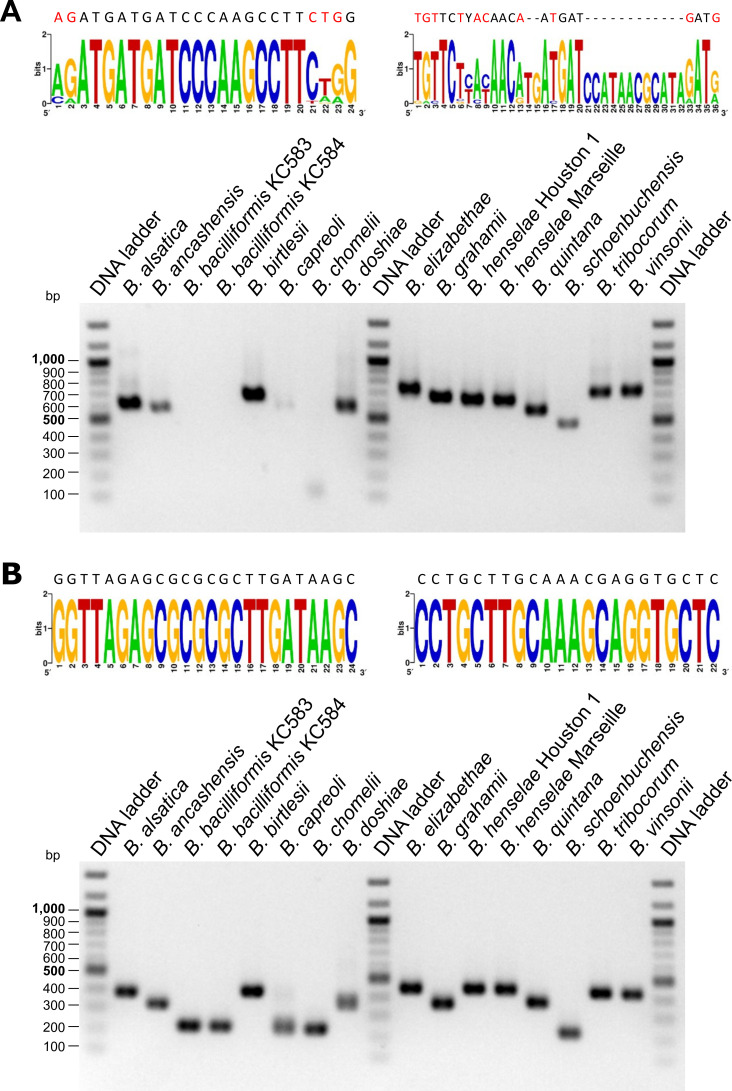 Fig 1
Fig 1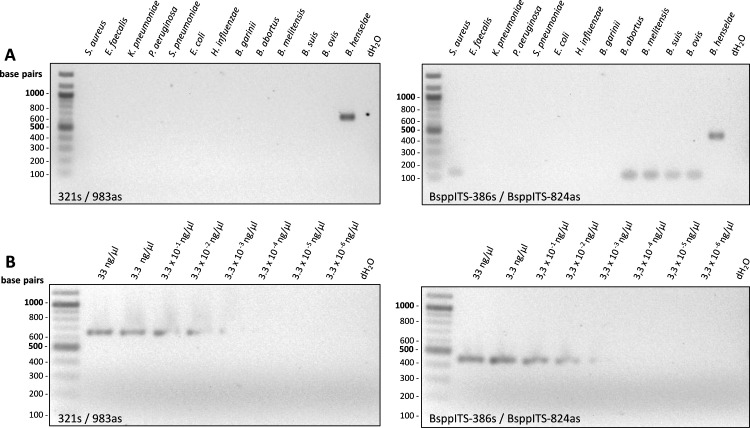 Fig 2
Fig 2| Accession no. of reference genome | PCR amplicon size | |
|---|---|---|
|
| 367 | |
|
| 311 | |
|
| 255 | |
|
| 255 | |
|
| 407 | |
|
| 207 | |
|
| 219 | |
|
| 329 | |
|
| 438 | |
|
| 352 | |
|
| 438 | |
|
| 438 | |
|
| 367 | |
|
| 207 | |
|
| 424 | |
|
| 406 |
- —Robert Koch Institute Berlin, Germany
- —Prociencia Perú
- —State of Hesse, Germany
Peer Reviews
No public reviews on file for this paper yet. If you reviewed it on a platform where reviews are public (OpenReview, ICLR, NeurIPS, ICML), you can paste yours below so the community can read it here.
Videos
No videos yet. Explain this paper in a talk, walkthrough, or lecture? Add one.
Taxonomy
TopicsBartonella species infections research · Vector-borne infectious diseases · Research on Leishmaniasis Studies
LETTER
The emerging genus Bartonella comprises 60 species with unknown medical relevance (National Center for Biotechnology Information, Taxonomy Browser, 5 December 2025 [1]). Some species are human pathogenic (e.g., B. henselae: cat scratch disease, bacillary angiomatosis; B. quintana: trench fever, endocarditis; and B. bacilliformis: Carrion’s disease); other species (e.g., B. alsatica: endocarditis and B. grahamii: lymphadenopathy) are only rarely described to cause human infections (2). Accurate diagnosis of Bartonella infections remains challenging due to unspecific clinical manifestations, difficulties in cultivation, genetic diversity within the genus, and frequent occurrence of low-level bacteremia in infected patients (3). Therefore, because of the fact that serological diagnostics have been developed only for B. henselae, B. quintana (4), and recently for B. bacilliformis (5), PCR-based assays have become indispensable for pathogen detection and differentiation. Pioneer work of Maggi and Breitschwerdt established the 16S–23S rRNA intergenic spacer (ITS) region as a valuable diagnostic target widely used in molecular diagnostics of Bartonella infections. This region is highly variable in sequence and length between Bartonella species and is embedded between conserved flanking regions, allowing the design of universal primers and enabling a reliable discrimination among closely related Bartonella species (6). Despite this great contribution to diagnostics, our results revealed that this PCR protocol with the described ITS primers fails to amplify particular species that were later fully sequenced or discovered because of numerous mismatches to the ITS target sequence (Fig. 1A). This limitation might lead to false-negative results in both clinical and epidemiological studies, ultimately impacting patient management or public health surveillance. Here, we aimed to optimize an ITS-PCR (targeting a sequence of the 16S–23S rRNA ITS) for improved diagnosis of clinically relevant Bartonella species.
Primer binding sites and PCR amplification results (agarose gel electrophoresis) targeting the Bartonella ITS region. (A) Previously published primers (6) and (B) primers designed based on the consensus sequence established in this study were used. The consensus sequence of the ITS region and the corresponding primer sequences are shown in the subfigures, with mismatches indicated in red.
Genomic sequences from 16 Bartonella species (Table 1) were aligned using MAFFT v.7.490 (Geneious, Dotmatics, Auckland, New Zealand). Only 16S–23S rRNA ITS sites that were 100% conserved across all aligned sequences were considered for primer construction, covering the major pathogenic and novel emerging species (BsppITS-386s: 5′-GGTTAGAGCGCGCGCTTGATAAGC-3′ [3′ end of the 16S rRNA gene] and BsppITS-824as: 5′-CCTGCTTGCAAAGCAGGTGCTC-3′ [5′ end of the 23S rRNA gene]) generating PCR amplicons between 207 and 438 nucleotides.
DNA was extracted from Bartonella cultures and 12 bacterial control strains (Table S1). PCR was performed under certified conditions (DIN EN ISO 15189:2024, certificate number D-ML-13102-01-00): initial denaturation (95°C/3 min), followed by 35 cycles (denaturation 94°C/20 s; annealing: 60°C/30 s, elongation: 72°C/40 s, final extension 72°C/1 min). Products were analyzed by agarose gel electrophoresis, demonstrating a robust amplification across all tested strains, including B. bacilliformis and B. ancashensis (Fig. 1B).
In silico, PCR products were aligned using MAFFT to assess sequence variability within the amplified ITS region to evaluate the potential for species-level discrimination. This in silico sequence analysis of the expected amplicons revealed unique DNA sequences except for B. capreoli and B. schoenbuchensis (Table S2), confirmed by Sanger sequencing (data not shown). Specificities of the old and new PCR protocols were evaluated using a broad selection of 12 clinically relevant bacterial strains (Fig. 2A; Table S1), demonstrating no unspecific amplicons between 207 and 438 bp, not even for the four closely related Brucella spp. PCR sensitivities were evaluated by spiking sterile human blood samples with DNA from B. henselae Marseille (final concentrations: 33 ng/µL to 3.3 × 10^−6^ ng/µL). DNA was extracted using the QIAsymphony DSP Virus/Pathogen Kit (Qiagen, Hilden, Germany) under certified conditions (DIN EN ISO 15189:2024), and the 16S–23S rRNA ITS region was amplified using both the old and new PCR protocol. Data revealed that both PCRs have a comparable sensitivity (3.3 × 10^−3^ ng/µL, Fig. 2B). As the 16S–23S rRNA ITS region is present twice in the genomes of Bartonella spp., it might represent a PCR target resulting in more sensitive PCRs compared to PCR targets with only one copy (16S-rDNA, ftsZ, gltA, groEL, ribC, and rpoB). This speculation, however, has not been addressed experimentally.
Determination of (A) specificity and (B) sensitivity of the 16S–23S rRNA intergenic spacer region PCRs. (A) Control bacteria (see Table S1) were grown under standard laboratory conditions. Positive control: B. henselae Marseille, negative control: aqua dest. (dH2O). (B) Sterile human blood samples were spiked with DNA from B. henselae Marseille at the indicated final concentrations (ranging from 33 to 3.3 × 10⁻⁶ ng/µL). Negative control: aqua dest. (dH2O). Left panels: Primers 321s/983as (described in reference 6). Right panels: Primers BsppITS-386s/BsppITS-824as (described in this study).
Our study underscores the importance of periodically re-evaluating diagnostic primers in PCR-based diagnostic approaches as new bacterial species are identified. In regions where Bartonella-related illnesses are endemic, implementation of the optimized ITS primers could improve diagnostic accuracy, facilitate timely treatment, and support more reliable molecular epidemiology.
The reference list from the paper itself. Each links out to its DOI / PubMed record.
- 1National Center for Biotechnology Information (NCBI). 2026 Bartonellaceae (Taxonomy ID: 772) and Bartonella (Taxonomy ID: 773). NCBI Taxonomy. https://www.ncbi.nlm.nih.gov/datasets/taxonomy/tree/?taxon=772,773
- 2Krügel M, Król N, Kempf VAJ, Pfeffer M, Obiegala A. 2022. Emerging rodent-associated Bartonella: a threat for human health? Parasit Vectors 15:113. doi:10.1186/s 13071-022-05162-535361285 PMC 8969336 · doi ↗ · pubmed ↗
- 3Maggi RG, Richardson T, Breitschwerdt EB, Miller JC. 2020. Development and validation of a droplet digital PCR assay for the detection and quantification of Bartonella species within human clinical samples. J Microbiol Methods 176:106022. doi:10.1016/j.mimet.2020.10602232795640 · doi ↗ · pubmed ↗
- 4Centers of Disease Control and Prevention (CDC). 1999. Serodiagnosis of emerging infectious diseases: Bartonella and Ehrlichia infections (course manual). Workshop February 1-4, 1999. Georgia Public Health Laboratory, Atlanta, Georgia, USA.
- 5Dichter AA, Schultze TG, Wenigmann A, Ballhorn W, Latz A, Schlüfter E, Ventosilla P, Guerra Allison H, Ugarte-Gil C, Tsukayama P, Kempf VAJ. 2021. Identification of immunodominant Bartonella bacilliformis proteins: a combined in-silico and serology approach. Lancet Microbe 2:e 685–e 694. doi:10.1016/S 2666-5247(21)00184-135544109 · doi ↗ · pubmed ↗
- 6Maggi RG, Breitschwerdt EB. 2005. Potential limitations of the 16S-23S r RNA intergenic region for molecular detection of Bartonella species. J Clin Microbiol 43:1171–1176. doi:10.1128/JCM.43.3.1171-1176.200515750079 PMC 1081238 · doi ↗ · pubmed ↗