Correction: Breath-Focused Mindfulness and Compassion Training in Parent-Child Dyads: Pilot Intervention Study
Satish Jaiswal, Jason Nan, Seth Dizon, Jessica O Young, Suzanna R Purpura, James K Manchanda, Dhakshin Ramanathan, Dennis J Kuo, Jyoti Mishra

Abstract
Genes, proteins, chemicals, diseases, species, mutations and cell lines named across the full text — each resolved to its canonical identifier and authoritative record.
Click any figure to enlarge with its caption.
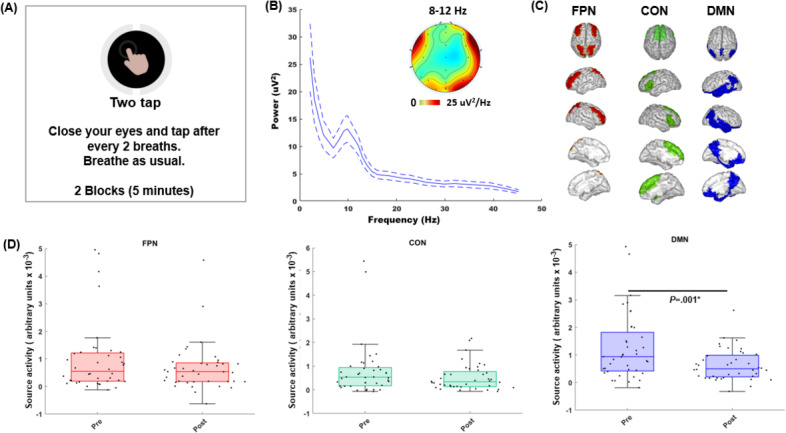 Figure 1
| Post versus preintervention outcomes | Cohen | Mean difference (95% CI) | fdr |
|---|---|---|---|
| Child depression (self-reported) | –0.19 | –3.57 (–8.89 to 1.74) | ns |
| Child depression (parent-reported) | –0.20 | –1.83 (–4.93 to 1.27) | ns |
| Parental stress | –0.41 | –1.39 (–2.63 to –0.16) | .03 |
| Parental anxiety | –0.47 | –1.44 (–2.6 to –0.20) | .03 |
| Parental depression | –0.50 | –1.67 (–3.25 to –0.08) | .03 |
| Children emotion bias cognitive processing (all faces) |
|
|
|
| Parent emotion bias cognitive processing (all faces) |
|
|
|
| DMN |
| - |
|
| Demographics and baseline mental health | Parents (n=24) | Children (n=24) |
|---|---|---|
| Age (y) | ||
| Mean (SD) | 44.5 (6.5) | 9.5 (3.27) |
| Range | 28-54 |
|
| Gender, n (%) | ||
| Male | 4 (16.7) | 10 (41.7) |
| Female | 20 (83.3) | 14 (58.3) |
| Race, n (%) | ||
| Asian | 8 (33.3) | 5 (20.8) |
| Black/African American | 0 (0) | 0 (0) |
| Native American | 0 (0) | 0 (0) |
| Native Hawaiian or Other Pacific | 0 (0) | 0 (0) |
| White | 14 (58.3) | 11 (45.8) |
| More than 1 ethnicity | 2 (8.3) | 7 (29.2) |
| Other | 0 (0) | 1 (4.2) |
| Ethnicity, n (%) | ||
| Hispanic or Latino | 5 (20.8) | 5 (20.8) |
| Not Hispanic or Latino | 18 (75) | 19 (79.2) |
| Unknown | 1 (4.2) | 0 (0) |
| Socioeconomic status | ||
| Mean (SD) | 6.5 (1.4) | — |
| Range | 4-8 | — |
| Child Depression Index | ||
| Mean (SD) | 54.08 (9.06) | 57.96 (13.75) |
| Range | 40-90 | 37-74 |
| Parental Stress (DASS-21) | ||
| Mean (SD) | 4.91 (3.61) | — |
| Range | 0-13 | — |
| Parental Anxiety (GAD-7) | ||
| Mean (SD) | 4.39 (3.28) | — |
| Range | 0-14 | — |
| Parental Depression (PHQ-9) | ||
| Mean (SD) | 5.13 (3.52) | — |
| Range | 0-13 | — |
Peer Reviews
No public reviews on file for this paper yet. If you reviewed it on a platform where reviews are public (OpenReview, ICLR, NeurIPS, ICML), you can paste yours below so the community can read it here.
Videos
No videos yet. Explain this paper in a talk, walkthrough, or lecture? Add one.
Taxonomy
TopicsMindfulness and Compassion Interventions · Music Therapy and Health · Digital Mental Health Interventions
Errors Identified
This corrigendum is being submitted for the article “Breath-Focused Mindfulness and Compassion Training in Parent-Child Dyads: Pilot Intervention Study” [1] in response to a PubPeer comment [2] regarding the neural data shared on Drayd. We found two major issues: (1) the duplications observed resulted from a batch processing script that erroneously plugged in repeat data, and (2) the subject IDs for pre- and postdata were misaligned when creating the final Dryad data Excel file.
Addressing Errors
The following steps were taken to address the errors:
We reprocessed all child neural data individually instead of as a batch process. In this iteration, all child neural data were successfully individually processed. Final data are now unique for each child participant, except child subject PJ24 (one of the subjects flagged in the PubPeer comment [2]), which could not be processed as they did not have any meaningful on-task responses (child continuously held down response spacebar throughout task), hence had to be excluded.As part of our processing pipeline involves across-subject outlier cleaning (as explained in Multimedia Appendix 1 of the original paper [1]), all data values are now updated (ie, values that were previously processed correctly are also slightly updated, with a 98% correlation between previous and current processing).We have doubly ensured that subject IDs and data are correctly aligned in the updated final data.
Impact of the Errors on the Overall Findings
With the corrections made to the dataset, the overall conclusion of the study remains unchanged.
In the Neural Outcomes section, the statistics were changed from the following:
Across all participants, there was no significant change in FPN or CON source localized α activity (P>.4), but DMN activity was significantly reduced at postintervention relative to preintervention (signed rank test z=−2.48; d=−0.62; 95% CI −0.0096 to −0.0002; P=.01). In addition, there was no significant group difference in post- versus pre-DMN activity for children versus parents (rank sum test, P=.09; Figure 4). Group-specific post- versus prechanges in DMN activity showed significant reduction in DMN activity in children (signed rank test z=−2.56; d=−1.09; 95% CI −0.0015 to −0.0003; P=.01), but no change in parent (P>.5), suggesting that this neural outcome was exclusively driven by post- versus prechange in children.
This section now reads:
Across all participants, there was no significant change in FPN or CON source localized α activity (P>.1), but DMN activity was significantly reduced at postintervention relative to preintervention (signed rank test z=−3.21; d=−0.53; 95% CI −0.0010 to −0.0003; P=.001; Figure 4). There was a significant group difference in post- versus pre-DMN activity for children versus parents (rank sum test, P=.002). Group-specific post- versus prechanges in DMN activity showed significant reduction in DMN activity in children (signed rank test z=−3.46; d=−0.98; 95% CI −0.0015 to −0.0005; P=.0005), but no change in parent (P>.5), suggesting that this neural outcome was exclusively driven by post- versus prechange in children.
Additionally, these data updates are now reflected in the newly generated Figure 4D (attached here as Figure 1).
Cooperative compassion training–related neurophysiological changes evaluated on the attention-to-breath monitoring assessment. (A) Schematic of attention-to-breath task instructions. (B) Power frequency plot of scalp channel data across all participants and sessions showed peak processing in the α frequency band (8‐12 Hz); dashed lines are 95% CIs. (C) Source-reconstructed electroencephalographic data were analyzed for 3 cognitive control networks: frontoparietal network (FPN), the cingulo-opercular network (CON), and the default mode network (DMN); regions of interest (ROIs) averaged within each network are highlighted. The identity of the ROIs within the 3 cognitive control networks is detailed in Multimedia Appendix 1. (D) Comparisons of the pre- to postintervention network changes across all participants are shown as swarm box plots. Box plots show median values with lower and upper quartiles as the bottom and top edges of the boxes, respectively. The whiskers denote the data range, and the scatter points show individual α source activity values.
The last statement in the abstract was updated from the following:
Cortical source imaging of electroencephalographic recordings was acquired simultaneous to an attention-to-breathing assessment that showed significant reduction in task-related default mode network activity (d=−0.62; 95% CI −0.0096 to −0.0002; P=.01).
This sentence now reads:
Cortical source imaging of electroencephalographic recordings was acquired simultaneous to an attention-to-breathing assessment that showed significant reduction in task-related default mode network activity (d=−0.53; 95% CI −0.0010 to −0.0003; P=.001).
The false discovery rate–corrected statistics are shown in Table 4 (attached here as Table 1), with changed values shown in italics.
The updated data files can be found on Dryad [3].
Lastly, we noted that in the previous corrected version, the correction in Table 1 regarding the age range of the children was only partially addressed. The age range for children was reported as:
5‐12
This now reads:
5-15
An updated table is shown below (attached here as Table 2), with changes marked in italics
The corrections will appear in the online version of the paper on the JMIR Publications website, together with the publication of this correction notice. Because these were made after submission to PubMed, PubMed Central, and other full-text repositories, the corrected article has also been resubmitted to those repositories.
The reference list from the paper itself. Each links out to its DOI / PubMed record.
- 1Jaiswal S Nan J Dizon S et al Breath-focused mindfulness and compassion training in parent-child dyads: pilot intervention study JMIR Form Res 071720259 e 69607 doi 10.2196/69607 Medline 40674736 PMC 12289298 · doi ↗ · pubmed ↗
- 2Jaiswal S Nan J Dizon S et al Breath-focused mindfulness and compassion training in parent-child dyads: pilot intervention study Pub Peer UR Lhttps://pubpeer.com/publications/A 3A 0B 6DC 3D 0240024423 B 217F 3171 E Accessed 28-01-202610.2196/69607 PMC 1228929840674736 · doi ↗ · pubmed ↗
- 3Jaiswal S Nan J Dizon S et al Data: breath-focused mindfulness and compassion training in parent-child dyads: a pilot intervention study Dryad UR Lhttps://datadryad.org/dataset/doi:10.5061/dryad.9ghx 3ffss Accessed 28-01-202610.2196/69607 PMC 1228929840674736 · doi ↗ · pubmed ↗