Artificial intelligence policies in neurology journals: a cross-sectional analysis
Kohl Kirby, Noah Calvert, Kaylyn Rowsey, Jillian Brassfield, Taylor Gardner, Patrick Crotty, Alec Young, Andrew Tran, Alicia Ito Ford, Matt Vassar

TL;DR
This study examines AI policies in top neurology journals, finding widespread but inconsistent guidelines for AI use in research and publishing.
Contribution
The study provides the first comprehensive analysis of AI policies across top neurology journals, revealing gaps in standardization and alignment with ethical frameworks.
Findings
97% of the top 100 neurology journals have AI-related policies, but these policies are inconsistent.
Few journals reference established ethical frameworks like ICMJE or COPE, and only one references AI-specific guidelines like CONSORT-AI.
AI-assisted writing is widely permitted, but permissions for AI-generated content and images vary significantly.
Abstract
Artificial intelligence (AI) is increasingly used in neurology research and scientific publishing. However, concerns regarding authorship, transparency, and ethical oversight have prompted journals to establish policies governing AI use. The objective of this study was to characterize the presence and content of AI-related author-guideline policies across the top 100 neurology journals and to evaluate their alignment with established editorial frameworks and AI-specific reporting guidelines. We conducted a cross-sectional analysis of the top 100 neurology journals. Data were extracted from each journal’s Instructions for Authors and included policies regarding AI use, disclosure requirements, authorship restrictions, and permissions for AI-assisted writing, AI-generated content, and AI-generated images. References to ethical frameworks and AI-specific reporting guidelines were also…
Genes, proteins, chemicals, diseases, species, mutations and cell lines named across the full text — each resolved to its canonical identifier and authoritative record.
Click any figure to enlarge with its caption.
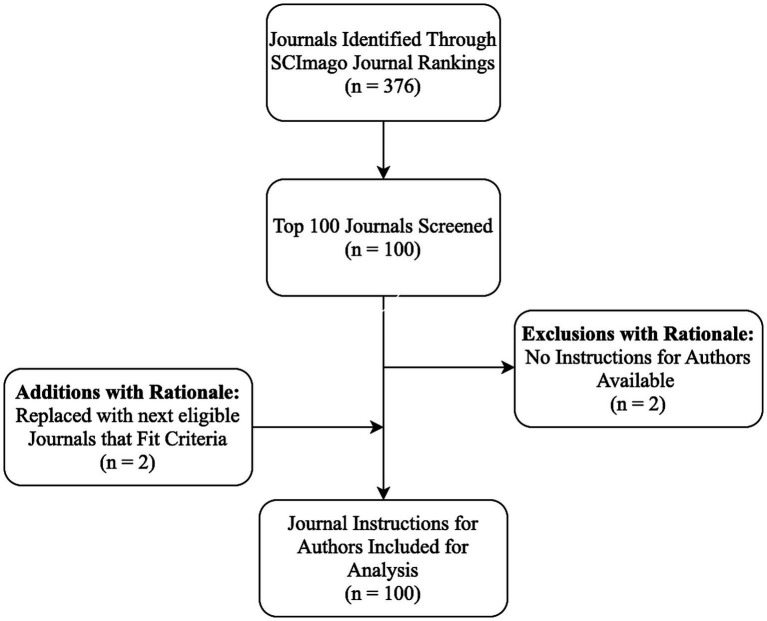 Figure 1
| Characteristic | |
|---|---|
| Continent, n (%) | |
| North America | 49 (49.0) |
| Europe | 47 (47.0) |
| Asia | 4 (4.0) |
| SJR Quartile, n (%) | |
| Q1 | 97 (97.0) |
| Q2 | 3 (3.0) |
| SCImago Rank, Median (IQR) | 52 (27–77) |
| 2023 Journal Impact Factor, Median (IQR) | 4.5 (3.6–6.7) |
| Publisher, n (%) | |
| Springer Nature | 18 (18.0) |
| Wiley-Blackwell | 15 (15.0) |
| Elsevier | 14 (14.0) |
| SAGE Publications | 12 (12.0) |
| Oxford University Press | 7 (7.0) |
| Lippincott Williams and Wilkins | 6 (6.0) |
| BMJ Group | 4 (4.0) |
| American Association of Neurological Surgeons | 3 (3.0) |
| IOS Press | 2 (2.0) |
| Karger | 2 (2.0) |
| Taylor and Francis | 2 (2.0) |
| Adis | 1 (1.0) |
| American Academy of Sleep Medicine | 1 (1.0) |
| American Heart Association | 1 (1.0) |
| American Medical Association | 1 (1.0) |
| American Society of Neuroradiology | 1 (1.0) |
| Annual Reviews | 1 (1.0) |
| Bentham Science | 1 (1.0) |
| Cambridge University Press | 1 (1.0) |
| Current Medicine Group | 1 (1.0) |
| International Society on Aging and Disease | 1 (1.0) |
| Korean Spinal Neurosurgery Society | 1 (1.0) |
| Korean Stroke Society | 1 (1.0) |
| Masson | 1 (1.0) |
| Portland Press | 1 (1.0) |
| Wolters Kluwer Medknow | 1 (1.0) |
| Characteristic | |
|---|---|
| AI mentioned in the Instructions for Authors, n (%) | |
| Yes | 97 (97.0) |
| No | 3 (3.0) |
| ICMJE Statement, n (%) | |
| Yes | 14 (14.0) |
| No | 86 (86.0) |
| COPE Statement, n (%) | |
| Yes | 26 (26.0) |
| No | 74 (74.0) |
| WAME Statement, n (%) | |
| Yes | 10 (10.0) |
| No | 90 (90.0) |
| AI Specific Reporting Guideline, n (%) | |
| Yes | 1 (1.0) |
| No | 99 (99.0) |
| Journal recommend or require adherence to said guideline(s), n (%) | |
| NA | 99 (99.0) |
| Required | 1 (1.0) |
| Specific Guidelines, n (%) | |
| CONSORT-AI, SPIRIT-AI | 1 (100.0) |
| Unknown | 99 |
| Characteristic | |
|---|---|
| AI tools allowed for Authorship, n (%) | |
| Yes | 0 (0.0) |
| No | 97 (97.0) |
| Not Stated | 3 (3.0) |
| Require authors to disclose the use of AI during submission, n (%) | |
| Yes | 96 (96.0) |
| No | 1 (1.0) |
| Not Stated | 3 (3.0) |
| AI tools allowed in Manuscript Writing, n (%) | |
| Yes | 93 (93.0) |
| No | 0 (0.0) |
| Not Stated | 7 (7.0) |
| AI tools allowed in content generation, n (%) | |
| Yes | 77 (77.0) |
| No | 16 (16.0) |
| Not Stated | 7 (7.0) |
| AI tools allowed in image generation, n (%) | |
| Yes | 37 (37.0) |
| No | 39 (39.0) |
| Not Stated | 24 (24.0) |
| Characteristic | |
|---|---|
| AI tools allowed for Authorship, n (%) | |
| Yes | 0 (0.0) |
| No | 97 (100.0) |
| Not Stated | 0 (0.0) |
| Require authors to disclose the use of AI during submission, n (%) | |
| Yes | 96 (99.0) |
| No | 1 (1.0) |
| Not Stated | 0 (0.0) |
| AI tools allowed in Manuscript Writing, n (%) | |
| Yes | 93 (95.9) |
| No | 0 (0.0) |
| Not Stated | 4 (4.1) |
| AI tools allowed in content generation, n (%) | |
| Yes | 77 (79.4) |
| No | 16 (16.5) |
| Not Stated | 4 (4.1) |
| AI tools allowed in image generation, n (%) | |
| Yes | 37 (38.1) |
| No | 39 (40.2) |
| Not Stated | 21 (21.6) |
Peer Reviews
No public reviews on file for this paper yet. If you reviewed it on a platform where reviews are public (OpenReview, ICLR, NeurIPS, ICML), you can paste yours below so the community can read it here.
Videos
No videos yet. Explain this paper in a talk, walkthrough, or lecture? Add one.
Taxonomy
TopicsArtificial Intelligence in Healthcare and Education · Radiomics and Machine Learning in Medical Imaging · Radiology practices and education
Introduction
Artificial intelligence (AI) is rapidly becoming a transformative tool in neurology, with expanding applications across clinical practice and research. In clinical settings, AI has been used to support diagnostic and decision-making processes, including applications in neuroimaging and electrophysiology (1–4). This growth in clinical interest is mirrored in research, where AI has facilitated large-scale data analysis and improved understanding of disease mechanisms and treatment efficacy, including in neuropathology and neurodegenerative diseases such as Alzheimer’s and Parkinson’s (5–13). In addition, natural language processing and automated data extraction tools have improved the efficiency of systematic reviews, meta-analyses, and clinical studies (14). While these advances offer substantial opportunities, they also introduce challenges that may undermine the quality, transparency, and integrity of scientific work.
A major concern is the risk of bias in AI models, which rely on training data. If datasets lack diversity, models may produce skewed or discriminatory results (15). In neurology, where diseases affect diverse populations, biased AI can perpetuate disparities in diagnosis, treatment, and research, potentially leading to misinterpretation or missed diagnoses when applied to underrepresented groups (16). Additionally, the “black box” nature of many AI algorithms complicates their use in research. The lack of transparency makes it difficult for researchers to understand how AI systems arrive at conclusions, undermining trust in findings and impeding the reproducibility of results (17). In fields like neurology, where precision is critical, this opacity can jeopardize scientific rigor (18). When research outcomes depend on tools that cannot be fully understood or explained, the integrity of the research itself is at risk.
As the role of AI continues to expand in neurology research, the growing reliance on these technologies raises important ethical and practical concerns. With AI analyzing vast amounts of data and assisting in manuscript preparation, there is a risk that poorly validated AI models may produce false or misleading results. If published, these inaccuracies could have significant consequences for both clinical practice and future research (19). Furthermore, AI-assisted writing tools, while efficient, may generate drafts that lack the clarity or depth of analysis needed for high-quality scientific communication, ultimately compromising the quality of published research (20).
Given the rapid adoption of AI in neurology research, there is a clear need for regulation and oversight to address these challenges. Without such regulation, the promise of AI to advance neurology research could be overshadowed by the risks it introduces to data quality, research accuracy, and scientific rigor. This study seeks to evaluate how neurology journals are addressing the opportunities and challenges posed by AI in research. Through a systematic review of the author guidelines from leading neurology journals, we examine the extent to which these journals have established policies on AI usage. Specifically, we focus on transparency standards, ethical considerations, and protocols for reporting AI-driven contributions to research. This work fills a critical gap in understanding how well neurology journals are equipped to handle the complexities of AI integration—an issue that is becoming increasingly important. By highlighting current practices and identifying gaps in these guidelines, our study provides valuable insights for refining journal policies, encouraging responsible AI usage, and maintaining the integrity of neurology research in the age of technological innovation.
Methods
Study design
We conducted a cross-sectional analysis of the manuscript submission guidelines for the top 100 journals, as ranked by the 2023 SCImago Journal Rankings. Data were collected from the Instructions for Authors webpages of these 100 journals. This study adhered to the Strengthening the Reporting of Observational Studies in Epidemiology (STROBE) guidelines.
Search strategy
The selection of eligible journals was carried out through consultation between the two investigators (PC, AVT) and the medical research librarian. The 2023 SCImago Journal Rankings were used to gather 396 journal listings for screening. SCImago is an online platform that ranks journals using bibliometric indicators, including the h-index and the SCImago Journal Rank Indicator (SJR). The SJR is considered a more robust metric than the traditional impact factor, as it is open-access and evaluates both the quantity and quality of a publication’s citations. The rankings are generated annually using Elsevier’s subscription-based Scopus database, which encompasses a vast collection of scientific journals, providing a comprehensive dataset for this study. All peer-reviewed journals categorized under subject area ‘medicine’ and subject category ‘neurology’ of the 2023 SCImago journal listings were included in this study.
Exclusion criteria
Journals were excluded from our study if they met any of the following criteria: (i) were discontinued, (ii) lacked editorial office contact information on their website, as we sought to minimize bias by providing editors an opportunity to clarify their publication policies, or (iii) were published in a language other than English without offering a translation option.
Data extraction process
Data was independently extracted by two investigators (KK, NC) from the Instructions for Authors pages of included journals in a masked, duplicate manner. The data were recorded using a standardized Google Form, which was pilot-tested and designed in advance by investigators PC and AVT. During this process, we carefully reviewed publishing policies, authorship criteria, and any editorials or updates from journals and publishing companies related to the use of AI, chatbots, and large language models (LLMs). Data extraction occurred between November 1, 2024 and July 31, 2025. Once the extraction was completed, investigators KK and NC reconciled their data, with a third investigator (PC) available to resolve any discrepancies. All journals were re-reviewed prior to final data reconciliation to ensure that policy information was accurate as of July 31, 2025.
Editorial outreach
For journals without a statement on AI usage in their Instructions for Authors webpage, a standardized email was sent to the Editor-in-Chief or a member of the editorial office to inquire about the development of policies regarding AI use in their publication process. To enhance response rates, emails were sent weekly for three consecutive weeks. All responses, including non-responses, were documented.
Outcomes
The primary outcome of this study evaluated AI usage statements in journal guidelines. The secondary outcome involved reviewing and summarizing the number of journals that permit or prohibit the use of AI-generated content, images, writing, and the inclusion of AI authorship.
Data synthesis
Data summaries of descriptive statistics for journal AI policies were created using R (version 4.2.1) and RStudio. These descriptive statistics consisted of statements regarding: (1) AI generated images (2) AI generated content (3) AI authorship inclusion (4) AI assisted manuscript writing. Bias analysis was not necessary, as the data collected involved a direct evaluation of the Instructions for Authors as opposed to an assessment of each individual study.
In addition, R (version 4.2.1) and RStudio were used to conduct correlational analyses. The strength of correlation was analyzed between the AI usage policies in research and SJR score, journal rank, impact factor, and publishing country. Point-biserial correlations were used because AI policy variables were dichotomous (e.g., permitted vs. not permitted), whereas journal metrics were continuous, making point-biserial correlation an appropriate effect-size measure equivalent to Pearson correlation in this setting. Given the exploratory nature of these analyses, we considered multiple-comparison adjustment but did not apply formal correction; exact p-values are reported for transparency.
Reproducibility
To ensure transparency and reproducibility, analysis scripts, standardized emails, extraction forms, and all raw data collected are publicly available on Open Science Framework (OSF) (21). Generative AI (ChatGPT, OpenAI; GPT-5.1) was used solely to assist with grammar and wording refinement during manuscript preparation; it was not used for data extraction, analysis, interpretation, or content generation, and all edits were reviewed for accuracy by the authors.
Results
A total of 100 neurology journals were included in the analysis following screening and replacement of two journals that lacked Instructions for Authors (Figure 1). Journal characteristics are summarized in Table 1. Nearly half were published in North America (49/100, 49.0%) and a similar proportion in Europe (47/100, 47.0%). Most journals were ranked in the first SJR quartile (97/100, 97.0%). The median SCImago Rank was 52 (IQR 27–77), and the median 2023 Journal Impact Factor was 4.5 (IQR 3.6–6.7). Springer Nature (18/100, 18.0%), Wiley-Blackwell (15/100, 15.0%), and Elsevier (14/100, 14.0%) were the most frequently represented publishers.
Flow diagram for study selection. This diagram illustrates the identification, screening, and inclusion process for neurology journals assessed in the study. A total of 376 journals were initially identified through the 2023 SCImago Journal Rankings. The top 100 journals were screened, after which two journals were excluded due to the absence of an available Instructions for Authors. These were replaced with two journals that met inclusion criteria, resulting in 100 journals included for analysis.
General editorial guidelines
Most journals (97/100, 97.0%) referenced artificial intelligence within their Instructions for Authors (Table 2). Fewer endorsed established editorial frameworks: 14.0% (14/100) cited International Committee of Medical Journal Editors (ICMJE) recommendations, 26.0% (26/100) cited Committee on Publication Ethics (COPE) guidance, and 10.0% (10/100) referenced World Association of Medical Editors (WAME). Only one journal (1/100, 1.0%) endorsed an AI-specific reporting guideline. The three journals without an AI statement were contacted via editorial outreach; no responses were received and no policy classifications changed.
AI-related publication policies among all journals
AI authorship was universally prohibited among journals with clear policies, with 97.0% (97/100) explicitly disallowing AI tools as authors (Table 3). Disclosure of AI use during manuscript submission was required by 96.0% (96/100) of journals. AI-assisted writing was widely permitted (93/100, 93.0%). Policies regarding AI-generated outputs were more variable: 77.0% (77/100) allowed AI-generated content, whereas 37.0% (37/100) allowed AI-generated images.
AI-related publication policies among journals explicitly mentioning AI
Among journals that explicitly referenced AI in their guidelines (n = 97), all prohibited AI authorship (97/97, 100%) and nearly all required disclosure of AI use (96/97, 99.0%; Table 4). AI-assisted writing was permitted by 95.9% (93/97). Policies on AI-generated content (77/97, 79.4%) and AI-generated images (37/97, 38.1%) remained heterogeneous.
Biserial correlations
No significant associations were observed between AI-related policies and journal characteristics, including Impact Factor, SCImago Rank, or publisher. Prespecified correlation analyses are reported in Supplementary Additional File 1.
Discussion
Our study provides a comprehensive evaluation of how leading neurology journals are addressing the rapid integration of AI into scientific research and publishing. By systematically analyzing the Instructions for Authors of the top 100 neurology journals, we identified substantial inconsistencies in AI-related policies, underscoring the lack of standardization across the field. Although nearly all journals acknowledged AI in their submission guidelines and mandated disclosure of AI use, their policies varied widely in scope, specificity, and enforcement. These findings highlight both the growing recognition of AI’s impact in research and the urgent need for clearer frameworks to ensure its responsible use (22). Notably, we observed no meaningful associations between AI policy adoption and journal metrics, suggesting that implementation may reflect publisher-level governance or ethical positioning rather than citation-based prestige.
Variability and gaps in journal AI policies
The majority of neurology journals in our study prohibited AI authorship and required disclosure of AI use, aligning with the recommendations of the ICMJE (23). However, notable heterogeneity emerged regarding which forms of AI assistance were permissible. While nearly all journals (95.9%) allowed AI for language refinement or writing assistance, only 79.4% permitted AI in content generation and less than half (38.1%) endorsed AI-generated images. This variability reflects an ongoing tension between encouraging technological innovation and maintaining the integrity of scientific communication (24). Such inconsistencies are not unique to neurology. In ophthalmology, for example, Almobayed et al. reported that only two-thirds of journals had implemented AI policies, a finding that mirrors the uneven adoption we observed (25). Similar discrepancies across disciplines indicate that policy development is lagging behind technological progress, creating uncertainty for authors and editors alike (26).
Importance of AI-specific reporting guidelines
Despite the ubiquity of AI in contemporary research, adherence to AI-specific reporting guidelines was almost nonexistent in our sample, only one journal referenced the Consolidated Standards of Reporting Trials–Artificial Intelligence (CONSORT-AI) and Standard Protocol Items: Recommendations for Interventional Trials–Artificial Intelligence (SPIRIT-AI) extensions (27, 28). These guidelines were designed to enhance transparency, reproducibility, and interpretability in studies that develop or evaluate AI interventions (29). Their absence in neurology journals raises concerns about the reporting quality of AI-driven studies. Even when broader editorial and ethical frameworks were considered, adherence remained limited. Only 14% of journals referenced ICMJE, 26% cited COPE, and 10% mentioned WAME in regards to their AI policies (23, 30, 31). These figures indicate that, while some recognition of established ethical guidance exists, consistent enforcement across neurology journals is lacking. Each of these organizations has recently begun addressing AI’s role in scientific writing, uniformly prohibiting AI authorship, mandating disclosure of AI assistance, and affirming that human authors bear full responsibility for verifying the accuracy and integrity of all AI-generated content (32). Integrating these limited ethical frameworks with robust, AI-specific reporting guidelines would provide a more cohesive and enforceable foundation for responsible AI use across both research conduct and manuscript preparation (22).
The role and benefits of AI in research
While the current lack of standardization presents challenges, AI also offers substantial benefits to neurological science. AI-assisted data analysis can accelerate hypothesis generation, detect subtle imaging biomarkers, and uncover complex patterns in high-dimensional datasets that exceed human analytic capacity (33–36). Natural language processing tools have demonstrated efficiency in screening abstracts and extracting data for systematic reviews, thereby reducing researcher workload and enhancing reproducibility (37, 38). However, these advantages are contingent upon transparent documentation of AI involvement. Unregulated or undisclosed use risks propagating bias or producing misleading conclusions, which could ultimately compromise clinical translation (39). Therefore, enforcing standardized policies is not merely procedural, it is essential for maintaining scientific rigor as neurology increasingly embraces computational methodologies.
Strengths and limitations
This study possesses several strengths, especially in its design. To minimize bias and improve accuracy, data extraction was performed in a masked, duplicate manner with two trained authors. Additionally, we adhered to a pre-established protocol, ensuring a structured and systematic approach. While this study has many strengths, it is not without limitations. Human error in data extraction and analysis remains a possibility; however, we aimed to minimize this risk through reconciliation, discussion, and the involvement of a third party to resolve any discrepancies. Additionally, some neurology journals lacked standardized Instructions for Authors, which may have led to missed information if AI policies were only accessible through external links. To address this, we contacted editorial teams to verify the existence of an AI policy when it was initially coded as absent.
Relevance of AI guidelines in neurology
The ethical and methodological stakes of AI integration are particularly high in neurology, where diagnostic accuracy and interpretive precision are paramount (40). To meet these demands, AI systems require sufficient transparency to allow clinicians and reviewers to evaluate how predictions are derived and whether they align with neurobiological principles. Standardized reporting guidelines, such as CONSORT-AI and SPIRIT-AI, could be implemented to help mitigate these risks by enforcing transparency in dataset composition, model validation, and interpretability (27, 28). Furthermore, providing clear guidance on the permissible use of generative AI in writing and figure creation would ensure that human oversight remains central to scientific authorship (41). As AI continues to shape the landscape of neurological research, journals must act proactively to establish enforceable, transparent, and ethically sound frameworks.
Conclusion
Our analysis reveals that while most neurology journals have acknowledged the growing role of AI in research, their policies remain fragmented, inconsistently applied, and often lack reference to established reporting standards. To preserve the credibility and rigor of neurology research, journals and publishers should collaborate to implement uniform, enforceable policies that promote transparency and ethical responsibility in AI use. Encouraging adoption of AI-specific reporting frameworks and harmonizing disclosure requirements across publishers will be essential to ensuring that the integration of AI strengthens rather than undermines the scientific enterprise.
The reference list from the paper itself. Each links out to its DOI / PubMed record.
- 1Voigtlaender S Pawelczyk J Geiger M Vaios EJ Karschnia P Cudkowicz M . Artificial intelligence in neurology: opportunities, challenges, and policy implications. J Neurol. (2024) 271:2258–73. doi: 10.1007/s 00415-024-12220-8, 38367046 PMC 12239762 · doi ↗ · pubmed ↗
- 2Hillis JM Bizzo BC. Use of artificial intelligence in clinical neurology. Semin Neurol. (2022) 42:39–47. doi: 10.1055/s-0041-174218035576929 · doi ↗ · pubmed ↗
- 3Bonkhoff AK Grefkes C. Precision medicine in stroke: towards personalized outcome predictions using artificial intelligence. Brain. (2022) 145:457–75. doi: 10.1093/brain/awab 439, 34918041 PMC 9014757 · doi ↗ · pubmed ↗
- 4Smith CM Weathers AL Lewis SL. An overview of clinical machine learning applications in neurology. J Neurol Sci. (2023) 455:122799. doi: 10.1016/j.jns.2023.12279937979413 · doi ↗ · pubmed ↗
- 5Marzi SJ Schilder BM Nott A Frigerio CS Willaime-Morawek S Bucholc M . Artificial intelligence for neurodegenerative experimental models. Alzheimers Dement. (2023) 19:5970–87. doi: 10.1002/alz.13479, 37768001 · doi ↗ · pubmed ↗
- 6Jin L Shi F Chun Q Chen H Ma Y Wu S . Artificial intelligence neuropathologist for glioma classification using deep learning on hematoxylin and eosin stained slide images and molecular markers. Neuro-Oncology. (2021) 23:44–52. doi: 10.1093/neuonc/noaa 163, 32663285 PMC 7850049 · doi ↗ · pubmed ↗
- 7Komori T. AI neuropathologist: an innovative technology enabling a faultless pathological diagnosis? Neuro-Oncology. (2021) 23:1–2. doi: 10.1093/neuonc/noaa 229, 33059363 PMC 7850128 · doi ↗ · pubmed ↗
- 8Signaevsky M Prastawa M Farrell K. Artificial intelligence in neuropathology: deep learning-based assessment of tauopathy. Lab Investig. (2019) 99:1019–29. doi: 10.1038/s 41374-019-0202-430770886 PMC 7684013 · doi ↗ · pubmed ↗