First successful percutaneous transhepatic cholangioscopic recanalization of post-hepatectomy biliary atresia with concurrent bile leak
Mengying Zhao, Jingyi Zhang, Jie Zhang, Rongxing Zhou

Abstract
Genes, proteins, chemicals, diseases, species, mutations and cell lines named across the full text — each resolved to its canonical identifier and authoritative record.
Click any figure to enlarge with its caption.
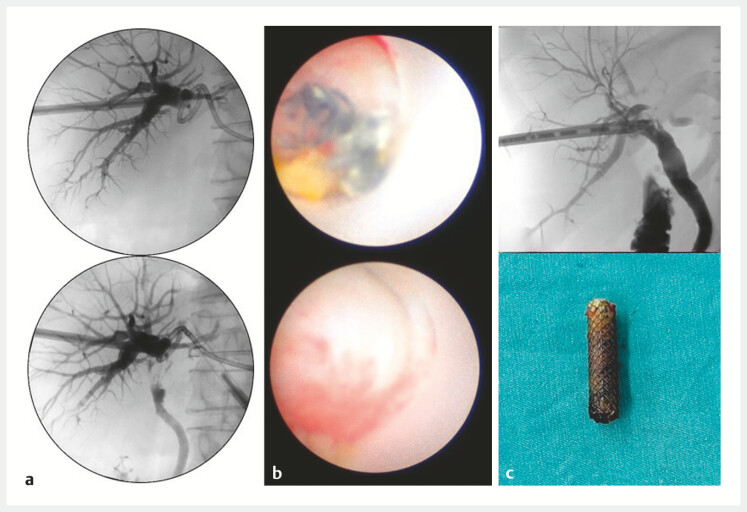 Fig. 1
Peer Reviews
No public reviews on file for this paper yet. If you reviewed it on a platform where reviews are public (OpenReview, ICLR, NeurIPS, ICML), you can paste yours below so the community can read it here.
Videos
No videos yet. Explain this paper in a talk, walkthrough, or lecture? Add one.
Taxonomy
TopicsPediatric Hepatobiliary Diseases and Treatments · Gallbladder and Bile Duct Disorders · Organ Transplantation Techniques and Outcomes
A 58-year-old woman developed biliary complications 1 month after left hemihepatectomy with common bile duct exploration for hepatocellular carcinoma. She presented with abdominal pain, markedly reduced T-tube output (approximately 5 mL/d), and a large postoperative biloma requiring percutaneous drainage (approximately 1,200 mL/d).
Percutaneous transhepatic cholangioscopy (PTCS) confirmed complete biliary occlusion. Direct visualization demonstrated surgical sutures encircling the obstructed segment together with an active bile leak at the same site. PTCS has been established as a reliable technique for direct biliary inspection and therapeutic intervention in complex biliary disorders 1 . The exact etiology of the occlusion could not be definitively determined, but it was presumed to be related to suture-related compression, bile leakage, or both.
Under real-time ultrasound guidance, combined rigid and flexible choledochoscopy was used to achieve precise recanalization of the occluded bile duct ( Video 1 ). After successful guidewire passage, a fully covered self-expanding metal stent (FCSEMS) was deployed across the occluded segment ( Fig. 1 ). FCSEMS placement has been shown to be effective for benign biliary strictures and bile leaks while allowing safe stent removal 2 3 .
Under real-time ultrasound guidance and direct cholangioscopic visualization, precise puncture of the atretic bile duct segment.Video 1
Multimodal imaging and cholangioscopic findings during PTCS-guided recanalization. a Pre-intervention percutaneous cholangiography demonstrating complete biliary occlusion at the hepatectomy site with contrast extravasation consistent with an active bile leak. b A percutaneous transhepatic cholangioscopic view showing surgical sutures and occlusion. c The stent and follow-up cholangiography after stent removal at 8 months confirming restored biliary patency with free contrast flow into the duodenum and complete resolution of the bile leak.
The patient recovered uneventfully with progressive reduction of biloma output and restoration of internal biliary drainage. At a 8-month follow-up, the stent was removed via PTCS. Follow-up cholangiography demonstrated the complete resolution of the bile leak and a patent biliary tract. Temporary endoscopic or percutaneous stenting has been increasingly emphasized as a minimally invasive alternative to surgical re-exploration for postoperative bile leaks 4 .
Recent reports have also confirmed the feasibility of PTCS-guided recanalization for completely obstructed bile ducts 5 . This case further supports PTCS-guided recanalization combined with temporary FCSEMS placement as an effective minimally invasive strategy for the simultaneous management of post-hepatectomy biliary occlusion and bile leak.
Endoscopy_UCTN_Code_TTT_1AR_2AJ
The reference list from the paper itself. Each links out to its DOI / PubMed record.
- 1Sun Y Wang W Li Y Efficacy and safety of percutaneous papillary balloon dilation for common bile duct stones: a systematic review and meta-analysis BMC Gastroenterol 20252572610.1186/s 12876-025-04238-741087977 PMC 12522935 · doi ↗ · pubmed ↗
- 2Ramchandani M Lakhtakia S Costamagna G Fully Covered Self-Expanding Metal Stent vs Multiple Plastic Stents to Treat Benign Biliary Strictures Secondary to Chronic Pancreatitis: A Multicenter Randomized Trial Gastroenterology 202116118519510.1053/j.gastro.2021.03.01533741314 · doi ↗ · pubmed ↗
- 3Nakagawa K Matsubara S Suda K Usefulness of Intraductal Placement of a Dumbbell-Shaped Fully Covered Self-Expandable Metal Stent for Post-Cholecystectomy Bile Leaks J Clin Med 202312653010.3390/jcm 1220653037892668 PMC 10607715 · doi ↗ · pubmed ↗
- 4Quintini D Rizzo GEM Tarantino I Endoscopic or combined management of post-surgical biliary leaks: a two-center recent experience Surg Endosc 2024387233724210.1007/s 00464-024-11243-639384654 PMC 11615086 · doi ↗ · pubmed ↗
- 5Chen R Zhang J Chen T Recanalization of occluded biliary intestinal anastomosis through utilizing percutaneous transhepatic cholangioscopy for a 2-year-old patient after liver transplantation Endoscopy 202456 E 770E 77110.1055/a-2384-930339231521 PMC 11374442 · doi ↗ · pubmed ↗