Application of the novel peroral choledochoscope in hepatolithiasis after liver transplantation
Ximin Lin, Wen Cheng, Xiaokui Qiu, Jiawen Sun, ShaoBo Chen, Huan Peng, Zhongming Dai

Abstract
Genes, proteins, chemicals, diseases, species, mutations and cell lines named across the full text — each resolved to its canonical identifier and authoritative record.
Click any figure to enlarge with its caption.
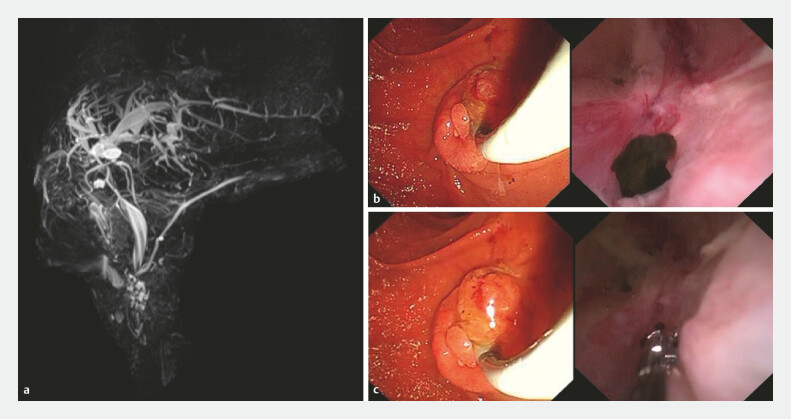 Fig. 1
- —Sanming Project of Medicine in Shenzhen Guangming
Peer Reviews
No public reviews on file for this paper yet. If you reviewed it on a platform where reviews are public (OpenReview, ICLR, NeurIPS, ICML), you can paste yours below so the community can read it here.
Videos
No videos yet. Explain this paper in a talk, walkthrough, or lecture? Add one.
Taxonomy
TopicsGallbladder and Bile Duct Disorders · Organ Transplantation Techniques and Outcomes · Congenital Anomalies and Fetal Surgery
Hepatolithiasis (HL) is a refractory benign biliary disease 1 . HL frequently recurs and is difficult to cure completely 2 , rendering its surgical therapy challenging. It also is a rare and complex complication after liver transplantation 3 . Herein, we report the use of a novel biliary choledochoscope (EyeMax Choledochoscope System Digital Controller; Micro-Tech, Nanjing, China) for the treatment of HL after liver transplantation.
A 58-year-old man was admitted with a history of recurrent right upper quadrant abdominal pain for over 3 years. Twenty years prior, he had undergone orthotopic liver transplantation for decompensated hepatitis B-related cirrhosis. Physical examination revealed tenderness in the right upper quadrant, with no other remarkable findings. Routine laboratory testing results revealed the following levels: a total bilirubin of 34.6 µmol/L and a direct bilirubin of 18.6 µmol/L. Magnetic resonance cholangiopancreatography ( Fig. 1 a ) demonstrated a focal stenosis of the hilar bile duct and dilation of the left intrahepatic bile ducts. With the patient’s consent, an exploratory procedure using the novel peroral choledochoscope was recommended. During the procedure, cannulation of the distal common bile duct was achieved with a 0.025-inch guidewire-assisted sphincterotome (Boston Scientific, USA). Subsequently, the peroral choledochoscope was advanced through the working channel of the duodenoscope into the left intrahepatic bile duct, revealing a dark brown stone ( Fig. 1 b ). The biliary biopsy forceps (Micro-Tech, Nanjing, China; Fig. 1 c ) was introduced through the working channel of the peroral choledochoscope. Under direct visualization, the stone was grasped and pulled into the duodenum. Finally, repeated exploration of the bile ducts confirmed no residual stones ( Video 1 ). The patient recovered well and was discharged 5 days later.
a In a 58-year-old man with a history of intermittent right upper abdominal pain after orthotopic liver transplantation, magnetic resonance cholangiopancreatography revealed a focal stenosis of the hilar bile duct and dilation of the left intrahepatic bile ducts. b The peroral choledochoscope was advanced into the left intrahepatic bile duct, revealing a dark brown stone. c Under direct visualization, the stone was grasped and pulled into the duodenum.
Hepatolithiasis removal after liver transplantation with the eyeMax choledochoscope.Video 1
Compared to ERCP, the eyeMax pancreatobiliary imaging system provides superior image clarity 4 5 . It compensates for the shortcomings of ERCP, avoids the trauma caused by surgical procedures, and provides new ideas for the treatment of HL after liver transplantation.
Endoscopy_UCTN_Code_TTT_1AR_2AG
The reference list from the paper itself. Each links out to its DOI / PubMed record.
- 1Feng Y Lu HY Chen JQ Progress in the treatment of hepatolithiasis Hainan Med J 2024353031303610.3969/i.issn.1003-6350.2024.20.029 · doi ↗
- 2Wang B Jin GC Guan P Construction and evaluation of a predictive model for recurence of intrahepatic bile duct stones after surgery Chin J Curr Adv Gen Surg 20242786186610.3969/j.issn.1009-9905.2024.11.005 · doi ↗
- 3Clarete A Nasner D Toro-Gutiérrez JS Successful application of percutaneous endoscopic cholangioscopy + electrohydraulic lithotripsy for hepatolithiasis post-liver transplantation: a case report J Med Case Rep 20241847210.1186/s 13256-024-04669-y 39334321 PMC 11429367 · doi ↗ · pubmed ↗
- 4Guo XR Huang LY Application of Eye Max Insight Pancreatic and Gallbladder Imaging System in Gallbladder and Pancreatic Stones Mod Dig Intervention 20242935035310.3969/j.issn.1672-2159.2024.03.021 · doi ↗
- 5Tao LY Wang HG Guo QM Efficacy of endoscopic retrograde cholangiopancreatography combined with electrohydraulic lithotripsy under the direct view of eye Max biliary-pancreatic imaging system in treatment of difficult choledocholithiasis J Clin Hepatol 20244035135510.12449/JCH 240220 · doi ↗