Isotretinoin-Associated Eruptive Milia: A Rare Adverse Effect
Fatima AlQaydi, Esmaeel AlMarzouqi

TL;DR
A rare skin condition called eruptive milia can occur as a side effect of isotretinoin treatment for acne.
Contribution
This case report highlights isotretinoin as a rare cause of eruptive milia, which may be underrecognized in clinical practice.
Findings
A 17-year-old male developed eruptive milia after two months of isotretinoin therapy.
Manual extraction effectively resolved the milia without recurrence.
The condition was managed without discontinuing isotretinoin treatment.
Abstract
Isotretinoin is a widely used systemic retinoid for the treatment of moderate-to-severe acne vulgaris. While its common cutaneous side effects include dryness, cheilitis, and photosensitivity, eruptive milia is a rarely reported adverse event. Awareness of such uncommon associations is important for dermatologists managing patients on isotretinoin. A 17-year-old male with moderate-to-severe acne vulgaris was initiated on oral isotretinoin at a dose of 30 mg daily. After two months of therapy, he developed multiple tiny, white, dome-shaped papules localized to the upper cheeks, mainly below the lower eyelids. Approximately 20 lesions were noted, clinically consistent with milia. There was no history of preceding trauma, cosmetic product use, or dermatologic procedures. Isotretinoin treatment was continued, and the milia were managed with simple manual extraction, leading to complete…
Genes, proteins, chemicals, diseases, species, mutations and cell lines named across the full text — each resolved to its canonical identifier and authoritative record.
Click any figure to enlarge with its caption.
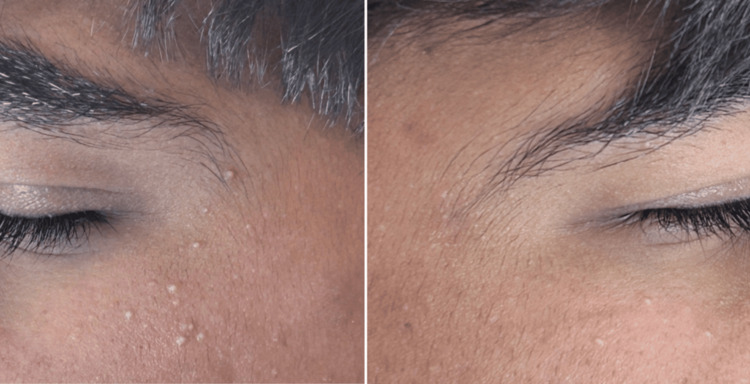 Figure 1
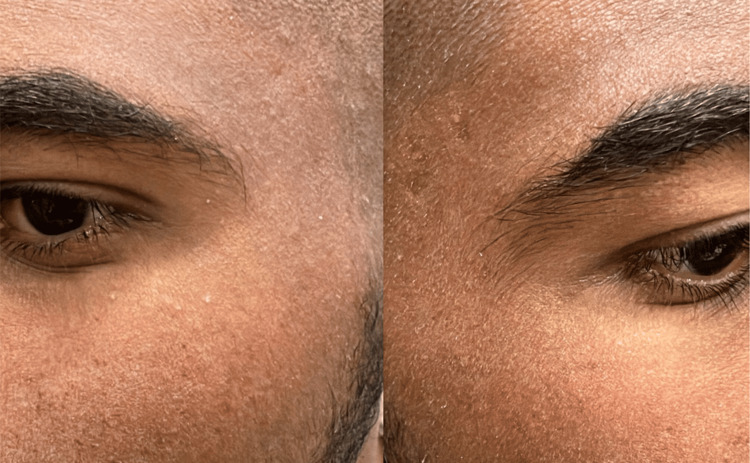 Figure 2
Peer Reviews
No public reviews on file for this paper yet. If you reviewed it on a platform where reviews are public (OpenReview, ICLR, NeurIPS, ICML), you can paste yours below so the community can read it here.
Videos
No videos yet. Explain this paper in a talk, walkthrough, or lecture? Add one.
Taxonomy
TopicsAcne and Rosacea Treatments and Effects · Oral Health Pathology and Treatment · Retinoids in leukemia and cellular processes
Introduction
Isotretinoin is a systemic retinoid indicated for the treatment of severe nodulocystic acne and moderate acne refractory to conventional therapies. Its therapeutic efficacy stems from reducing sebaceous gland size and sebum production, normalizing follicular keratinization, and exerting anti-inflammatory effects [1,2]. Despite its widespread use, isotretinoin is associated with several mucocutaneous adverse effects, including xerosis, cheilitis, epistaxis, and photosensitivity [3].
Milia are benign, keratin-filled epidermal inclusion cysts presenting as small, firm, white or yellowish papules, typically 1-2 mm in diameter. They commonly localize on the face, especially the periorbital region. Milia can be classified as primary or secondary, the latter often arising following cutaneous trauma, blistering disorders, cosmetic procedures, or certain medications [4].
Eruptive milia as a side effect of isotretinoin therapy is rare, with only limited cases documented in the literature [5]. The mechanism remains unclear but may be related to altered follicular keratinization induced by retinoids. We present a case of eruptive milia occurring in an adolescent male undergoing oral isotretinoin therapy for acne vulgaris, highlighting this uncommon but benign adverse reaction and its management without discontinuation of treatment.
Case presentation
A 17-year-old male with no significant past medical or dermatologic history presented to our dermatology clinic with moderate inflammatory acne vulgaris predominantly affecting the face. The patient was started on oral isotretinoin therapy at a dose of 0.5 mg once daily, with no prior use of systemic retinoids or other acne treatments.
After approximately two months of continuous isotretinoin treatment, the patient demonstrated a marked improvement in his acne vulgaris, with a significant reduction in inflammatory papules and pustules and no new nodulocystic lesions. During this period, he developed multiple small, whitish papules on his face. Clinical examination revealed about 15 to 20 discrete, dome-shaped papules measuring 1-2 mm in diameter, distributed symmetrically on the upper cheeks, primarily concentrated below the lower eyelids bilaterally (Figure 1).
Multiple discrete, white, dome-shaped papules consistent with milia, distributed bilaterally over the temporal regions.
The lesions were asymptomatic and non-inflammatory, with no associated erythema, pustulation, or follicular plugging. Their uniform size, pearly-white appearance, and lack of inflammatory features distinguished them from comedonal or inflammatory acne lesions. Dermoscopic examination revealed well-defined, round, homogeneous white-to-yellowish structures without surrounding vascular patterns, findings consistent with milia and further supporting the diagnosis of eruptive milia.
Isotretinoin therapy was maintained at the same dosage without interruption. Management of the milia consisted of manual extraction during follow-up visits, which the patient tolerated well. The lesions resolved completely following extraction and represented a one-time eruption. No recurrence or development of new milia was observed after extraction (Figure 2), despite continuation of isotretinoin therapy throughout the follow-up period.
Follow-up picture showing resolution of milia after extraction.
Discussion
Eruptive milia as an adverse effect of isotretinoin therapy is exceedingly rare, with only a limited number of cases reported in the dermatologic literature [6]. This rarity may contribute to underrecognition among clinicians treating acne patients with systemic retinoids. Awareness of this benign but potentially distressing condition is essential to ensure proper management.
The pathogenesis of isotretinoin-associated eruptive milia remains incompletely understood. It is postulated that isotretinoin’s effects on follicular keratinization and epidermal differentiation may lead to keratin entrapment within the pilosebaceous units, resulting in the formation of keratin-filled cysts characteristic of milia [7,8]. Altered epidermal turnover and sebaceous gland suppression caused by isotretinoin may further disrupt normal follicular desquamation, thereby promoting cyst development [9]. Additionally, this presentation may reflect a paradoxical early retinoid-related reaction, analogous to the initial inflammatory “flare” or retinoid dermatitis sometimes observed at the onset of therapy. Although retinoid dermatitis typically manifests as erythema and scaling rather than milia, a similar transient disruption of epidermal differentiation and cutaneous barrier function may contribute to eruptive milia in susceptible individuals. These hypotheses align with the known pharmacodynamics of retinoids on cutaneous cell proliferation and differentiation.
Clinically, eruptive milia present as numerous small, firm, white to yellowish papules localized mainly to the facial region, often involving the periorbital area and cheeks [10]. Diagnosis is predominantly clinical, and biopsy is rarely required unless atypical features or diagnostic uncertainty exist. The main differential diagnoses include syringomas, sebaceous hyperplasia, and other epidermal cystic lesions, which may show overlapping clinical features. Syringomas typically present as multiple flesh-colored papules in the periorbital region, whereas sebaceous hyperplasia is characterized by soft papules with central umbilication and prominent vascular patterns. In this context, dermoscopy is a useful noninvasive adjunct, as milia characteristically appear as well-defined, homogeneous white to yellowish structures without associated vascular patterns, aiding in differentiation from other adnexal or epidermal lesions and reducing the need for biopsy.
Management typically involves conservative approaches, with manual extraction being the treatment of choice. Importantly, continuation of isotretinoin therapy is generally safe and does not appear to worsen or prolong the condition [6,11]. Thus, discontinuation of isotretinoin is not routinely indicated unless the lesions are symptomatic or significantly affect the patient’s quality of life.
Conclusions
This case adds to the sparse literature on isotretinoin-induced eruptive milia and emphasizes that the condition is benign and manageable without cessation of essential acne therapy. Limitations include the absence of histopathologic confirmation, which was deemed unnecessary given the classic clinical presentation. Further studies with larger patient cohorts are needed to better characterize the incidence, pathophysiology, and optimal management strategies.
Clinicians should remain attentive to the possibility of eruptive milia in patients undergoing isotretinoin therapy and provide reassurance about its benign and manageable nature. Appropriate conservative management can effectively resolve the lesions, allowing uninterrupted continuation of isotretinoin therapy.
The reference list from the paper itself. Each links out to its DOI / PubMed record.
- 1Guidelines of care for the management of acne vulgaris J Am Acad Dermatol Zaenglein AL Pathy AL Schlosser BJ 945973742016 https://pubmed.ncbi.nlm.nih.gov/26897386/2689738610.1016/j.jaad.2015.12.037 · doi ↗ · pubmed ↗
- 2The use of isotretinoin in acne Dermatoendocrinol Layton A 16216912009 https://pubmed.ncbi.nlm.nih.gov/20436884/2043688410.4161/derm.1.3.9364 PMC 2835909 · doi ↗ · pubmed ↗
- 3Adverse effects of isotretinoin: a large, retrospective review Dermatol Ther Brzezinski P Borowska K Chiriac A Smigielski J 30201710.1111/dth.1248328295859 · doi ↗ · pubmed ↗
- 4Milia: a review and classification J Am Acad Dermatol Berk DR Bayliss SJ 105010635920081881972610.1016/j.jaad.2008.07.034 · doi ↗ · pubmed ↗
- 5Multiple eruptive milia Cutis Fett N Nevas J 191192912013 https://pubmed.ncbi.nlm.nih.gov/23763079/23763079 · pubmed ↗
- 6Eruptive milia during isotretinoin therapy Pediatr Dermatol Farmer W Cheng K Marathe K 7287293420172894061910.1111/pde.13270 · doi ↗ · pubmed ↗
- 7Dermatology (4th ed) Bolognia JL Schaffer JV Cerroni L Amsterdam, Netherlands Elsevier 2017 https://www.elsevier.com/books/dermatology/bolognia/978-0-7020-6275-9
- 8Retinoids in dermatology Indian J Dermatol Venereol Leprol Thappa DM 142146631997