Duodenal hematoma following endoscopic duodenal biopsy in an adult requiring arterial embolization and surgical evacuation: a case report and review of the literature
Kelly L. Buchanan, Robert M. Wilechansky, Mythili P. Pathipati, Allan M. Goldstein, Daniel P. Ryan, Joseph C. Yarze

TL;DR
A 21-year-old man developed a rare complication after a duodenal biopsy, requiring embolization and surgery to treat a growing blood clot.
Contribution
This is the first report of an enlarging duodenal hematoma managed with arterial embolization and surgical evacuation.
Findings
Arterial embolization followed by laparoscopic evacuation successfully managed an enlarging duodenal hematoma.
Surgical interventions are typically reserved for severe cases, but minimally invasive approaches may be effective.
The case highlights a rare complication of endoscopic duodenal biopsy.
Abstract
A 21-year-old man presented with severe abdominal pain four days after undergoing upper endoscopy with duodenal biopsies and was found to have an intramural duodenal hematoma. Symptoms progressed after attempts at diet advancement, and repeat imaging showed an enlarging hematoma with duodenal obstruction. The patient was managed with arterial embolization followed by laparoscopic surgical evacuation of the hematoma. This is the first report of an enlarging duodenal hematoma managed by this combination approach. While surgical interventions have previously been reserved for the most severe cases, we review the literature on minimally invasive approaches to manage this rare endoscopic complication.
Genes, proteins, chemicals, diseases, species, mutations and cell lines named across the full text — each resolved to its canonical identifier and authoritative record.
Click any figure to enlarge with its caption.
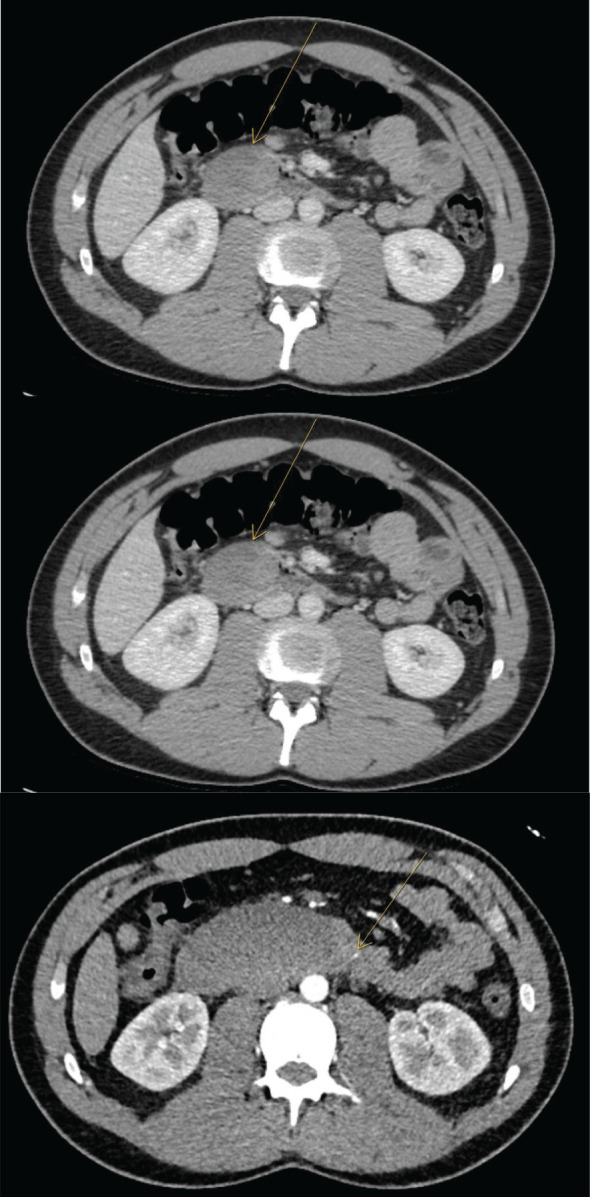 Figure 1
| Treatment | Case report | Age | Sex | Risk factors | Symptom onset | Intervention | Time to intervention (days) | Time to improvement (days) |
|---|---|---|---|---|---|---|---|---|
| Conservative management | Zinelis, 1989 | 23 | M | None | 24 hours | NG tube, TPN | N/a | 17 |
| Lipson, 1996 (1) | 36 | F | CML | 6 hours | NG tube, TPN | N/a | 11 | |
| Worynski, 1998 | 23 | M | CML, post-BMT | 4 days | NG tube, TPN | N/a | Died on day 13 | |
| Sgouros, 2002 | 32 | M | Noonan’s syndrome | 6 hours | NG tube, TPN | N/a | 21 | |
| Chen, 2006 | 39 | M | None | Unknown | NG tube, TPN | N/a | 7 | |
| Hoenisch, 2011 | 21 | F | None | 24 hours | NG tube, TPN | N/a | 19 | |
| Henker, 2021 | 21 | M | AML, post-BMT | 24 hours | NG tube, TPN | N/a | 21 | |
| Surgical management | Lipson, 1996 (2) | 32 | F | AML | 16 hours | Surgical evacuation | 16 | Died on post-operative day 12 |
| Minimally invasive management | Lloyd, 2004 | 18 | F | None | 1 day | Ultrasound-guided drainage | 15 | 18 |
| Samra, 2018 | 28 | M | None | A few hours | Endoscopic dilation | 5 | 7 |
| Case report | Age | Sex | Mechanism of injury | Intervention | Time to intervention (days) | Time to improvement (days) |
|---|---|---|---|---|---|---|
| Aizawa, 1990 | 52 | M | Traumatic – fell striking abdomen | Ultrasound guided drainage followed by EGD with balloon catheter dilatation | 0 to drainage, 7 to EGD | 45 |
| Lloyd, 2004 | 18 | F | EGD with biopsies | Ultrasound-guided drainage | 15 | 18 |
| Gulotto, 2005 | 44 | M | Traumatic – fell during seizure | CT-guided percutaneous drainage | 15 | 21 |
| Kwon, 2008 | 63 | M | Post-treatment of duodenal ulcers with epinephrin and fibrin glue | Endoscopic incision and drainage | 21 | 28 |
| Pan, 2013 | 48 | M | Post-ERCP with sphincterotomy | Endoscopic incision and drainage | 1 | 5 |
| Samra, 2018 | 28 | M | EGD with biopsies | Dilation with endoscope | 5 | 7 |
| Alharbi, 2020 | 10 | M | Traumatic – road traffic accident | Serial EGD with balloon dilation | 5 | 7 |
Peer Reviews
No public reviews on file for this paper yet. If you reviewed it on a platform where reviews are public (OpenReview, ICLR, NeurIPS, ICML), you can paste yours below so the community can read it here.
Videos
No videos yet. Explain this paper in a talk, walkthrough, or lecture? Add one.
Taxonomy
TopicsGastrointestinal Bleeding Diagnosis and Treatment · Gastrointestinal disorders and treatments · Gallbladder and Bile Duct Disorders
Introduction
Intramural duodenal hematoma is a rare complication of upper endoscopy. Information about its occurrence is limited to case reports, and data on incidence rates in adults are lacking. Duodenal hematoma after upper endoscopy is often related to tissue sampling, and the sequelae can be significant; patients may require several weeks of nutritional support due to duodenal obstruction (1–3). Early recognition is key to initiation of conservative management with nasogastric decompression and parenteral nutrition. Surgical decompression is considered in severe cases (4), and recent reports have raised the possibility of minimally invasive approaches to treatment (3, 5).
Case report
A 21-year-old man with eosinophilic esophagitis was admitted with acute, severe abdominal pain. The pain initially began in the lower abdomen and progressed to involve the right upper quadrant and epigastrium. He had undergone upper endoscopy at another institution 4 days previously, at which time duodenal biopsies were performed to screen for celiac disease due to chronic upper gastrointestinal symptoms. The EGD was uneventful and there was not any report of excessive bleeding during the procedure. Pathology from these biopsies showed vascular congestion and erosion, negative for increased intraepithelial lymphocytes and negative for eosinophilic infiltration. On admission, his physical exam was notable for right upper quadrant and epigastric tenderness. Bloodwork revealed hypokalemia, and normal blood counts, liver enzymes and serum lipase. A computed tomography (CT) scan showed focal dilation of the second and third portions of the duodenum with luminal narrowing and an intramural duodenal hematoma extending from the second part of the duodenum (D2) to the ligament of Treitz, measuring 4.7 x 3.0 x 3.5 cm (Figure 1). Over the initial 24 hours of hospitalization, the patient developed nausea and bilious emesis with concern for intestinal obstruction. A repeat CT scan showed significant enlargement of the duodenal hematoma, measuring 3.9 x 8.3 x 4.5 cm (Figure 1). A nasogastric tube was placed with copious output. On the third day of hospitalization, due to progressive symptoms, he underwent CT angiography of the abdomen, which demonstrated a punctate focus of arterial phase enhancement consistent with active extravasation (Figure 1). Urgent gastroduodenal arterial embolization was performed. Nasogastric decompression was continued and parenteral feeding was instituted without clinical improvement. On day 7 of hospitalization, given continued lack of improvement with conservative treatment, surgical laparoscopic evacuation of the duodenal hematoma was performed after multidisciplinary discussion. During surgery, a bulging duodenal hematoma was visualized, submucosal blot clot was evacuated, and a drain was placed. Within hours of surgery, nasogastric tube output dropped precipitously, and the nasogastric tube was removed on post-operative day 2. Drain was removed on post-operative day 5. The diet was advanced successfully and the patient was discharged after 13 days of hospitalization.
Progressive CT A/P images at day 1 and day 3 with expansion of duodenal hematoma and CT angio at day 5 with area of active extravasation.
Discussion
Intramural duodenal hematoma is an exceedingly rare complication after endoscopic biopsy. Duodenal hematoma is more commonly caused by blunt abdominal trauma, particularly in children due to their thinner abdominal walls. In the post-endoscopy population, research to date has focused on its incidence in pediatric populations. In a single-center retrospective study of 26,905 pediatric patients, intramural duodenal hematoma after endoscopy had an incidence of approximately 1 in 2000 (1). Similar numbers in children have been reported at other institutions (2). The incidence rate of duodenal hematoma in adults has not been established, and may be even more rare. The first case report of duodenal hematoma after routine endoscopic biopsy in an adult was reported in 1989 (6), and since then, there have been only 10 additional reports (Table 1 ). Additional cases of duodenal hematoma have been reported after other endoscopic procedures [e.g. endoscopic retrograde cholangiopancreatography (7), ulcer therapy (8)], as well as in cases of blunt abdominal trauma, duodenal ulcers, and pancreatitis (9).
Given the low incidence rate, the mechanism of and risk factors for duodenal hematoma development after endoscopy are poorly characterized. Proposed mechanisms include both macroscopic and microscopic factors. For example, the duodenum may be at increased risk for shear injury given that it is in a fixed retroperitoneal position adjacent to the lumbar spine (6). Further, it has a rich, highly vascularized submucosal plexus which can be prone to bleeding (2, 9). Procedure-related risk factors include method of sedation and positioning, while procedural experience has not been shown to be related to risk (1). Clinical risk factors for duodenal hematoma include coagulopathy, prior solid organ transplant, prior bone marrow transplant, and anticoagulation (1, 2, 6). Our patient had no known risk factors.
The natural history of duodenal hematoma has been established through case reports. Patients typically present within the first 72 hours following endoscopy (1); in this case, the patient presented at approximately 96 hours. Growth of the hematoma in this location can occlude the duodenal lumen causing proximal intestinal obstruction, resulting in vomiting. Compression and obstruction of the ampulla of Vater can lead to pancreatitis, and if left untreated, biliary obstruction may occur. In order to avoid these complications, we felt that surgical management would provide the most definitive solution given that surgical management has been the mainstay of treatment thus far. There are rare reports of more serious complications such as extraluminal rupture and hemoperitoneum (4).
The standard of care for duodenal hematoma after endoscopic biopsy is conservative management; of the 11 case reports in adults, 7 were managed conservatively with nasogastric decompression and parenteral nutrition (Table 1) (6, 10–14). In these patients, 3–4 weeks of parenteral nutrition was often required before clinical improvement. The other 4 patients received intervention: surgical evacuation (10), endoscopic dilation (3), or ultrasound-guided drainage (15). AXIOS stent is a possibility for management as well (16).
Here, we report the first case of a patient managed with arterial embolization to limit hematoma expansion followed by surgical evacuation to treat persistent duodenal obstruction. While conservative and surgical management have been the mainstays of treatment to date, advances in endoscopic and interventional radiology techniques have expanded treatment options. On review of duodenal hematoma reports across the spectrum of age and causes, 7 prior cases have been managed with minimally invasive techniques, including image-guided drainage (3, 15, 17, 18), endoscopic incision and drainage (7, 8), and endoscopy with dilation (3, 5). Arterial embolization represents a new approach for active bleeding (Table 2).
In this case, we attempted conservative manage at first but the patient’s symptoms became worse each day. He initially did not have obstructive symptoms and developed these the course of his admission and was having difficulty tolerating tube feeds with an NG tube. Ultimately multiple options were presented to the patient, but given the rapid expansion of his hematoma and ongoing severe symptoms, we felt that surgical intervention would provide the most definitive and expeditious improvement which was in line with the patient’s preferences as well.
In conclusion, we describe an unusual case of duodenal hematoma in a 21-year-old man occurring after routine endoscopic duodenal biopsies. The patient had no clear risk factors, he presented more than 72 hours after endoscopy, and the hematoma enlarged by more than three-fold in the first 24-hours of hospital observation. Given rapid progression of the hematoma and persistent duodenal obstruction, the patient was managed with a combination of arterial embolization which successfully prevented further expansion of the hematoma, and subsequent laparoscopic hematoma evacuation. Further study and use of minimally invasive approaches for duodenal hematoma management could help reduce potential complications and time to recovery.
Data availability statement
The original contributions presented in the study are included in the article/supplementary material. Further inquiries can be directed to the corresponding author.
Ethics statement
Written informed consent was obtained from the individual(s) for the publication of any potentially identifiable images or data included in this article.
Author contributions
KB: Writing – original draft, Writing – review & editing. RW: Writing – review & editing. MP: Writing – review & editing. AG: Writing – review & editing. DR: Writing – review & editing. JY: Writing – review & editing.
The reference list from the paper itself. Each links out to its DOI / PubMed record.
- 1Sahn B Anupindi SA Dadhania NJ Kelsen JR Nance ML Mamula P . Duodenal hematoma following EGD: Comparison with blunt abdominal trauma-induced duodenal hematoma. J Pediatr Gastroenterol Nutr. (2015) 60:69–74. doi: 10.1097/MPG.0000000000000564 25207477 · doi ↗ · pubmed ↗
- 2Guzman C Bousvaros A Buonomo C Nurko S . Intraduodenal hematoma complicating intestinal biopsy: Case reports and review of the literature. Am J Gastroenterol. (1998) 93:2547–50. doi: 10.1111/j.1572-0241.1998.00716.x 9860424 · doi ↗ · pubmed ↗
- 3Samra M Al-Mouradi T Berkelhammer C . Gastric Outlet Obstruction due to Intramural Duodenal Hematoma after Endoscopic Biopsy: Possible Therapeutic Role of Endoscopic Dilation. Case Rep Gastroenterol. (2018) 12:692–8. doi: 10.1159/000494967 PMC 632339630631254 · doi ↗ · pubmed ↗
- 4Elmoghazy W Noaman I Mahfouz AE Elaffandi A Khalaf H . Surgical management of complicated intramural duodenal hematoma: A case report and review of the literature. Int J Surg Case Rep. (2015) 17:103–5. doi: 10.1016/j.ijscr.2015.10.028 PMC 470179726595897 · doi ↗ · pubmed ↗
- 5Alharbi FM Abo Amer ZA Hamamesh KH Algubaisi SN . Endoscopic dilatation as a new technique in managing pediatric duodenal hematoma. Saudi Med J. (2020) 41:874–7. doi: 10.15537/smj.2020.8.25128 PMC 750295732789429 · doi ↗ · pubmed ↗
- 6Zinelis SA Hershenson LM Ennis MF Boller M Ismail-Beigi F . Intramural duodenal hematoma following upper gastrointestinal endoscopic biopsy. Dig Dis Sci. (1989) 34:289–91. doi: 10.1007/BF 01536064 2644113 · doi ↗ · pubmed ↗
- 7Pan YM Wang TT Wu J Hu B . Endoscopic drainage for duodenal hematoma following endoscopic retrograde cholangiopancreatography: A case report. World J Gastroenterol. (2013) 19:2118–21. doi: 10.3748/wjg.v 19.i 13.2118 PMC 362399323599635 · doi ↗ · pubmed ↗
- 8Kwon CIL Ko KH Kim HY Kim Y Hong SP Hwang SG . Bowel obstruction caused by an intramural duodenal hematoma: A case report of endoscopic incision and drainage. J Korean Med Sci. (2009) 24:179–83. doi: 10.3346/jkms.2009.24.1.179 PMC 265096819270837 · doi ↗ · pubmed ↗