nf-core/proteinfamilies: a scalable pipeline for the generation of protein families
Evangelos Karatzas, Martin Beracochea, Fotis A Baltoumas, Eleni Aplakidou, Lorna Richardson, James A Fellows Yates, Daniel Lundin, Aydin Buluç, Nikos C Kyrpides, Ilias Georgakopoulos-Soares, Georgios A Pavlopoulos, Robert D Finn

TL;DR
This paper introduces a pipeline for grouping uncharacterized proteins into families to help understand their functions and relationships.
Contribution
A scalable and open-source pipeline for generating or assigning proteins to families is introduced.
Findings
The pipeline's resource usage scales linearly with input size.
Generated protein families closely resemble manually curated ones in major databases.
Abstract
The growth of metagenomics-derived amino acid sequence data has transformed our understanding of protein function, microbial diversity, and evolutionary relationships. However, the vast majority of these proteins remain functionally uncharacterized. Grouping the millions of such uncharacterized sequences with the few experimentally characterized ones allows the transfer of annotations, while the inspection of conserved residues with multiple sequence alignments can provide clues to function, even in the absence of existing functional information. To address the challenges associated with this data surge and the need to group sequences, we present a scalable, open-source, parametrizable Nextflow pipeline (nf-core/proteinfamilies) that generates nascent protein families or assigns new proteins to existing families. The computational benchmarks demonstrated that resource usage scales…
Genes, proteins, chemicals, diseases, species, mutations and cell lines named across the full text — each resolved to its canonical identifier and authoritative record.
Click any figure to enlarge with its caption.
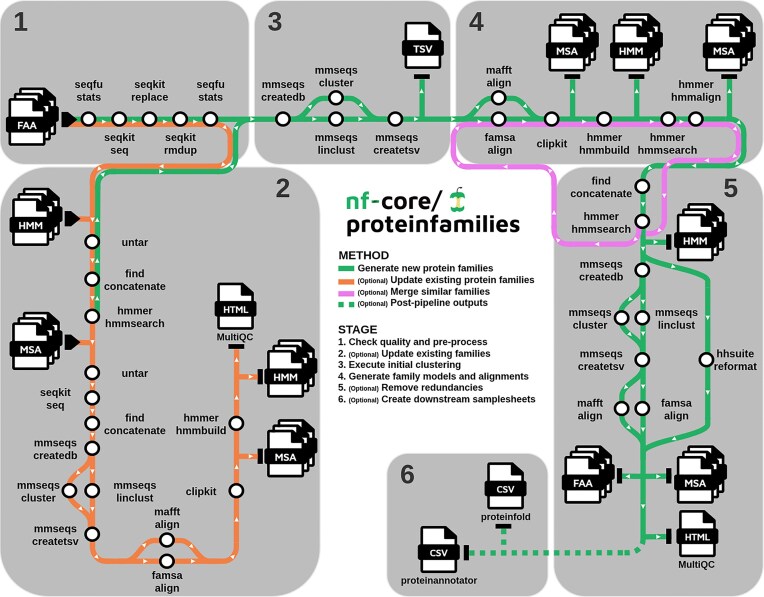 Figure 1
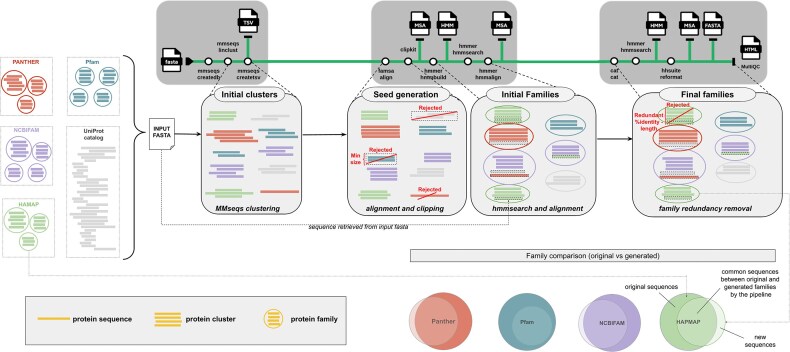 Figure 2
- —European Union10.13039/501100000780
- —Hellenic Foundation for Research and Innovation10.13039/501100013209
Peer Reviews
No public reviews on file for this paper yet. If you reviewed it on a platform where reviews are public (OpenReview, ICLR, NeurIPS, ICML), you can paste yours below so the community can read it here.
Videos
No videos yet. Explain this paper in a talk, walkthrough, or lecture? Add one.
Taxonomy
TopicsGenomics and Phylogenetic Studies · Bioinformatics and Genomic Networks · Machine Learning in Bioinformatics
Introduction
The generation of protein families is a common approach for facilitating the transfer of functional annotations from sequences with a determined function to uncharacterized sequences. Given the enormous volume of unannotated sequences obtained from metagenomic analyses, it is necessary to group sequences to transfer these functional annotations at scale [1, 2]. Grouping-related sequences and building protein family models can enable the detection and annotation of distant homologs across large datasets. Profile hidden Markov models (HMMs) are especially effective for this task, as they capture conserved sequence patterns and model insertions and deletions. Efficiently transferring annotations at scale can expedite key applications such as identifying novel enzymes for industrial use, predicting drug targets in pathogenic organisms, and reconstructing metabolic pathways in microbial communities. To achieve this, biological databases and platforms provide curated protein information and metadata to support both functional and 3D-structure annotation of protein families. Primary resources include UniProtKB [3], Protein Data Bank (PDB) [4], RefSeq [5], GenBank [6], IMG/M [7], Big Fantastic Database (BFD) [8], and MGnify [9]. These databases collectively host hundreds of millions to billions of sequences, many of which remain uncharacterized, particularly those derived from metagenomic sources.
While the aforementioned databases catalog raw sequence or structure data, protein classification resources help interpret this information by organizing proteins into families based on shared evolutionary or functional traits. Some widely used resources include Pfam [10], InterPro [11], the Novel Metagenome Protein Families Database (NMPFamsDB) [12, 13], FunFams [14], eggNOG [15, 16], KEGG Orthology (KO) [17], Clusters of Orthologous Groups (COG) [18], and its extension for eukaryotic proteins, KOG [19], each serving distinct purposes in protein classification. Notably, InterPro integrates protein family, domain, and functional site data from 13 contributing databases. As of May 2025, InterPro provides standardized annotations for over 200 million proteins. Conversely, NMPFamsDB focuses on protein families derived from metagenomic and metatranscriptomic data that do not correspond to known reference genome proteins or Pfam domains. Its latest version features over 106,000 distinct protein families, each containing at least 100 sequences, cumulating to ∼20 million proteins.
As the number of protein sequences grows, the manual curation of protein families at scale seems unfeasible. Computational methods for automatically generating protein families must therefore strike a balance between sensitivity, scalability, and usability. Pfam-B [20], a compendium to profile HMM-based families in Pfam, is a computationally generated set of putative protein families that complement the Pfam families. Pfam-B families are based on a bidirectional MMseqs2 clustering [21]—a high-speed tool for sequence clustering—and are recalculated at each Pfam major release, but are not readily transferable to other sequences. Another widely used clustering tool is CD-HIT [22], which, similarly to MMseqs2, prioritizes speed by employing greedy incremental clustering starting from longer sequences. However, both MMseqs2 and CD-HIT sacrifice sensitivity compared to profile HMM methods and pose challenges when transferring family annotations to additional sequences. Thus, there is a need for streamlined, scalable solutions that can generate and maintain protein families from large, ever-expanding sequence datasets.
We have developed the nf-core/proteinfamilies pipeline to address many of the challenges mentioned above, by chaining modules for clustering sequences, generating protein family-level models, alignments, and metadata, removing redundancies, and updating families as more sequences become available. The pipeline leverages the Nextflow [23] workflow orchestrator and nf-core principles [24, 25], enabling standardized pipeline execution, efficient resource management, and parallel processing, hence allowing users to handle large datasets effectively.
Methodology
The nf-core/proteinfamilies pipeline is a bioinformatics tool designed to generate new protein families or update existing ones, given a FASTA file of amino acid sequences as input, along with profile HMMs and alignments of existing families when updating. The main components of the pipeline are (i) input sequences quality check and pre-processing, (ii) optional model and alignment updating of existing families, (iii) sequence clustering, (iv) family generation, and (v) optional redundancy removal (Fig. 1).
Quality check and pre-processing: The first stage employs a basic sequence quality check mechanism using SeqFu [26], which generates a report summarizing statistics such as the number of sequences, total amino acid count, and the minimum, average, and maximum sequence lengths. The SeqKit [27] library is also used to reformat (i.e., convert to uppercase and remove gaps) and validate input sequences, to filter sequences by user-defined minimum and maximum length thresholds (defaults [30,5000]), and to remove duplicate sequences by name. Existing families update: In this complementary workflow, users can enrich existing families with new sequences by recruiting new members into the full alignment of a family. When users provide existing family profile HMMs and multiple-sequence alignment (MSA) files—in compressed archive format (.tar.gz)—along with an amino acid sequence file, the pipeline begins by searching for matches of the input sequences against the current families. This is done by combining the existing HMMs into a library and performing an hmmsearch against that with the input sequences. For each family hit, the relevant input sequences are combined with the non-aligned sequences from the corresponding family MSA in an aggregated FASTA file, which can optionally undergo strict clustering to eliminate redundancies. The remaining sequences are then aligned and, optionally, undergo gap removal, resulting in an updated family full MSA. Finally, the family profile HMM is retrained based on the updated MSA. Sequence clustering: The first stage of the workflow clusters protein sequences using MMseqs2, enabling fast clustering. The input FASTA file is converted into an MMseqs2 database, and then the MMseqs2 clustering algorithm of choice (linclust—focus on speed, *or cluster—*focus on sensitivity) is applied to group similar sequences into initial seed clusters. The clustering results are saved as a two-column (i.e., cluster representative, cluster member) TSV-formatted output, and are then filtered based on minimum membership. Family generation: The next stage of the workflow generates protein families for each filtered cluster. In parallel, for each seed cluster, an MSA is performed using either FAMSA [28] or MAFFT [29]. This process generates the seed MSA file of a family. An optional step allows users to trim poorly aligned or gap-rich regions from the seed MSA using ClipKIT [30], either across the entire alignment or only at the ends, thereby improving alignment quality for downstream analyses. The seed alignments are then used to generate profile HMMs via the HMMER (v3.4) hmmbuild command [31]. The hmmsearch command is optionally used to recruit additional sequences from the input FASTA file into the generated families, according to user-defined thresholds such as e-value or minimum matching HMM length. Subsequently, recruited sequences are realigned to the family HMM with the hmmalign tool, generating a full MSA file for each family. Redundancy removal: In most cases, the initial MMseqs2 clustering does not group all related sequences to a single cluster, leading to multiple clusters that may be evolutionarily related. In subsequent pipeline steps, the same sequence may be assigned to multiple clusters, resulting in multiple representations of the same protein family. Furthermore, in larger sequence datasets, the presence of identical or highly similar sequences within a family can unnecessarily consume storage space without contributing additional functional, evolutionary, or structural variability. To address these issues, the third stage of the pipeline employs two distinct mechanisms for redundancy detection and elimination. These mechanisms can be deployed both (i) inter-family, where redundant families are removed and/or similar families are merged, and (ii) intra-family, where redundant sequences (those with very similar identity and alignment coverage) within a family are eliminated. Users can choose to use both mechanisms together, separately, or skip this step.
Workflow of the nf-core/proteinfamilies pipeline. The process begins with a mandatory input amino acid FASTA file, which undergoes a quality check using SeqFu and SeqKit (1) to generate sequence quality statistics, pre-process and validate the initial sequences, and remove duplicates. Optionally, in the update existing families stage (2), users can provide compressed archives containing HMMs and MSAs of existing families. Sequences that match existing families are integrated into those families, updating the respective MSAs and HMMs. Sequences without matches follow the default workflow to generate new families, starting with an initial MMseqs2 clustering (3) and then proceeding to family generation (4). Users may then optionally apply redundancy reduction (5), either across families (inter-family removal and/or merging) or within families (intra-family), to remove similar families or sequences, respectively. Finally, users can opt to produce samplesheets (6) for downstream analyses with other nf-core pipelines (i.e., protein folding and annotation).
The inter-family redundancy removal process involves several steps. First, all generated profile HMMs are combined into a single file to form a profile HMM library. Next, family representative sequences are searched against the profile HMM library using hmmsearch. The premise is that if a family representative sequence matches another family profile HMM with a strict matching length threshold (e.g., 100%), it suggests redundancy between the two families, allowing one to be labelled as redundant (currently removing the family with the fewest sequences). Achieving a lower matching length threshold (e.g., 90%) still indicates similarity between families. The pipeline can optionally merge the seed alignments for such families and proceed to generate updated profile HMMs and full alignments.
In the intra-family redundancy removal mechanism, the pipeline begins with stringent MMseqs2-based clustering of members (default parameters: 0.9 identity, 0.9 coverage length, bidirectional), retaining only the cluster representatives. This step removes duplicate or nearly identical sequences, reducing the family size while preserving a subset of diverse sequences that represent the family.
The workflow finishes with the generation of reports, including the input sequence quality check before and after pre-processing, the size distribution of the initial MMseqs2-generated clusters, and the produced family data and metadata using MultiQC [32]. The size distribution section reports the number of initial clusters for each observed size (number of proteins). The produced family report contains information such as unique family identifiers, family sizes, family representative sequences, and their lengths. These results are presented in an interactive HTML report that provides users with a concise overview of the generated data.
Parameterization
Various user-defined parameters guide the execution flow. Pipeline parameters can be directly specified in the nextflow.config file, or be overridden either by providing an additional configuration file or by directly setting them in the run command. Furthermore, any tool parameters not exposed as Nextflow variables can be set via the ext.args variable for each process in the modules.config file. For clustering, users can choose between one of two MMseqs2 clustering algorithms: (i) the standard “cluster” method (default), suitable for medium-sized inputs (thousands to a few million sequences), or (ii) “linclust,” which offers faster but less sensitive clustering for larger sequence datasets (thousands of millions to a few billion sequences). Additional clustering parameters include sequence identity, query/target coverage, and coverage mode (unidirectional or bidirectional), which can be configured separately for the initial input sequence clustering and for the redundancy removal (strict clustering within families) steps. The default bidirectional value for coverage mode (cluster_cov_mode = 0) automatically sets the MMseqs2 clustering to greedy set cover mode. However, users can override this parameter either indirectly, by changing the coverage mode, or directly, by setting the --cluster-mode argument in the modules configuration file. Users can also define the minimum cluster size required for the downstream family generation.
There are two available MSA algorithms: (i) FAMSA and (ii) MAFFT. FAMSA is the default option due to its balance of time efficiency, memory usage, and overall accuracy, while MAFFT can still outperform it in certain edge cases [33]. Users may trim MSA columns that exceed a defined gap percentage threshold using ClipKit, either along its entire length or only at its ends. Setting higher MMseqs2 coverage thresholds (e.g., ≥0.8) with alignment trimming enabled tends to bias protein family results towards conserved domains, whereas lower coverage thresholds (e.g., ≤0.5) with skipped trimming tend to produce more full-length or multi-domain families. To expand sequence families, users are encouraged to search the input sequences against the initial family profile HMMs generated by seed MSAs. This can be achieved by using HMMER/hmmsearch, where users can specify an e-value cutoff and minimum length threshold.
Lastly, users may enable redundancy removal after families are constructed. This process is controlled by two settings: one that eliminates redundancy between families, either by removing identical or merging highly similar families, and another that removes redundancy within families. Enabling both options, which is the default in the pipeline, is recommended to prevent family and sequence duplication while preserving sequence diversity. The amino acid sequence files (FASTA) generated throughout the pipeline can also be saved in the results folder by setting the appropriate parameters.
Protein family reproducibility benchmark
To evaluate the applicability of the pipeline, we assessed how well the automatically generated protein families it produced matched expert-curated protein families from established databases that have undergone extensive curation, including multiple rounds of search and refinement (Fig. 2). To do so, we collected protein sequences from 50 families (each containing at least 25 sequence members) from each of the following databases: NCBIFAM [34], PANTHER [35], Pfam [20], and HAMAP [36]. To explore diverse biological families and prevent overlap, each family was sampled from different branches of the InterPro hierarchy. The 200 families matched a total of 106,959 non-redundant sequences. To this sequence dataset, we added 10,000 additional sequences from UniProt-SwissProt and verified the absence of significant similarity to the pooled family proteins using DIAMOND BLASTp [37] with default parameters (>60% sequence identity, the tantan repeat masking algorithm for alignments, and e-value ≤ 0.001). This resulted in a final input set of 116,959 unique protein sequences.
Workflow of the nf-core/proteinfamilies biological benchmark. First, 200 protein families are selected from diverse InterPro entries and merged with a set of seemingly unrelated UniProt-SwissProt sequences identified by a DIAMOND search. Next, the nf-core/proteinfamilies pipeline was applied to generate initial seed clusters, filtering out any cluster containing fewer than three sequences and creating an MSA (termed seed generation). Subsequently, the MSA is used to construct a profile HMM, which is then used to identify additional sequences related to the family. Finally, highly similar sequences are removed to reduce redundancy within the results. Overall, this process successfully incorporated 96.66% of the original family sequences into the output families, accurately reconstructing 173 of the 200 initial protein families.
Subsequently, we executed the nf-core/proteinfamilies pipeline with the combined protein dataset as input, using the “linclust” algorithm along with a clustering identity of 0.5, coverage of 0.9 (both strands, with the greedy set cover mode), and a minimum cluster size of three sequences, for the initial seed clusters generation. Using these parameters, the pipeline produced 5,826 seed clusters. The pipeline then recruited additional sequences into families via hmmsearch, capturing 97.72% of the original unique sequence identifiers (104,522 out of 106,959). Subsequently, families with a profile HMM match to another profile HMM spanning 100% of the length of the query profile HMM were eliminated to reduce redundancy, leaving 709 families. These 709 remaining families captured 96.66% of the original unique sequence identifiers (103,385 out of 106,959). Even with this redundancy-reduction step, a single input protein family can be represented by multiple families from the 709 families due to differences in length and match composition. Thus, the 103,385 sequences were represented by 178,279 sequence regions. Family sequence recall was highest for HAMAP (99.7% of sequences, 84,051/84,335), followed by Pfam (90.6%, 7,452/8,227), NCBIFAM (89.9%, 2,407/2,677), and PANTHER (80.8%, 9,475/11,720). A total of 2,941 additional UniProt sequences were also grouped into 295 families (without any sequences from the original input families set) out of the 709 (41.61%), and 395 out of the 709 (55.71%) contained only sequences from the original families. Despite the DIAMOND BLASTp search, 19 families contained both original input family and UniProt-SwissProt sequences.
To better understand how well these newly generated families represent the original 200 curated families used as input, we calculated the Jaccard index based on the protein identifiers between the generated and original families. Two hundred seventy-four families out of the 414 new families containing input family sequences had a Jaccard index score of at least 0.5 (i.e., they contained at least 50% of the original family sequences), representing 173 distinct families out of the 200 original ones (Supplementary Table 1). Family representation across databases was highest for HAMAP (50/50), followed by NCBIFAM (44/50), Pfam (42/50), and PANTHER (37/50). Thirty-one of the original families (15.5%) were represented by more than one new family, but differed in their sequence composition. An extreme example of such a case is the PANTHER family PTHR23500. This sugar transport protein family is a long transmembrane family (average sequence length: 499) containing 1,316 sequences. This input family was represented by 53 families, each with slightly different sequence lengths due to variability in the input seed alignments (but significantly overlapping, as they all pass the Jaccard score index). The number of produced families that would match original families for stricter Jaccard similarity score thresholds (i.e., >0.5) can be seen in Supplementary Fig. 1.
Twenty-seven of the original 200 families were not represented among the 274 families. Eight families were highly divergent, such that MMseqs2 clustering could not produce seeds containing three or more sequences; hence, they were filtered out at that step. For example, NCBIFAM family TIGR01988 (IPR010971) had 31 original sequences, all of which were clustered as singletons, highlighting the diverse nature of the family. For another 16 families, while these were also divergent, initial seed alignments were produced, but were split into multiple small subfamilies such that the Jaccard similarity score with the original families was below 0.5 for each of them. For example, the PANTHER family PTHR23072 (IPR039527) was initially split into eight seed clusters with MMseqs2. After hmmsearch recruitment and family redundancy removal, two families remained: use_case_1124 and use_case_427, matching 19 and 31 sequences from PTHR23072, respectively, with no overlap between them, leaving 40 sequences unmatched. The Pfam family PF09826 (IPR019198) contains 68 total beta propellers and was split into use_case_4917 (30 sequences, 550 average length) and use_case_893 (16 sequences, 534 average length), with 6 sequences in common between the two generated families, leaving 28 initial sequences unmatched. The PANTHER family PTHR21227 (IPR006676), with an average sequence length of 347 amino acids, was mapped by three generated families: use_case_1769, use_case_2952, and use_case_2953. Families use_case_1769 and use_case_2953 were similar in length (244 and 239, respectively) and shared 52 of their total 54 respective sequences, whereas use_case_2952 recruited 20 of the larger original sequences, leading to an average sequence length of 459. Finally, three original families (PF00459, PF09704, and PTHR33910) were each partially mapped by a single generated family, but with a Jaccard score below 0.5. The generated family use_case_118 matched 21 proteins from PF00459, leaving 22 unmatched, and thus scored just below the set threshold of 0.5. Similarly, use_case_3397 matched 14 out of 37 proteins from PF09704, leaving 23 unmatched, and use_case_2154 matched 8 out of 28 proteins from PTHR33910, leaving 20 unmatched.
Focusing on those families that scored above the Jaccard index score threshold, 255 families out of the 274 matching families contained only original family sequences (Supplementary Table 2). The remaining 19 families (2.68% of the total 709) contained 27 sequences not found in the original families (note that these are different from the 19 that fell below the Jaccard score index). Concerned that the families were recruiting seemingly unrelated sequences, we investigated them in more detail to understand the nature of the matches (Supplementary Table 3). The family use_case_3613, based on NCBIFAM NF045717, matched three sequences from PTHR23500 (A0A3B6G0N7/23–139, A0A3B6U448/23–139, and A0A3B6ETY9/23–140) and three further sequences from UniProt-SwissProt (O25918/1–120, T2KMF4/1116–1235, and Q1QI44/18–124). NF045717 is a family of response regulator receiver domain proteins lacking a DNA-binding domain, but all additional matched sequences also contain the same response regulator domain. They have been excluded from this NCBIFAM presumably because the sequences in this family only have the response regulator domain, while the additional sequences contain additional accessory domains. The family use_case_2043, based on NCBIFAM TIGR03685, matched a sequence from PTHR20856 (A0A2G3AJI4/1–108) and another from UniProt-SwissProt (P10622/5–104). The TIGR03685 family contains large ribosomal subunit proteins from Archaea, and P10622 is also a large ribosomal subunit protein, explaining the recruitment. The PTHR20856 family contains longer sequences that encode DNA-directed RNA polymerase subunits involved in RNA synthesis. Nevertheless, the matched region of A0A2G3AJI4, residues 1–108, has a similar predicted structure to that of the TIGR03685 sequences—a disordered region followed by four short helices. The remaining 17 families contained either one or two sequences from the UniProt-SwissProt set. However, in all cases, the addition of these sequences to the family could be explained due to the presence of a common sequence motif. For example, use_case_1007 recruited all 2,622 proteins from the HAMAP family of bacterial small ribosomal subunit proteins (uS14) (HAMAP accession: MF_01364_B), along with one additional UniProt-SwissProt sequence (A6MMU2). This sequence is also a small ribosomal subunit protein (uS14c) from the species Illicium verum, but neither the DIAMOND search nor the HAMAP entry identified this similarity. The reproducibility benchmark results can be accessed through Zenodo [38].
We then carried out a series of additional reproducibility benchmarks to pinpoint the clustering and trimming parameter combinations that most affect the matched protein family results. We tried with the same parameters (cluster_seq_identity = 0.5, cluster_coverage = 0.9, cluster_cov_mode = 0, skip_msa_trimming = false) but with the cluster algorithm instead of linclust, since the number of sequences is of medium size and execution speed could be sacrificed for more sensitive initial clusters. This halved the total number of initial clusters, increasing their size, and finally matched five additional families (178 instead of 173) from NCBIFAM and PANTHER, due to fewer split families and initial sequences that did not cluster at all. Due to this increase in matched families, the cluster algorithm was used for all subsequent parameter combinations. All parameter combinations are listed in Supplementary Table 4, and the corresponding family-matching results are in Supplementary Table 5.
The most matched original families results were achieved by the “broad_and_trim” combination (cluster_seq_identity = 0.3, cluster_coverage = 0.5, cluster_cov_mode = 0, skip_msa_trimming = false), with a total of 192 matched out of the 200 original families, failing to reproduce only two Pfam and six PANTHER families. These eight unmatched families were split into multiple generated families. The same combination of parameters, but without alignment trimming, failed to produce 14 additional PANTHER families, indicating that some of the sampled PANTHER families contain one or more domains that are highly representative of the family. The results from using stricter identity and coverage combinations were even worse, mainly because they failed to produce enough initial clusters. This is somewhat expected because many of the protein families have been extensively iterated to represent a broader evolutionary range. Based on these benchmark results, we tested a final parameter combination (the best-scoring) along with the greedy incremental MMseqs2 mode. This resulted in the same number of matched families, but with a slight increase in the number of initial clusters and final families, unnecessarily producing more groups and wasting more compute. Finally, by allowing the merging of generated families within our best-scoring “broad_and_trim” benchmark, with an hmmsearch length similarity score threshold of 0.9, we managed to generate 930 total families (97 fewer families than without merging) while also matching an additional (previously split) original family, matching a total of 193 out of the 200 initially sampled families.
Computational benchmark
Following the protein family reproducibility benchmark, we then evaluated the computational performance of the nf-core/proteinfamilies workflow. To do so, the pipeline (version 1.0.0) was tested with UniRef90, a large-scale benchmark comprising 194,348,997 sequences (45 GB compressed in FASTA format). The workflow execution was conducted on a SLURM High-Performance Computing (HPC) infrastructure, utilizing Singularity containers. The shared HPC cluster comprises 340 compute nodes, each equipped with 48 physical cores and 468 GB of RAM, and 20 memory nodes, each with 48 physical cores and 1977 GB of RAM.
One of the most resource-intensive stages of the pipeline is the initial MMseqs2 linclust clustering. A sequence identity of 50% and coverage of 90% for both strands were set as parameters. During this process, the pipeline utilized 150 GB of RAM. This step required the most CPUs (12) in the pipeline and took 93.5 min to complete. Upon completion, clusters with fewer than 100 members were filtered out, since the larger ones are more likely to yield high-quality seed alignments. This step produced 23,245 seed clusters. After inter-family redundancy removal (>80% model-length similarity), 4,921 families remained (∼21% of the initial clusters). This reduction is expected, since we used a relaxed length threshold for model similarity (80%), which eliminated families that could have been sub-domains or super-families of other families, avoiding protein identifier duplication across the final set of families. Two histograms displaying the distribution of family sizes and representative sequence lengths are shown in Supplementary Fig. 2.
Regarding the longest job durations, the FASTA partitioning process took approximately 3.3 h, whereas the longest-running module was a FAMSA alignment process on an input containing over a million proteins, which required 33 h to complete. On average, each FAMSA process took 4.7 h, each hmmsearch process required 83 min, and extracting family representative sequences, which can be used for further downstream analyses (i.e., protein annotation, structural prediction), from Stockholm MSA files took 37 h. Detailed resource statistics are available in Supplementary File 1 and the computational benchmark results can be accessed through Zenodo [39].
Discussion
The ever-increasing size of protein databases limits the extent to which manual efforts for protein family curation can be applied. The open-source nf-core/proteinfamilies pipeline provides essential features that make it well-suited for automated, scalable protein family generation. It also ensures portability, modularity, reproducibility, transparency, and updating. The pipeline design prioritizes interoperability, producing standardized outputs at every stage to allow smooth integration with other tools and workflows. The pipeline also leverages the caching mechanism of Nextflow, which allows interrupted runs to resume without recomputing completed steps. Hosted on GitHub by the nf-core organization, the pipeline can be readily executed on any machine using Nextflow and Java. Users can choose to run it with Conda environments (conda-forge/bioconda) [40] or using containerized modules via Docker [41] or Singularity [42], enabling seamless deployment across different operating systems and computational environments. With comprehensive documentation and support for both the command-line interface (CLI) and the nf-core graphical user interface (GUI), researchers of varying bioinformatics skill levels can navigate, configure, and use the pipeline effectively without extensive training.
The computational benchmarks (pipeline version 1.0.0) demonstrated that, despite handling vast datasets, the resource requirements remained moderate, but did require access to an HPC. The resource utilization statistics also highlighted key bottlenecks in the pipeline, such as the time required to extract family representatives (for post-pipeline downstream analyses). After running this benchmark, we have addressed this performance issue by optimizing the module for extracting family representatives to enable parallel execution (as of v1.3.1). As this is a purely technical improvement that does not alter the output, we have not rerun our benchmarks with the updated pipeline. While the pipeline currently scales well, further optimizations such as improved parallel execution, the use of more efficient sequence-processing libraries, and dataset-size-specific resource allocation could further enhance computational performance, enabling continued scaling well into the future as sequence sets continue to grow.
As demonstrated by our protein family reproducibility benchmark, what constitutes a protein family differs according to the goal of the protein family database, e.g., capturing isofunctional sequences versus broad capture of a functional fold or full-length sequences versus globular domains. Due to the nature of the initial seed generation and the strict sequence clustering coverage, our initial benchmark approach focused on matching conserved regions or domains rather than matching full-length proteins. Nevertheless, we were able to recreate a substantial set of protein families by placing 96.66% of sequences drawn from 200 InterPro families into 414 generated families, with only 19 of those recruiting additional UniProt-SwissProt sequences. A closer inspection of the 27 UniProt-SwissProt sequences matching the families revealed significant sequence or structure similarity and/or consistent annotations, indicating that these were not false-positive matches. With the advent of protein structure-based similarity searches sparked by the protein structure prediction revolution, these more distant relationships can now often be readily detected, overcoming this limitation.
Twenty-seven of the original 200 families were not represented in the final set, as highly divergent families could not be generated using the benchmark’s parameters, which is likely a limitation of the approach. Similarly, 31 original families were represented by more than one family, indicating that some of the curated families represented more divergent families, and that our unsupervised approach was unable to recapitulate them. Both types of families typically came from PANTHER or Pfam, which are recognized as representing more divergent families or domains. A series of follow-up benchmarks with different clustering and trimming parameter combinations highlighted that the approach to use when replicating protein families may differ, depending on the nature of the target protein family resource (e.g., domain-centric, full-length/multi-domain, and/or isofunctional). However, we managed to identify parameter values for which the nf-core/proteinfamilies pipeline appears to replicate the original families at best across all four of the tested resources. This parameter combination consists of lower-sequence identity and coverage thresholds for clustering, along with trimming the gappy ends of the produced alignments, and managed to replicate 193 out of the 200 initially sampled families.
Certain sequence classes, such as transmembrane segments, coiled-coils, repeats, and intrinsically disordered regions, are known to bias generation of seed alignments and profile HMM building by generating short, low-complexity motifs. This behaviour has previously been documented and mitigated in search tools via masking and compositional corrections (e.g., MMseqs2; masking/TANTAN). As a result, the nf-core/proteinfamilies pipeline may produce fragmented families or leave such sequences unclustered, consistent with challenges observed in curated databases. While the current workflow does not include explicit handling of such cases, its modular design allows downstream integration with structure-based analyses and repeat/transmembrane/intrinsically disorder region annotation tools to further explore these effects.
While nf-core/proteinfamilies is focused on sequence-based clustering, structural similarity methods can provide a complementary means of assessing family purity. The increasing coverage of AlphaFoldDB and tools such as Foldseek [43] could be used to verify that family members share the same structural superfamily. The nf-core/proteinfold pipeline [44] can predict 3D structures for family representative sequences from nf-core/proteinfamilies and then identify their structural homologs using Foldseek. We enable this functionality by automatically generating a samplesheet for use as input in the downstream nf-core/proteinfold pipeline. After protein families are generated, applying annotations from curated databases is an obvious next step. To keep the scope modular, nf-core/proteinfamilies focuses exclusively on protein family generation, while annotation functionality is being developed in complementary pipelines such as nf-core/proteinannotator [45]. We also enable the chaining of nf-core/proteinfamilies to nf-core/proteinannotator, by producing the respective downstream samplesheet with the family representative sequences. It is also important to note that predicting structures and annotating the millions of sequences generated by metagenomics studies at scale would incur substantial computational cost. By running the nf-core/proteinfamilies pipeline in between, we enable the reduction of the search space for downstream analyses by highlighting a representative sequence per family, as structural features and functional annotations are expected to be largely transferable among family members.
The automatic generation of protein families at scale enables the exploration of vast sequence collections and provides starting points for manual curation. Redundancy removal mechanisms can reduce storage requirements while retaining both family and sequence diversity. The family updating mechanism enables updating of alignments and models when new sequences become available, without the need to recluster the entire sequence database, and allows persistent identifiers to be established. With its robustness, scalability, portability, and ease of use, we anticipate that the nf-core/proteinfamilies pipeline will be widely adopted for protein family generation across various bioinformatics applications, further advancing research in the field.
Availability of source code and requirements
The nf-core/proteinfamilies pipeline is implemented using Nextflow DSL2 and follows nf-core pipeline standards. Each release is archived on Zenodo (current latest release: 2.2.0, DOI: 10.5281/zenodo.15373136). For HPC infrastructures, the pipeline supports one of the available centralized nf-core configurations (currently more than 150): https://github.com/nf-core/configs. Detailed documentation is available at https://nf-co.re/proteinfamilies, and the pipeline can be executed via the CLI or the nf-core GUI on the same website. The pipeline has been deposited to SciCrunch (RRID:SCR_027374), bio.tools (https://bio.tools/nf-core_proteinfamilies), and workflowhub.eu (DOI: 10.48546/workflowhub.workflow.1954.4).
Project name: proteinfamilies
Project homepage: https://github.com/nf-core/proteinfamilies
License: MIT license
SciCrunch RRID: SCR_027374
bio.tools ID: nf-core_proteinfamilies
System requirements
Operating system: POSIX-compatible (Linux, macOS). Can also run on Windows, via the Windows Subsystem for Linux (WSL).
Programming language: Nextflow
Package management: Nextflow must be installed. Nextflow also requires Bash 3.2 (or later) and Java 17 (or later, up to 25). The pipeline can run end-to-end with profiles for either Docker or Singularity containers, or with conda environments.
Hardware requirements: Dataset-dependent. The minimum available test profile (50,000 amino acid sequences) should be able to run on a system with four threads and less than 16-GB memory.
Additional files
Supplementary Figure 1.png
Supplementary Figure 2.png
Supplementary File 1.pdf
Supplementary Table 1.xlsx
Supplementary Table 2.xlsx
Supplementary Table 3.xlsx
Supplementary Table 4.xlsx
Supplementary Table 5.xlsx
Abbreviations
BFD: Big Fantastic Database; CLI: command-line interface; COG: Clusters of Orthologous Groups; GUI: graphical user interface; HMM: Hidden Markov Models; HPC: High-Performance Computing; KO: KEGG Orthology; MSA: multiple-sequence alignment; NMPFamsDB: Novel Metagenome Protein Families Database; PDB: Protein Data Bank.
Author contributions
Evangelos Karatzas (Conceptualization, Data curation, Formal Analysis, Investigation, Methodology, Project administration, Software, Validation, Visualization, Writing – Original Draft), Martin Beracochea (Methodology, Software, Supervision, Writing – review & editing), Fotis A. Baltoumas (Investigation, Methodology, Validation), Eleni Aplakidou (Visualization, Writing – review & editing), Lorna Richardson (Project administration, Supervision, Writing – review & editing), James A. Fellows Yates (Methodology, Validation, Software), Daniel Lundin (Conceptualization, Methodology, Writing – Review & Editing), nf-core community (Software), Aydin Buluç (Investigation, Writing – review & editing), Nikos C. Kyrpides (Methodology, Supervision), Ilias Georgakopoulos-Soares (Investigation, Writing – Review & Editing), Georgios A. Pavlopoulos (Conceptualization, Methodology, Supervision, Writing – Original Draft), Robert D. Finn (Conceptualization, Funding Acquisition, Methodology, Project administration, Resources, Supervision, Validation, Visualization, Writing – Original Draft).
Competing Interests
The authors declare that they have no competing interests.
Supplementary Material
giag009_Supplemental_Files
giag009_Authors_Response_To_Reviewer_Comments_original_submission
giag009_GIGA-D-25-00328_original_submission
giag009_GIGA-D-25-00328_Revision_1
giag009_Reviewer_1_Report_original_submission9/16/2025
giag009_Reviewer_1_Report_Revision_112/25/2025
giag009_Reviewer_2_Report_original_submission9/18/2025
giag009_Reviewer_2_Report_Revision_11/18/2026
The reference list from the paper itself. Each links out to its DOI / PubMed record.
- 1Aplakidou E, Vergoulidis N, Chasapi M, et al. Visualizing metagenomic and metatranscriptomic data: a comprehensive review. Comput Struct Biotechnol J. 2024;23:2011–33. 10.1016/j.csbj.2024.04.060.38765606 PMC 11101950 · doi ↗ · pubmed ↗
- 2Baltoumas F A, Karatzas E, Paez-Espino D, et al. Exploring microbial functional biodiversity at the protein family level-from metagenomic sequence reads to annotated protein clusters. Front Bioinform. 2023;3:1157956. 10.3389/fbinf.2023.1157956.36959975 PMC 10029925 · doi ↗ · pubmed ↗
- 3Uni Prot Consortium T, Bateman A, Martin M-J, et al. Uni Prot: the Universal Protein knowledgebase in 2023. Nucleic Acids Res. 2023;51:D 523–31. 10.1093/nar/gkac 1052.36408920 PMC 9825514 · doi ↗ · pubmed ↗
- 4Berman H M . The Protein Data Bank. Nucleic Acids Res. 2000;28:235–42. 10.1093/nar/28.1.235.10592235 PMC 102472 · doi ↗ · pubmed ↗
- 5O’Leary N A, Wright M W, Brister J R et al. Reference sequence (Ref Seq) database at NCBI: current status, taxonomic expansion, and functional annotation. Nucleic Acids Res. 2016;44:D 733–45. 10.1093/nar/gkv 1189.26553804 PMC 4702849 · doi ↗ · pubmed ↗
- 6Sayers E W, Cavanaugh M, Clark K et al. Gen Bank. Nucleic Acids Res. 2022;50:D 161–64. 10.1093/nar/gkab 1135.34850943 PMC 8690257 · doi ↗ · pubmed ↗
- 7Chen I-MA, Chu K, Palaniappan K et al. The IMG/M data management and analysis system v.7: content updates and new features. Nucleic Acids Res. 2023;51:D 723–32. 10.1093/nar/gkac 976.36382399 PMC 9825475 · doi ↗ · pubmed ↗
- 8Jumper J, Evans R, Pritzel A, et al. Highly accurate protein structure prediction with Alpha Fold. Nature. 2021;596:583–89. 10.1038/s 41586-021-03819-2.34265844 PMC 8371605 · doi ↗ · pubmed ↗