Arthrodesis of the distal interphalangeal joint: an accurate method of screw length measurement
L Ibrahim, T Ammari, N Sheppard

Abstract
Genes, proteins, chemicals, diseases, species, mutations and cell lines named across the full text — each resolved to its canonical identifier and authoritative record.
Click any figure to enlarge with its caption.
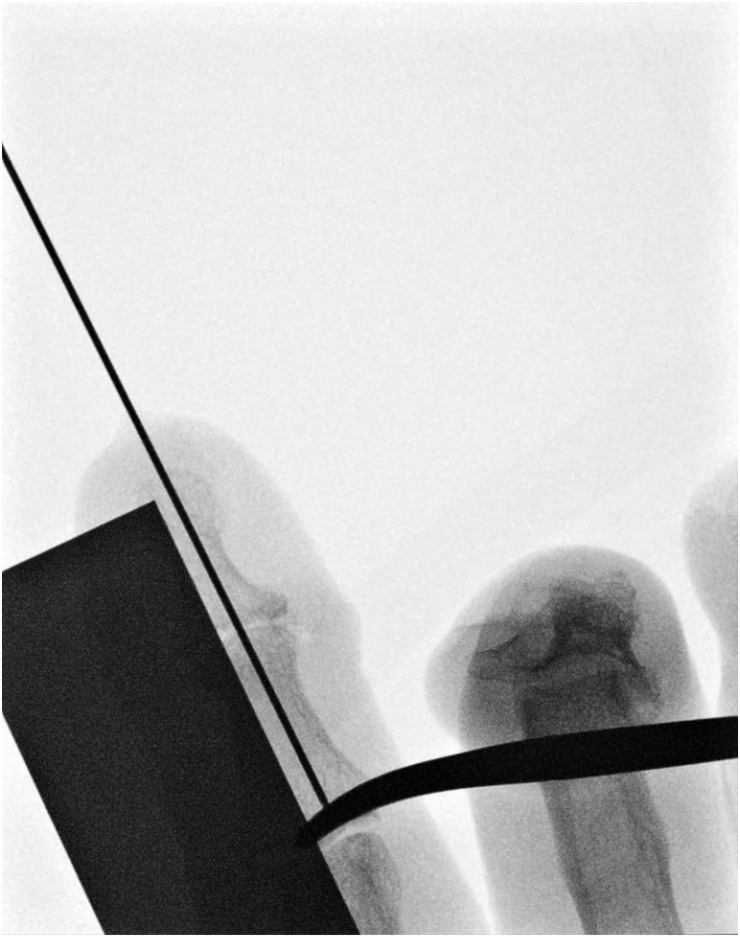 Figure 1
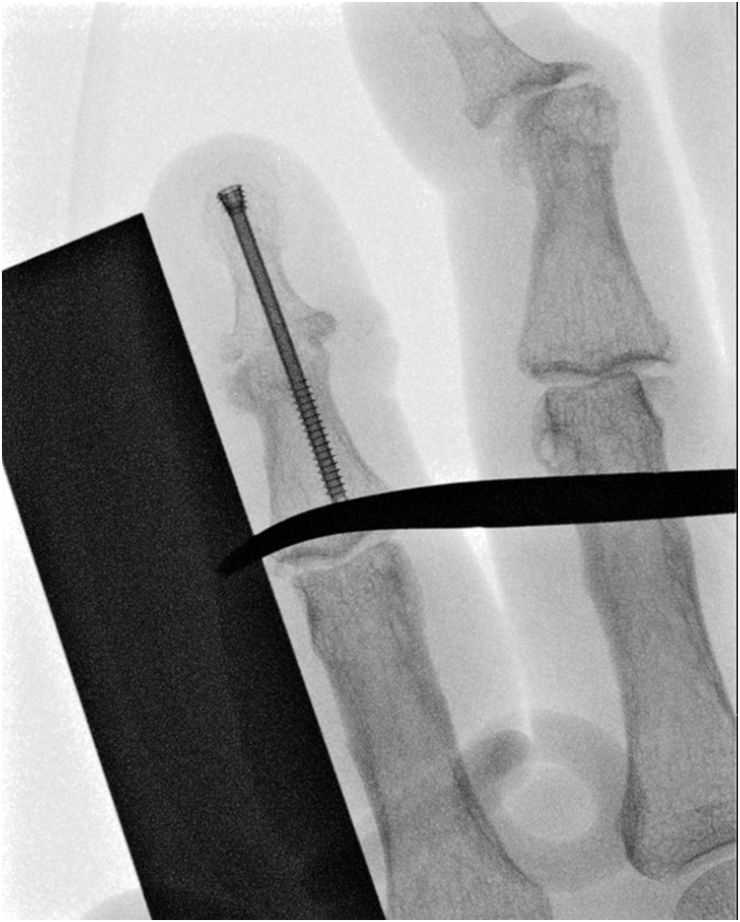 Figure 2
Peer Reviews
No public reviews on file for this paper yet. If you reviewed it on a platform where reviews are public (OpenReview, ICLR, NeurIPS, ICML), you can paste yours below so the community can read it here.
Videos
No videos yet. Explain this paper in a talk, walkthrough, or lecture? Add one.
Taxonomy
TopicsOrthopedic Surgery and Rehabilitation · Nail Diseases and Treatments · Dupuytren's Contracture and Treatments
Headless compression screws provide stable fixation in distal interphalangeal joint (DIPJ) fusion.^1,2^ This involves decortication of the articular surfaces of the distal (P3) and middle phalanx (P2) through an open surgical approach, followed by retrograde K-wire insertion and siting the screw to fuse the DIPJ.^3^ Precise screw length measurement is imperative to avoid iatrogenic injury to the proximal interphalangeal joint (PIPJ). We present a novel method for screw length measurement in DIPJ arthrodesis.
Traditionally, following advancement of the K-wire through the DIPJ, a depth-gauge is used to measure the length of wire protruding from the digit, determining the screw length required. An alternative is a screw depth-gauge with its own protruding wire or hook. We present another method for measurement (Figures 1 and 2), using a haemostat and a metal ruler. The haemostat is aligned with the wire tip under fluoroscopic guidance, and the required screw length can be determined from the ruler. The screw position was planned to ensure completely burying the head within the P3 tuft. The screw length was chosen to allow positioning of the threads within the narrowest part of the intramedullary canal of P2, without breaching the PIPJ. This optimises DIPJ compression while maintaining screw containment within the bony architecture.
A wire-based depth-gauge is often impaired from reaching bone by pulp septations, which warrant further dissection for accurate measurement. The conventional depth-gauge has no implement to keep in position, necessitating removal of the wire to utilise. We present a simple method of screw length measurement which can be reproduced with simple equipment.
The reference list from the paper itself. Each links out to its DOI / PubMed record.
- 1Kocak E, Carruthers KH, Kobus RJ. Distal interphalangeal joint arthrodesis with the Herbert headless compression screw: outcomes and complications in 64 consecutively treated joints. Hand 2010; 6: 56–59.22379439 10.1007/s 11552-010-9295-3PMC 3041886 · doi ↗ · pubmed ↗
- 2Leibovic SJ. Arthrodesis of the interphalangeal joints with headless compression screws. J Hand Surg 2007; 32: 1113–1119.10.1016/j.jhsa.2007.06.01017826568 · doi ↗ · pubmed ↗
- 3Pickering GT, Barnes JR, Bhatia R. Accurate screw arthrodesis of the distal interphalangeal joint. Ann R Coll Surg Engl 2014; 96: 245–246.24780802 10.1308/rcsann.2014.96.3.245PMC 4474067 · doi ↗ · pubmed ↗