RIVER Technique: Retrograde IVUS Endovascular Revascularization of Anomalous Tibial Chronic Total Occlusions
Shadi Halabi, Eric Gonsiorowski, Wael Gad, Fares Chamma, Andrej Schmidt

TL;DR
A new technique called RIVER helps treat difficult foot ulcers by revascularizing arteries when standard methods fail.
Contribution
The RIVER technique provides a novel endovascular approach for revascularizing anomalous tibial chronic total occlusions.
Findings
Retrograde access at the posterior tibial artery successfully revascularized an anomalous occlusion.
Intravascular ultrasound confirmed proper wire placement and led to ulcer healing.
The RIVER technique is effective when antegrade revascularization attempts fail.
Abstract
A 62-year-old man presented with a long-standing history of a nonhealing ulcer to the left foot. Previous antegrade revascularization attempts failed. Retrograde access was obtained at the posterior tibial artery, but the wire traveled away from the tibial peroneal trunk and connected at the popliteal artery. Intravascular ultrasound confirmed intraluminal passage of the wire, which led to successful revascularization of the posterior tibial artery and ulcer healing. The RIVER (Retrograde Intravascular ultrasound Endovascular Revascularization of Anomalous Tibial Chronic Total Occlusions) technique is a useful strategy for revascularization of anomalous tibial occlusions when standard antegrade approaches fail.
Genes, proteins, chemicals, diseases, species, mutations and cell lines named across the full text — each resolved to its canonical identifier and authoritative record.
Click any figure to enlarge with its caption.
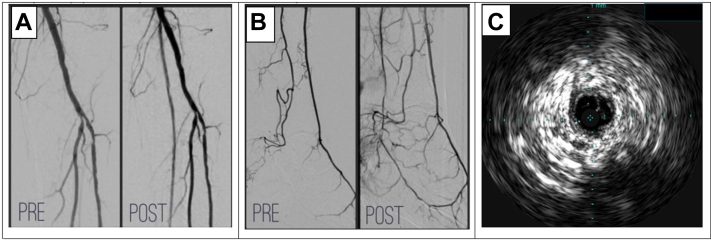 Figure 1
Peer Reviews
No public reviews on file for this paper yet. If you reviewed it on a platform where reviews are public (OpenReview, ICLR, NeurIPS, ICML), you can paste yours below so the community can read it here.
Videos
No videos yet. Explain this paper in a talk, walkthrough, or lecture? Add one.
Taxonomy
TopicsPeripheral Artery Disease Management · Bone fractures and treatments · Total Knee Arthroplasty Outcomes
Chronic limb-threatening ischemia is a serious manifestation of peripheral artery disease and is associated with poor outcomes including longer hospital stays, increased amputation rate, and higher mortality.1 Successful revascularization of tibial chronic total occlusions can be complicated by anatomic variants. Revascularization of these anomalous vessels has not been well described in the literature despite variation in tibial literature being found in up to 10% of patients.2 This case highlights the RIVER (Retrograde Intravascular ultrasound Endovascular Revascularization of Anomalous Tibial Chronic Total Occlusions) technique where a combination of retrograde access and intravascular ultrasound (IVUS) can aid in the successful and safe revascularization of such anatomic variants.
A 62-year-old man with a long-standing nonhealing ulcer to the left foot presented for a second opinion after failing multiple revascularizations attempts and being recommended a below-knee amputation. To further evaluate he was scheduled for an angiogram. Antegrade access was obtained at the common femoral artery. The posterior tibial artery (PTA) was occluded with no clear take-off (Figure 1A). Attempts were made at wiring the PTA near the tibial peroneal trunk expected take-off but were unsuccessful. Identification of the PTA ostium via IVUS guidance was attempted, but once again the PTA opening was not found.3 Next, retrograde access was obtained at the distal PTA. The PTA was calcified and underperfused, requiring multiple ultrasound-guided attempts for canalization. The wire was advanced up the left PTA where it was noted to take a path away from the typical tibial peroneal trunk. The wire from the PTA connected to the proximal popliteal artery (Figure 1A). Before performing balloon angioplasty, IVUS was performed, confirming an intraluminal wire crossing of the calcified PTA (Figure 1C). Successful balloon angioplasty was performed on the PTA restoring in-line flow to the wound (Figures 1A and 1B). The patient experienced wound healing with continued care at the wound clinic with prevention of a major amputation.Figure 1RIVER Technique for Revascularization of an Anomalous Posterior Tibial Artery(A) Pre- and postrevascularization of anomalous posterior tibial artery. (B) Pre- and postrevascularization of dorsal pedal loop. (C) Intravascular ultrasound image showing intraluminal access of anomalous posterior tibial artery.
The anomalous nature of an artery provides a unique challenge to successful revascularization by adding another layer of complexity including finding the vessel origin and ensuring true lumen access of the wire. We present a case of a patient with a nonhealing dorsal foot ulcer where we were unable to find the PTA take-off from the tibial peroneal trunk. The combination of retrograde access and IVUS proved to be essential in safely revascularizing the diseased anomalous artery.
Funding Support and Author Disclosures
The authors have reported that they have no relationships relevant to the contents of this paper to disclose.
The reference list from the paper itself. Each links out to its DOI / PubMed record.
- 1Torres C.Ujueta F.Rogers E.Healthcare disparities in patients with critical limb ischemia: insights from the national Inpatient sample database 2016-2019 J Am Coll Cardiol 818_Supplement 20232108
- 2Kropman R.H.Kiela G.Moll F.L.de Vries J.P.Variations in anatomy of the popliteal artery and its side branches Vasc Endovasc Surg 456201153654010.1177/153857441140906521669862 · doi ↗ · pubmed ↗
- 3Halabi S.Hennawi H.A.Secemsky E.A.Palena M.Manzi M.Intravascular ultrasound guided puncture of stumpless tibial occlusions Am J Cardiol 254202510811210.1016/j.amjcard.2025.08.00240789536 · doi ↗ · pubmed ↗