High‐Throughput DNA Sequencing Reveals Gastric Content Composition and Inter‐Specific Variation in Pampus Fishes
Wang Weiji, Liu Chengbin, Lv Ding, Hu Yulong, Lv Guanzheng, Shan Xiujuan

TL;DR
This study uses DNA sequencing to reveal the diets of three types of Pampus fish, showing differences in what they eat and how they fit into marine food webs.
Contribution
The study introduces eDNA high-throughput sequencing as an effective method for analyzing gastric content in Pampus species, overcoming limitations of traditional methods.
Findings
eDNA sequencing identified distinct prey species in the diets of three Pampus species, including anchovies and specific crustaceans.
Crustaceans were the most diverse and abundant dietary component across all Pampus species, comprising over 60% of identified taxa.
Cephalopods were found in two Pampus species but absent in P. cinereus, highlighting inter-specific dietary variation.
Abstract
Pampus species play a significant role in offshore food webs and are regarded as representative economically important fish. Owing to variations in their geographical distribution, distinct differences in feeding habits exist among pomfret species. However, the presence of an esophageal sac in pomfrets complicates accurate identification of their dietary composition through conventional stomach content analysis. Consequently, research on the feeding ecology of pomfrets remains limited and imprecise. This study employed environmental DNA (eDNA) high‐throughput sequencing technology to analyze the composition and relative abundance of gastric contents in three Pampus species ( P. argenteus , P. punctatissimus , and P. cinereus ) collected from Qingdao, Shandong Province and Wenchang, Hainan Province. Key findings include: (1) Analysis revealed 21, 7, and 2 fish species in the gastric…
Genes, proteins, chemicals, diseases, species, mutations and cell lines named across the full text — each resolved to its canonical identifier and authoritative record.
Click any figure to enlarge with its caption.
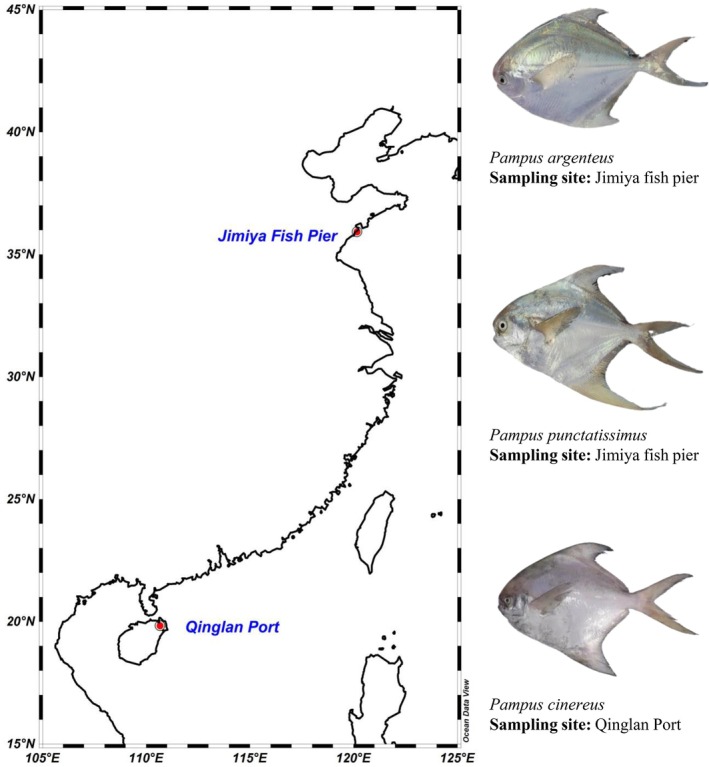 FIGURE 1
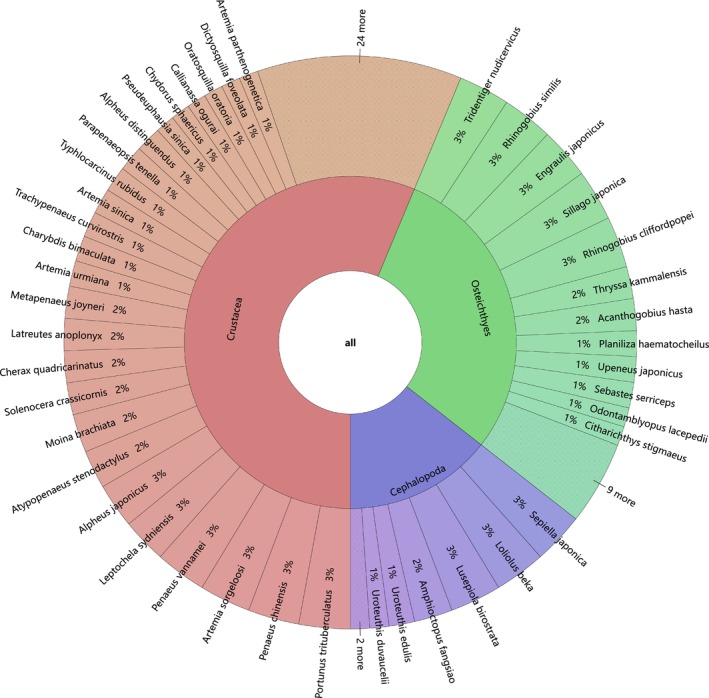 FIGURE 2
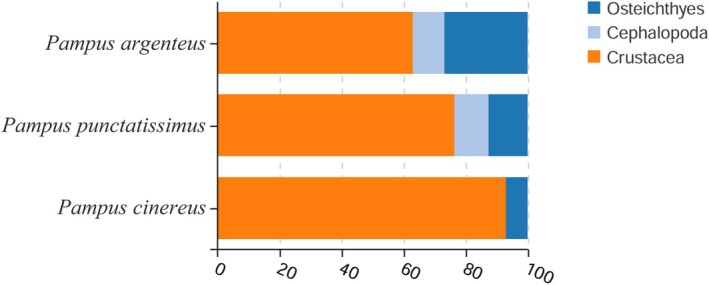 FIGURE 3
| Primer names | Target taxon | Amplification region | Primer sequences 5′‐3′ |
|---|---|---|---|
| Mifish | Marine teleosts | 12SrRNA gene | F: GTYGGTAAAWCTCGTGCCAGC |
| R: CATAGTGGGGTATCTAATCCYAGTTTG | |||
| Crust16S | Crustaceans | 16SrRNA gene | F: GGGACGATAAGACCCTATA |
| R: ATTACGCTGTTATCCCTAAAG | |||
| CephMLS | Cephalopods | 16SrRNA gene | F: TGCGGTATTWTAACTGTACT |
| R: TTATTCCTTRATCACCC |
| Primer names | Target taxon | species | Product size | reads numbers |
|---|---|---|---|---|
| Mifish | Marine teleosts |
| 169.90 | 955,427 |
|
| 169.06 | 958,138 | ||
|
| 169.46 | 965,462 | ||
| Crust16S | Crustaceans |
| 170.00 | 938,650 |
|
| 165.25 | 716,235 | ||
|
| 172.35 | 812,811 | ||
| CephMLS | Cephalopods |
| 205.24 | 851,843 |
|
| 197.04 | 220,103 | ||
|
| Failed | Failed |
| Primary forage organisms |
|
|
|
|---|---|---|---|
|
| √ | √ | |
|
| √ | √ | |
|
| √ | ||
|
| √ | ||
|
| √ | ||
|
| √ | ||
|
| √ | ||
|
| √ | ||
|
| √ | ||
|
| √ | √ | |
|
| √ | √ | |
|
| √ | ||
|
| √ | √ | √ |
|
| √ | ||
|
| √ | ||
|
| √ | √ | |
|
| √ | ||
|
| √ | ||
|
| √ | ||
|
| √ | ||
|
| √ | ||
|
| √ | √ | |
|
| √ | √ | √ |
|
| √ | √ | |
|
| √ |
| Classify | Traditional dissection | stable isotope analysis | eDNA |
|---|---|---|---|
| Crustacea | 17 | 7 | 48 |
| Mollusca | 1 | 1 | 8 |
| Polychaeta | 1 | 0 | 0 |
| Chaetognatha | 1 | 0 | 0 |
| Platyhelminthes | 1 | 0 | 0 |
| Algae | 5 | 2 | 0 |
| Fish | 0 | 0 | 21 |
- —National Key Research and Development Program of China10.13039/501100012166
- —Laoshan Laboratory under contract
Peer Reviews
No public reviews on file for this paper yet. If you reviewed it on a platform where reviews are public (OpenReview, ICLR, NeurIPS, ICML), you can paste yours below so the community can read it here.
Videos
No videos yet. Explain this paper in a talk, walkthrough, or lecture? Add one.
Taxonomy
TopicsEnvironmental DNA in Biodiversity Studies · Isotope Analysis in Ecology · Genomics and Phylogenetic Studies
Introduction
1
The genus Pampus (Perciformes: Stromateidae) comprises neritic, warm‐temperate pelagic fishes of economic importance, distributed extensively from the Bohai Sea to the South China Sea in China. These species occupy critical ecological niches in nearshore food chains and networks while holding significant importance in China's marine fisheries (Zhou et al. 2021; Lin et al. 2007; Shan et al. 2014). Chinese Pampus species, including Pampus argenteus , Pampus punctatissimus , Pampus cinereus , and Pampus chinensis , exhibit remarkable morphological similarity. Notably, even mitochondrial sequences demonstrate substantial conservation across congeneric species, rendering the taxonomy and phylogenetic relationships of Pampus a persistent focus of scientific inquiry (Liu et al. 2002; Wu et al. 2013).
Among the Pampus species in China, the silver pomfret ( Pampus argenteus ) demonstrates a continuous distribution along China's coastal waters from Liaodong Bay in the north to Guangxi coastal regions (Wei 2024). While the distribution pattern of the spotted pomfret ( Pampus punctatissimus ) overlaps with P. argenteus , it exhibits greater spatial fragmentation(Wei 2024). And the gray pomfret ( Pampus cinereus ) predominantly inhabits more southern coastal regions(Wei 2024). Despite their remarkable morphological similarities, these three Pampus species possess distinct mitochondrial sequences and represent well‐defined taxonomic entities, each playing significant ecological roles within their respective marine food chains and webs (Zhang et al. 2024). However, current research on the feeding ecology of species within the genus Pampus remains limited and has predominantly focused on a single species, Pampus argenteus . But distinct distribution ranges among Pampus species correlate with marked differences in dietary composition despite their morphological convergence. Consequently, investigating the trophic ecology of Pampus species not only elucidates fundamental feeding behaviors but also reveals their ecological roles within marine ecosystems. Such research provides critical insights for monitoring food web structures, assessing stability, and evaluating evolutionary dynamics within these biological networks (Dadzie et al. 2000; Peng et al. 2011; Wei et al. 2019).
Dadzie et al. (2000) employed direct dissection methods to analyze the dietary composition of Pampus argenteus in Kuwaiti waters through gastric content monitoring, identifying Crustacea and their eggs as the primary food sources, with copepods being the dominant taxa (Dadzie et al. 2000). However, other scholars have noted that fish of the genus Pampus possess an esophageal sac, which mechanically disrupts ingested prey prior to gastric processing, and this anatomical adaptation results in highly fragmented gastric contents, rendering traditional morphological identification methods inadequate for accurate dietary analysis (Tong et al. 2013; Tang et al. 2022). Consequently, researchers increasingly adopt indirect approaches such as stable isotope analysis to elucidate trophic relationships in Pampus species (Peng et al. 2011; Wei et al. 2019).
Beyond conventional methodological approaches, stable isotope analysis of carbon and nitrogen has been employed to tentatively identify the dietary sources of P. argenteus , which may include phytoplankton, zooplankton, benthic shrimp, Acetes chinensis , and Loligo japonica . Nevertheless, due to the inherent limitations of this technique, the precise taxonomic composition of its diet remains unresolved (Wei et al. 2019).
In recent years, with the rapid advancement of environmental DNA (eDNA) technology, gastric contents as a specialized form of eDNA have enabled researchers to identify and trace specific dietary components from digested materials where external morphological differentiation proves impossible (Bernhard et al. 2019). Particularly through the parallel development of next‐generation sequencing technologies and the application of universal primers targeting mitochondrial‐specific genes in aquatic organisms (Miya et al. 2015), researchers have gained the capability to conduct in‐depth analyses of dietary compositions in various aquatic species, including fish, using gastric content eDNA‐based NGS approaches (Amin et al. 2022; Minegishi et al. 2023; Sakaguchi 2017; Tsuji et al. 2024; Visser et al. 2021).
Notably, no existing studies have applied eDNA technology to comprehensively investigate the dietary compositions of these three pomfret species. To address this knowledge gap, this study employs gastric content eDNA‐based NGS technology to systematically identify and compare the dietary components of these congeneric species. The research objectives are twofold: (1) to elucidate the dietary compositions and interspecific variations among the three Pampus species, and (2) to examine how these dietary differences correlate with the spatial distribution patterns of prey organisms within their respective habitats. This investigation provides critical insights into the ecological roles of Pampus species within coastal trophic networks while concurrently evaluating the efficacy of gastric content eDNA‐NGS methodology in pomfret dietary studies.
Materials and Method
2
Sample Collection
2.1
Based on the geographical distribution patterns of Pampus species (Wei 2024), eight individuals of Pampus argenteus (body weight were from 328 g to 375 g) were collected from Jimiya fish pier lies in Qingdao, Shandong Province, and eight individuals of Pampus punctatissimus (body weight were from 337 g to 395 g) were collected from Jimiya fish pier as well. The left eight samples of Pampus cinereus (body weight were from 354 g to 440 g) were sampled at Qinglan Port, Wenchang City, Hainan Province. All samples were preserved in frozen conditions and transported to the laboratory for subsequent analysis. The samples were obtained as mortalities from routine fishing operations, with no active capture or euthanasia by researchers. Although precise habitat parameters (e.g., exact depth, distance from shore) were unrecorded due to standardized fishing protocols, all samples are representative of typical nearshore fishing grounds in China. The specific sampling locations are marked on the map, and the samples of three Pampus species are photographed by the authors and presented together in Figure 1.
Sampling locations and sample atlas.
eDNA Extraction
2.2
During the laboratory processing, the extraction of gastric contents strictly adhered to aseptic protocols: dissection was performed using instruments sterilized by high‐pressure steam, and the fish surface was thoroughly rinsed with sterile distilled water prior to dissection to eliminate exogenous contamination. The eDNA extraction of gastric contents was carried out using the DNeasy Blood and Tissue Kit (Qiagen, Germany) following the manufacturer's protocol.
High—Throughput Sequencing
2.3
This study focused on monitoring three target groups in pomfret gastric contents: marine teleosts, cephalopods, and crustaceans. And species‐specific PCR primers were employed as follows:
Universal primer for marine teleosts (Mifish) was developed by Miya (Miya et al. 2015), while those for crustaceans (Crust16S) were designed by Berry (Berry et al. 2017), and primers for cephalopods (CephMLS) were established by Jarman (Jarman et al. 2006). The amplified target regions and primer sequences for all three sets are provided in Table 1.
Three technical replicates were performed for each PCR sample. The PCR products from the same sample were pooled and separated via 2% agarose gel electrophoresis. Target DNA fragments were excised and purified using the AxyPrep DNA Gel Extraction Kit (AxyGen, USA), followed by postelution verification using 2% agarose gel electrophoresis.
The PCR amplification was conducted using TransStart FastPfu DNA Polymerase with a 20 μL reaction system containing: 4 μL 5× FastPfu Buffer, 2 μL 2.5 mM dNTPs, 0.8 μL Forward Primer (5 μM), 0.8 μL Reverse Primer (5 μM), 0.4 μL FastPfu Polymerase, 10 ng Template DNA, ddH₂O to adjust the final volume to 20 μL, Thermal cycling conditions: a. Initial denaturation: 1 cycle of 95°C for 5 mins; b. Amplification: 30 cycles of 95°C for 30 s, 58°C for 30 s, 72°C for 45 s; c. Final extension: 72°C for 10 mins; d. Hold: 10°C until termination.
Purified PCR products were quantified by Qubit3.0 (Life Invitrogen) and every twenty‐four amplicons whose barcodes were different were mixed equally. The pooled DNA product was used to construct Pair‐End library following the manufacturer's genomic DNA library preparation procedure. Then the amplicon library was paired‐end sequenced (2 × 250) on an MiSeq platform (Shanghai BIOZERON Co. Ltd) according to the standard protocols. The raw reads were deposited into the NCBI Sequence Read Archive (SRA) database (please contact the author to provide it).
Library Construction and Sequence Processing
2.4
Raw fastq files were first demultiplexed using in‐house perl scripts according to the barcode sequences information for each sample with the following criteria: (i) The 250 bp reads were truncated at any site receiving an average quality score < 20 over a 10 bp sliding window, discarding the truncated reads that were shorter than 50 bp. (ii) Exact barcode matching, 2 nucleotide mismatches in primer matching, and reads containing ambiguous characters were removed. (iii) Only sequences that overlap longer than 10 bp were assembled according to their overlap sequence. Reads that could not be assembled were discarded.
Sequences were clustered into operational taxonomic units (OTUs) at 100% similarity (identical) using the Deblur denoising algorithm, which removes noise due to sequencing error.
Results
3
High‐Throughput Raw Sequencing Data
3.1
Statistical analysis was conducted on the sequences obtained after trimming, assembly, and filtering of high‐throughput raw sequencing data, with the results presented in Table 2. Both Pampus argenteus and Pampus punctatissimus demonstrated robust amplification outcomes. However, amplification using CephMLS primers for Pampus cinereus samples yielded suboptimal results, with all eight samples failing to produce amplification products.
Composition of Gastric Contents in Three Species of Pampus
3.2
First of all, the exclusion of false positives constitutes a critical procedure in the analysis involving environmental DNA (eDNA) high‐throughput sequencing. In this study, the workflow and criteria for eliminating false positives from the eDNA high‐throughput sequencing results pertaining to dietary composition are outlined as follows: (1) For each primer–species combination, sequencing results from all eight replicates of the same species were consolidated; (2) Based on relative reads abundance, sequences accounting for less than 1% of the total were discarded and not subjected to further taxonomic assignment; (3) Screening was performed according to the target taxa amplified by the specific primers. For instance, 12S sequences in this study were expected to correspond to marine teleost fishes. Therefore, reads that were clearly inconsistent with potential dietary sources such as mammals (e.g., Homo sapiens , Mus musculus ), birds (e.g., Gallus gallus ), and freshwater fishes (e.g., Misgurnus anguillicaudatus , Chanodichthys mongolicus ) were removed; (4) The geographical distributions of the taxonomically assigned organisms were further verified. For example, Fenneropenaeus chinensis , a kind of shrimp mainly distributed in the Yellow and Bohai Seas of China, which is not found in the habitat range of the P. cinereus distributed in China, but could be found in the prey list of P. argenteus , but in the prey list of P. cinereus , which mainly distribute which is not found in the South Sea of China.
Based on the analysis of species distribution in the sampling marine area and after excluding false positive results from eDNA high‐throughput sequencing, the following composition characteristics were identified in the gastric contents of three Pampus species.
In the eDNA analysis of P. argenteus gastric contents, 21 marine fish species were detected. Six species were consistently present across all samples: Sillago japonica , Jaydia lineata, Engraulis japonicus , Rhinogobius cliffordpopei , Rhinogobius similis , and Tridentiger nudicervicus . The top three species in relative reads abundance were S. japonica , J. lineata , and E. japonicus . Species The occurrence frequency less than 1% included Ambassis gymnocephalus , Elates ransonnettii , Pungitius pungitius , and Scomberomorus niphonius . A total of eight cephalopod species were identified. Among them, Loliolus beka , Sepiella japonica , and Lusepiola birostrata were detected in all samples. The relative abundance of Loliolus beka reads was the highest in each individual of P. argenteus , with the relative reads abundance exceeding 90% in six P. argenteus samples. Forty‐nine crustacean species were identified. Acetes japonicus , Penaeus chinensis , Penaeus vannamei , Portunus trituberculatus, and Artemia sorgeloosi were consistently detected across all samples.
Using the P. argenteus as a case study, we recorded the detection frequency of each prey organism across all stomach content samples. The relative detection frequency of each prey taxon was calculated by dividing its individual detection count by the total number of detections for all prey organisms. The resulting taxonomic composition and relative detection frequencies of prey organisms are presented in Figure 2.
Classification of gastric contents of Pampus argenteus and the proportion of occurrence frequency.
From the eDNA analysis of P. punctatissimus gastric contents, a total of seven marine fish species were identified: Acanthogobius flavimanus , Engraulis japonicus , Hypomesus nipponensis , Jaydia lineata, Pampus argenteus , Scomberomorus niphonius , and Sphyraena pinguis . Among these, Engraulis japonicus (93.66%) and Jaydia lineata (5.03%) dominated in relative abundance. These two species are recognized as the primary prey organisms in the sampling area of P. punctatissimus (Li et al. 2009; Chen 2023), and their juveniles serve as palatable prey for Pampus punctatissimus , consistent with experimental findings. Six cephalopod species were detected, with Lusepiola birostrata overwhelmingly predominant (99% relative abundance). For crustaceans, 42 species were identified, including Acetes japonicus , Penaeus chinensis , Penaeus vannamei , and Artemia sorgeloosi, which exhibited notable prevalence in the samples.
A comprehensive analysis of environmental DNA (eDNA) from the gastric contents of Pampus cinereus revealed three marine fish species: Bregmaceros nectabanus and Encrasicholina punctifer . The latter dominated with a relative abundance of 98.53%. No cephalopod species were detected. Among crustaceans, 26 species were identified, including Acetes chinensis , Charybdis bimaculata, Penaeus chinensis , and Portunus trituberculatus. Acetes chinensis emerged as the predominant species in relative abundance.
Overall, species belonging to Osteichthyes, Cephalopoda, and Crustacea were detected in the gastric contents of P. argenteus and P. punctatissimus , whereas only Osteichthyes and Crustacea prey species were identified in P. cinereus . The proportional composition of different prey categories in the gastric contents of these three Pampus species is illustrated in Figure 3. Crustaceans exhibited the highest taxonomic diversity across all three species, consistently accounting for over 60% of dietary composition, thereby occupying a dominant position in their feeding ecology. Species consistently detected across all samples of each Pampus species were classified as primary prey, with statistical comparisons summarized in Table 3. Notably, * Engraulis japonicus and Nemipterus virgatus
- served as shared dominant prey for both P. argenteus and P. punctatissimus , demonstrating high relative abundance in detected fish species. This trophic overlap likely reflects their sympatric distribution in shared marine habitats. Additionally, crustacea constituted significant nutritional resources for Pampus species.
Proportion of different categories of gastric contents in three species of Pampus.
Discussion
4
Key Considerations in Primer Selection
4.1
The design of primers targeting the three taxonomic groups was guided by the following rationale: First, based on a review of the literature, crustaceans, cephalopods, and fish were identified as the dominant dietary components in the gastric contents of the three examined Pomfret species (adults). Second, primers for these taxa have been relatively well‐validated in previous studies, ensuring broad and reliable coverage of the target species composition. Finally, this study emphasizes methodological validation, aiming to evaluate the reliability of environmental DNA (eDNA) high‐throughput sequencing for analyzing the dietary composition of Pomfret species. And we have gained insights into primers targeting several gene regions, including COI, 12S rRNA, 16S rRNA, and 18S rRNA. Among these, the reference sequences in the COI primer database exhibit inadequate representation for certain taxonomic units, resulting in a substantial number of OTUs that cannot be annotated to the species level (Feng et al. 2022). Furthermore, certain COI primers demonstrate amplification bias toward specific species, thereby increasing the likelihood of false negative results (Sun et al. 2018). The primary reason is that the high evolutionary rate of the COI gene leads to significant sequence divergence in primer binding sites across different taxa, making it challenging to design universal primers with broad taxonomic coverage. This limitation is particularly evident in dietary studies of generalist species, where COI primers often fail to amplify all target taxa present in stomach content samples (Li et al. 2019). However, the actual identification capability of the 18S gene is weaker than that of COI, particularly in zooplankton studies where it often fails to annotate at the species level. Results obtained using 18S primers frequently underestimate species numbers and show significant discrepancies compared to outcomes from other primers. Meanwhile, the primer set designed for the 18S rRNA gene yields an amplified product of 500–700 bp, exceeding the read length limitations of second‐generation sequencing. Many studies have found that selecting the best primers for different target groups is essential to balance taxonomic coverage and taxonomic accuracy (Luna and Reindert 2020). Therefore, we ultimately selected three primers that have been extensively tested and widely cited as reliable tools for this study (Berry et al. 2017; Merten et al. 2023; Rishan et al. 2023; Wu et al. 2025).
Analysis of Gastric Contents Test Results
4.2
Due to their unique digestive structures, gastric contents of Pampus species typically present as chyme‐like substances, rendering conventional identification methods ineffective. Pampus species occupy a critical niche in the trophic ecology of coastal marine ecosystems and represent an economically significant fishery resource. Consequently, elucidating their trophic position, dietary habits, and prey preferences through gastric content analysis is of considerable scientific and ecological importance. Current research, however, remains limited in both methodological resolution and taxonomic coverage. From a methodological perspective, existing approaches allow only for coarse taxonomic identification of prey items, falling short of species‐level discrimination. In terms of species investigated, studies have predominantly focused on P. argenteus , with other pomfret species receiving little to no attention, thereby constraining the generalizability and comprehensiveness of current ecological understanding. This study successfully employed eDNA technology to analyze the gastric contents of Pampus species, thereby establishing a novel methodological framework for dietary investigation in these fish. The approach effectively overcomes limitations associated with conventional methods, which are often constrained by the distinctive physiological morphology of Pampus species. Based on this methodology, we analyzed the taxonomic composition and relative abundance of gastric contents in three Pampus species— P. argenteus , P. punctatissimus , and P. cinereus —collected from distinct marine regions across China. The variations in gastric content composition and relative abundance across species largely reflect their divergent feeding habits, which are closely associated with their respective ecological habitats.
In the gastric contents of three Pampus species, Crustacea exhibited the highest species richness, accounting for over 60% of their dietary composition and occupying a pivotal position in their feeding ecology. Taking P. argenteus as an example, we have listed the number of species in different categories of prey in Table 4, with 48 species of crustaceans detected. This finding aligns with the results reported by Dadzie et al. Such results demonstrate the accuracy of applying high‐throughput sequencing technology to the study of gastric contents in Pampus species. Meanwhile, the differences in the gastric content analysis results of the three Pomfret species reflect variations in community composition under different ecological environments. These three Pampus species either inhabit overlapping or distinct marine regions, leading to both similarities and differences in the composition and abundance of their gastric contents. In our study, P. argenteus and P. punctatissimus were collected from the southern waters of the Yellow Sea adjacent to the Shandong Peninsula. In this area, six dominant prey fish species were identified: Setipinna taty , Coilia mystus , Collichthys niveatus , Thryssa kammalensis , Engraulis japonicus , and Apogonichthys lineatus (Li et al. 2009). Among these, Engraulis japonicus and Apogonichthys lineatus exhibited the highest relative reads abundance in the gastric contents of P. argenteus and P. punctatissimus , as determined by eDNA analysis in this study. The samples of Pampus cinereus were collected from the South China Sea. The larval and juvenile abundance of Setipinna tenuifilis (Clupeiformes; Engraulidae; Setipinna) demonstrated absolute dominance (Chen 2023). The forage fish community in this maritime area primarily consists of larval and juvenile samples from Clupeidae and Engraulidae families, exhibiting significant compositional differences compared to the Yellow Sea ecosystem. Consistent with the regional forage fish composition, gastric content analysis of P. cinereus revealed that E. punctifer (Clupeiformes; Engraulidae; Setipinna) maintained predominant relative abundance. Regarding cephalopod components in the gastric contents, Sepiola birostrata (Sepiolidae) has been identified as a perennial dominant cephalopod species in the Yellow Sea waters (Du 2016). This finding indirectly reflects that DNA high‐throughput sequencing technology, through gastric content analysis of Pampus species, can partially elucidate the composition of forage organisms in their habitat waters.
TABLE 4: Comparative analysis of three detection methods for gastric contents examination in P. argenteus .
Comparison of Results With Traditional Detection Methods
4.3
Current research on gastric contents within the genus Pampus has predominantly focused on P. argenteus . Dadzie et al. employed traditional methods to investigate the seasonal variations in the dietary composition of P. argenteus , revealing that crustaceans constitute the primary prey, followed by copepods and their eggs. These findings are constrained by the unique digestive tract morphology of Pampus species, which permits only coarse identification of gastric contents, resulting in ambiguities for many prey items. This limitation underscores the potential of DNA high‐throughput sequencing technology as an innovative approach to elucidate feeding habits in Pampus species. Despite the minimal sample size in this experiment, DNA high‐throughput sequencing yielded substantially richer data compared to conventional methodologies. Future studies should prioritize the collection of temporally diverse samples to analyze ontogenetic shifts in feeding behavior across Pampus life stages. Additionally, integrating DNA high‐throughput sequencing with traditional assessments of stomach fullness could provide a comprehensive framework for evaluating feeding intensity.
This study analyzed the gastric contents of P. argenteus from the Yellow Sea, with samples consistent with previous investigations utilizing stable carbon and nitrogen isotope techniques. Stable carbon and nitrogen isotope analysis is a method used to determine the long‐term assimilated dietary sources and trophic levels of fish by examining the isotopic ratios in their tissues. In contrast to conventional gastric content analysis, this technique provides insights into the prolonged nutritional intake and feeding preferences of target species. Nevertheless, the approach has certain limitations. Due to the lack of significant variation in stable carbon and nitrogen isotope compositions among different prey species within the same taxonomic group, precise identification at the species level is often unachievable. Furthermore, the application of this method necessitates prior investigation into the habitat of the target species and presupposes the potential prey organisms present in the ecosystem. Consequently, in some studies employing stable carbon and nitrogen isotopes to analyze fish feeding ecology, prey items are frequently categorized broadly into functional groups such as “benthic shrimp,” “phytoplankton,” and “zooplankton.” The isotope‐based study identified benthic shrimps, phytoplankton, and zooplankton as primary dietary components, concluding that P. argenteus predominantly preys on benthic shrimps, followed by Acetes chinensis and Loligo japonica (Wei et al. 2019). These findings align with eDNA metabarcoding results: our research revealed the highest diversity of crustaceans in the gastric contents, with Loligo beka exhibiting the greatest relative abundance among detected mollusks. However, discrepancies emerged when compared to isotope‐derived conclusions. This divergence may arise from the inherent limitations of stable carbon and nitrogen isotope techniques in precisely classifying gastric content taxa. A comparative analysis of traditional dissection, stable isotope analysis, and eDNA‐based monitoring methods is presented in Table 4. Specifically, the stable isotope data were referenced from the aforementioned article by Wei (Wei et al. 2019). Notably, eDNA technology demonstrated superior detection capabilities despite smaller sample sizes, identifying significantly more crustacean, mollusk, and fish species. Neither conventional methods nor isotope techniques detected fish remains in the gastric contents.
Compared to traditional detection methods primarily based on morphological identification and isotope tracking, environmental DNA (eDNA) remains unaffected by morphological alterations in gastric contents. This advantage is particularly pronounced when gastric contents have been mechanically ground and chemically digested within the digestive tract, resulting in unrecognizable external structures, or when the dietary items include components such as eggs that cannot be reliably identified through morphological characteristics. Under these conditions, eDNA offers superior performance in determining both the species composition and quantitative proportions of gastric contents. Furthermore, the eDNA method eliminates the need for analysts with specialized taxonomic expertise to conduct compositional and statistical analyses of gastric contents. Additionally, it enables more straightforward estimation and quantification of the abundance of dietary items.
Compared to carbon and nitrogen stable isotope techniques, environmental DNA technology eliminates the need for prior assumptions about prey organisms in the gastric contents of Pampus species based on their feeding habits and habitat zones. By sequencing DNA from gastric contents using universal primers designed for various categories of prey organisms, this approach enables direct acquisition of comprehensive gastric content composition and relative abundance data. This advancement facilitates more precise determination of Pampus species' positions within local marine food chains and food webs, thereby enhancing our understanding of their dietary ecology.
Author Contributions
Shan Xiujuan: conceptualization (equal), resources (equal), supervision (equal). Wang Weiji: formal analysis (equal), funding acquisition (equal), methodology (equal), project administration (equal), validation (equal), writing – review and editing (equal). Liu Chengbin: formal analysis (equal), writing – original draft (equal). Hu Yulong: formal analysis (equal), methodology (equal), resources (equal), supervision (equal). Lv Ding: conceptualization (equal), investigation (equal), methodology (equal), software (equal), validation (equal), visualization (equal). Lv Guanzheng: conceptualization (equal), investigation (equal), supervision (equal), validation (equal), visualization (equal).
Funding
This work was supported by the National Key Research and Development Program of China: Grant No. 2024YFD2400400 Laoshan Laboratory under contract: No. LSKJ202203803.
Conflicts of Interest
The authors declare no conflicts of interest.
The reference list from the paper itself. Each links out to its DOI / PubMed record.
- 1Amin, M. , H. Yaha , S. H. Samara , et al. 2022. “Revealing Diets of Wild‐Caught Ornate Spiny Lobster, Panulirus ornatus, at Puerulus, Post‐Puerulus and Juvenile Stages Using Environmental DNA (e DNA) Metabarcoding.” Aquaculture Reports 27: 101361. 10.1016/j.aqrep.2022.101361. · doi ↗
- 2Bernhard, E. , N. Abrego , D. Gravel , T. Huotari , E. J. Vesterinen , and T. Roslin . 2019. “Assessing Changes in Arthropod Predator‐Prey Interactions Through DNA‐Based Gut Content Analysis‐Variable Environment, Stable Diet.” Molecular Ecology 28, no. 2: 266–280. 10.1111/mec.14872.30230073 · doi ↗ · pubmed ↗
- 3Berry, T. E. , S. K. Osterrieder , D. C. Murray , et al. 2017. “DNA Metabarcoding for Diet Analysis and Biodiversity: A Case Study Using the Endangered Australian Sea Lion (Neophocacinerea).” Ecology and Evolution 7, no. 7: 5435–5453. 10.1002/ece 3.31.28770080 PMC 5528208 · doi ↗ · pubmed ↗
- 4Chen, Y. Y. 2023. Study on the Characteristics of the Juvenile Fish Community Structure in the Central And Eastern Beibu Gulf (Master's Thesis). Guangdong Ocean University 10.27788/d.cnki.ggdhy.2023.000275. (in Chinese).
- 5Dadzie, S. , F. Abou‐Seedo , and E. Al‐Qattan . 2000. “The Food and Feeding Habits of the Silver Pomfret, Pampus argenteus (Euphrasen), in Kuwait Waters.” Journal of Applied Ichthyology 16: 61–67. 10.1046/j.1439-0426.2000.00150.x. · doi ↗
- 6Du, T. F. 2016. “Survey and Analysis of the Autumnal Cephalopod Distribution in the Yellow Sea During 2006–2013.” Journal of Fishery Sciences of China 23, no. 4: 955–964. 10.3724/SP.J.1118.2016.15381. · doi ↗
- 7Feng, Y. , D. Sun , Q. Shao , C. Fang , and C. Wang . 2022. “Applications of DNA Metabarcoding in Biodiversity and Ecology of Marine Zooplankton.” Acia Ecologica Sinica 42, no. 21: 8544–8554. 10.5846/stxb 202111223288. · doi ↗
- 8Jarman, S. N. , K. S. Redd , and N. J. Gales . 2006. “Group‐Specific Primers for Amplifying DNA Sequencesthat Identify Amphipoda, Cephalopoda, Echinodermata,Gastropoda, Isopoda, Ostracoda and Thoracica.” Molecular Ecology Notes 6: 268–271. 10.1111/j.1471-8286.2005.01172.x. · doi ↗