The BBM2‐BZR4‐GrxC2.2 Module Regulates Rice Embryogenesis Independently of the BR Pathway
Jia‐Wen Yu, Jin‐Dong Wang, Ying‐Mei Deng, Li‐Jun Kan, Cheng‐Chao Zhu, Meng‐Fan Jiang, Dong‐Sheng Zhao, Xiao‐Lei Fan, Chang‐Quan Zhang, Li‐Chun Huang, Qiao‐Quan Liu, Qian‐Feng Li

Abstract
Genes, proteins, chemicals, diseases, species, mutations and cell lines named across the full text — each resolved to its canonical identifier and authoritative record.
Click any figure to enlarge with its caption.
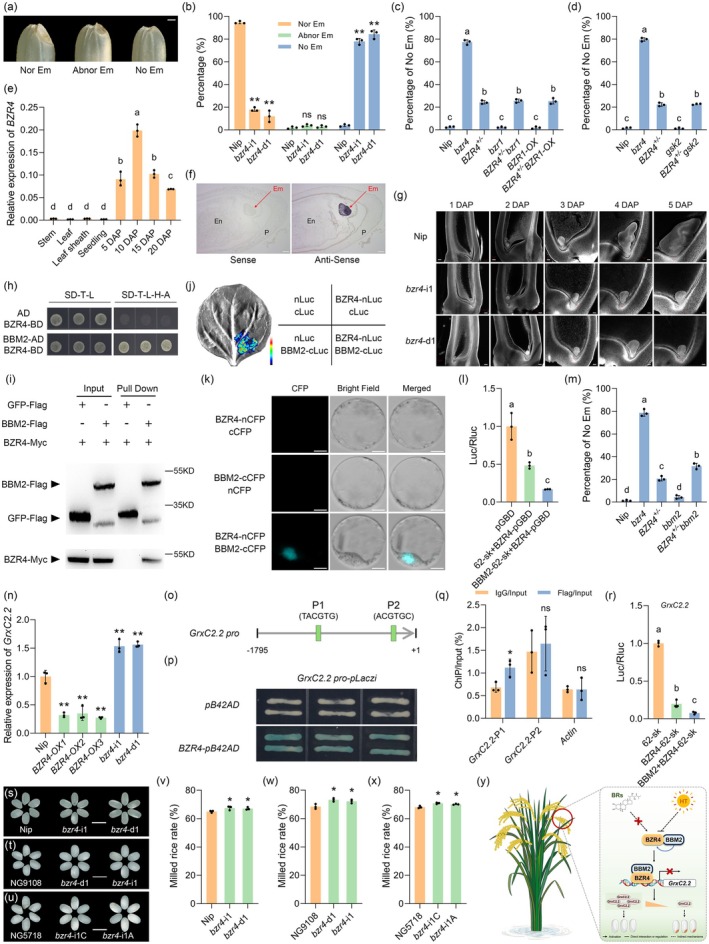 Figure 1
- —National Key Research and Development Program of China10.13039/501100012166
- —National Natural Science Foundation of China : 32270575
- —the Project of Zhongshan Biological Breeding Laboratory : BM2022008‐02
- —the Government of Jiangsu Province : BK20220567, BE2022336, JBGS[2021]001, PAPD
- —the Postgraduate Research & Practice Innovation Program of Jiangsu Province : KYCX21_3236
Peer Reviews
No public reviews on file for this paper yet. If you reviewed it on a platform where reviews are public (OpenReview, ICLR, NeurIPS, ICML), you can paste yours below so the community can read it here.
Videos
No videos yet. Explain this paper in a talk, walkthrough, or lecture? Add one.
Taxonomy
TopicsPlant Molecular Biology Research · Plant Gene Expression Analysis · Genetic Mapping and Diversity in Plants and Animals
Brassinosteroids (BRs) are sterol‐derived phytohormones that play a crucial role in regulating various agronomic traits related to crop yield (Song et al. 2023; Zhang, Meng, et al. 2024). It is therefore believed that precise manipulation of the BR pathway can effectively improve both crop yield and quality traits, thereby making a substantial contribution to the next green revolution (Yang et al. 2024; Li et al. 2023). BZR‐family transcription factors are pivotal positive regulators within the BR signalling cascade. In rice, knocking out OsBZR1 results in a pleiotropic phenotype characterised by reduced grain size, compact plant architecture and increased resistance to preharvest sprouting (PHS) (Xiong et al. 2022). However, a recent study reported that BZR5 functions as a negative regulator of BR signalling and rice grain size, revealing an unconventional role for BZRs in rice (Zhang, Wu, et al. 2024). This implies that functional redundancy, diversification and even antagonism coexist among different BZR members. Therefore, elucidating the biological functions of distinct BZR members will improve our understanding of the BR‐governed genetic network and advance the molecular breeding practices.
In this study, we generated loss‐of‐function mutants of all BZRs. Interestingly, only the bzr4 mutant exhibited an embryoless phenotype (Figure S1). We therefore classified the seeds of the bzr4 mutants into three groups: normal embryo, abnormal embryo, and no embryo (Figure 1a). Quantitative data showed that around 80% of bzr4 seeds were embryoless (Figure 1b). To determine whether BZR4 controls embryogenesis via the BR pathway, we examined the seeds of the other BR‐deficient and BR‐insensitive mutants. However, no aberrant embryoless phenotypes were observed (Figure S2). Although the in vitro and in vivo experiments confirmed that BZR4 directly interacts with BZR1 and GSK2 (Figures S3 and S4), BZR1 overexpression or GSK2 mutation could not restore the embryoless phenotype of the bzr4 mutant (Figure 1c,d). Overall, genetic evidence demonstrated that BZR4 regulates rice embryogenesis independently of BR signalling.
Several experiments were conducted to shed light on how BZR4 controls embryogenesis. RT‐qPCR results showed that BZR4 is predominantly expressed in seeds (Figure 1e). An in situ hybridisation experiment further demonstrated its embryo‐specific expression (Figure 1f). Furthermore, the BZR4 protein was localised in both the cytoplasm and the nucleus, exhibiting strong transcriptional repressor activity (Figure S5). The anthers, pistils and ovaries of bzr4 mutants appeared similar to those of the wild type (Figure S6), confirming that maternal floral organs develop normally. Confocal laser‐scanning microscopy of developing seeds revealed that bzr4 mutants experienced arrest of embryogenesis between 3 and 4 days after pollination (DAP) (Figure 1g). Further corroboration came from paraffin section analysis, which showed that most bzr4 seeds lacked an embryonic structure by 15 DAP (Figure S7). These data demonstrate that the developmental lesion in the bzr4 mutants occurs at the globular stage of embryogenesis. Additionally, a potential BZR4‐interacting protein, BBM2 (a close homologue of BBM1; Khanday et al. 2019), was identified by screening a yeast two‐hybrid library. RT‐qPCR results showed that BBM2 is also predominantly expressed in seeds (Figure S8). Further experiments demonstrated that BZR4 interacts with BBM2 in vitro and in vivo (Figure 1h–k). A dual‐luciferase reporter assay revealed that BBM2 significantly enhances the transcriptional repressor activity of BZR4 (Figure 1l). Although mutation of BBM2 alone had no effect on rice embryogenesis (Figure S9), mutation of this gene significantly increased the proportion of embryoless seeds in the bzr4 mutant (Figure 1m).
To further clarify the downstream targets of BZR4 in orchestrating embryogenesis, the candidate gene GrxC2.2 was investigated, given that its overexpression also results in embryoless seeds in rice (Liu et al. 2019). Notably, GrxC2.2 expression was repressed in BZR4‐overexpression lines and promoted in bzr4 mutants (Figures 1n and S10), indicating that BZR4 negatively regulates GrxC2.2 expression. Promoter analysis revealed the presence of two E‐boxes in the GrxC2.2 promoter (Figure 1o). Consequent yeast one‐hybrid and ChIP‐qPCR assays confirmed that BZR4 can directly bind to the GrxC2.2 promoter (Figure 1p,q). A further dual‐luciferase reporter assay confirmed that BZR4 significantly suppresses GrxC2.2 expression alone or in conjunction with BBM2 (Figure 1r). Consistently, knocking out BBM2 did not affect GrxC2.2 gene expression, but it can further promote GrxC2.2 expression in the bzr4 mutant (Figure S11).
The BZR4 mutation in Nipponbare significantly increased the milled rice rate (Figure 1s,v). To confirm this effect, two popular commercial rice varieties from Jiangsu (NG9108 and NG5718) were subjected to gene editing and subsequent evaluation (Figures S12 and S13). The phenotyping results indicated that the BZR4 mutation in both varieties resulted in more than 85% embryoless seeds and a significantly higher milled rice rate (Figure 1t,u,w,x). Therefore, the BZR4 mutation indeed enhances rice processing quality and has industrial potential. Recently, Wang et al. (2025) demonstrated that BZR4 modulates rice embryogenesis in a temperature‐dependent manner. This provides a new approach to designing temperature‐regulated embryoless germplasm. However, our research provides robust genetic evidence demonstrating that BZR4 regulates rice embryogenesis independently of the BR pathway. We have also successfully established a BBM2‐BZR4‐GrxC2.2 molecular module to illustrate this regulation. In summary, the establishment of the BR‐independent BBM2–BZR4–GrxC2.2 regulatory module in this study, alongside the work of Wang et al. (2025), has significantly advanced our understanding of the mechanisms that orchestrate rice embryogenesis (Figure 1y).
Author Contributions
Q.‐F.L. and Q.‐Q.L. conceived the project and supervised the study. J.‐W.Y., J.‐D.W., Y.‐M.D., L.‐C.H., L.‐J.K., C.‐C.Z., M.‐F.J., D.‐S.Z., X.‐L.F. and C.‐Q.Z. conducted the experiments. Q.‐F.L., Q.‐Q.L. and L.‐C.H. analysed the data. J.‐W.Y. and L.‐C.H. wrote the manuscript. Q.‐F.L. and Q.‐Q.L. revised the manuscript. All authors read and approved the manuscript.
Conflicts of Interest
The authors declare no conflicts of interest.
Supporting information
Figures S1–S13. Table S1.
The reference list from the paper itself. Each links out to its DOI / PubMed record.
- 1Khanday, I. , D. Skinner , B. Yang , R. Mercier , and V. Sundaresan . 2019. “A Male‐Expressed Rice Embryogenic Trigger Redirected for Asexual Propagation Through Seeds.” Nature 565: 91–95.30542157 10.1038/s 41586-018-0785-8 · doi ↗ · pubmed ↗
- 2Li, Q. , Q. Gao , J. Yu , and Q. Liu . 2023. “Brassinosteroid, a Prime Contributor to the Next Green Revolution.” Seed Biology 2: 7.
- 3Liu, S. , H. Fu , J. Jiang , et al. 2019. “Overexpression of a CPYC‐Type Glutaredoxin, Os Grx C 2.2, Causes Abnormal Embryos and an Increased Grain Weight in Rice.” Frontiers in Plant Science 10: 848.31316541 10.3389/fpls.2019.00848 PMC 6610441 · doi ↗ · pubmed ↗
- 4Song, L. , J. Liu , B. Cao , et al. 2023. “Reducing Brassinosteroid Signalling Enhances Grain Yield in Semi‐Dwarf Wheat.” Nature 617: 118–124.37100915 10.1038/s 41586-023-06023-6PMC 10156601 · doi ↗ · pubmed ↗
- 5Wang, Z. , M. Xu , Y. Liu , et al. 2025. “ Os BZR 4 Regulates Temperature‐Dependent Embryogenesis in Rice.” Nature Communications 16: 6893.10.1038/s 41467-025-62262-3PMC 1229673640715123 · doi ↗ · pubmed ↗
- 6Xiong, M. , J. Yu , J. Wang , et al. 2022. “Brassinosteroids Regulate Rice Seed Germination Through the BZR 1‐R Amy 3D Transcriptional Module.” Plant Physiology 189: 402–418.35139229 10.1093/plphys/kiac 043PMC 9070845 · doi ↗ · pubmed ↗
- 7Yang, Y. , C. Chu , Q. Qian , and H. Tong . 2024. “Leveraging Brassinosteroids Towards the Next Green Revolution.” Trends in Plant Science 29: 86–98.37805340 10.1016/j.tplants.2023.09.005 · doi ↗ · pubmed ↗
- 8Zhang, Q. , R. Wu , T. Hong , et al. 2024. “Natural Variation in the Promoter of q RBG 1/Os BZR 5 Underlies Enhanced Rice Yield.” Nature Communications 15: 8565.10.1038/s 41467-024-52928-9PMC 1144993339362889 · doi ↗ · pubmed ↗