Physicochemical Properties of Anopheles Mosquito Larval Habitats in Nouakchott, Mauritania
Mohamed Haidy Massa, Osman Abdillahi Guedi, Nicolas Gomez, Ali Ould Mohamed Salem Boukhary, Sébastien Briolant, Mohamed Aly Ould Lemrabott

TL;DR
This study identifies key factors influencing Anopheles mosquito larval habitats in Nouakchott, Mauritania, to help improve malaria control strategies.
Contribution
The study provides new insights into the physicochemical and ecological factors associated with Anopheles larval habitats in a specific urban setting.
Findings
Presence of Culex and Aedes larvae, pH, and temperature significantly influence Anopheles larval habitats.
Anopheles multicolor and An. arabiensis are the only species present in Nouakchott.
Findings suggest targeted destruction of breeding sites could aid malaria control.
Abstract
Malaria remains one of the main public health problems in Mauritania, and it is essential to identify the factors that determine the distribution and productivity of Anopheles breeding sites in order to develop more effective control strategies. A longitudinal survey with repeated measurements was conducted in Nouakchott between May 2023 and April 2024, in order to examine the factors influencing the distribution and productivity of Anopheles larval habitats. The larvae were collected by immersion in 60 water points, once a month during the dry season and twice a month during the rainy season, for a total of 294 observations. The physical and chemical characteristics of the sites were also measured. Logistic regression analyses with random effects showed that the presence of Culex and Aedes larvae, pH, and temperature were statistically significantly associated with positive water…
Genes, proteins, chemicals, diseases, species, mutations and cell lines named across the full text — each resolved to its canonical identifier and authoritative record.
Click any figure to enlarge with its caption.
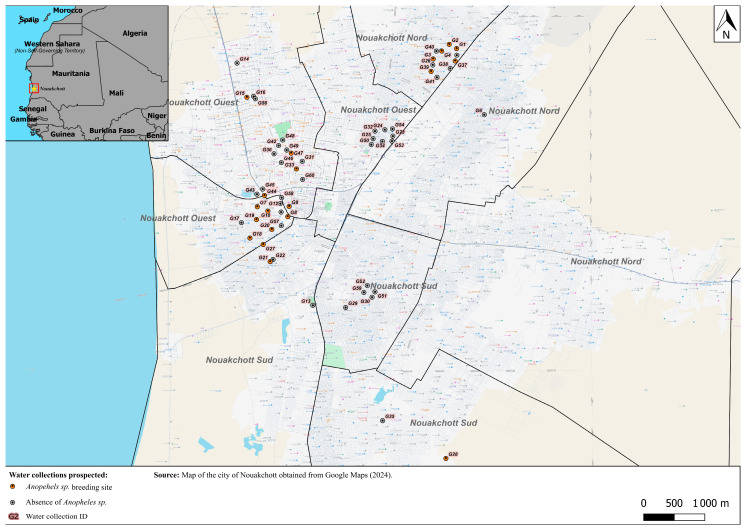 Figure 1
- —Direction Générale de l’Armement
- —Agence Nationale de la Recherche Scientifique et de l’Innovation
- —French Ministry of Foreign Affairs
Peer Reviews
No public reviews on file for this paper yet. If you reviewed it on a platform where reviews are public (OpenReview, ICLR, NeurIPS, ICML), you can paste yours below so the community can read it here.
Videos
No videos yet. Explain this paper in a talk, walkthrough, or lecture? Add one.
Taxonomy
TopicsMalaria Research and Control · Mosquito-borne diseases and control · Insect Pest Control Strategies
1. Introduction
The Anopheles mosquito is a vector for several diseases around the world, including malaria caused by Plasmodium spp. and lymphatic filariasis, the latter caused by the parasites Wuchereria bancrofti and Brugia malayi. It is also known to transmit O’nyong-nyong virus [1]. Malaria remains a significant public health challenge in 83 countries worldwide, with most deaths occurring in Africa. According to the Global Malaria Report, there were 263 million malaria cases and 597,000 malaria-related deaths in 2023 [2].
In Mauritania, malaria remains one of the major public health problems [3]. Transmission is intense and seasonal in the southern Sahel region, but unstable and sporadic in the northern Sahara region [4,5]. In this region of the Sahara, most cases of malaria are concentrated in Nouakchott [6,7]. Due to the short rainy season (July–September), malaria transmission peaks in October and November, following the rainy season [4]. The primary malaria vector in Nouakchott is Anopheles arabiensis [8]. Plasmodium vivax predominates, accounting for over 74% of PCR-confirmed cases, with P. falciparum and mixed infections making up smaller proportions [9].
Currently, pyrethroids are the only insecticides available for treating mosquito nets. However, due to widespread resistance to these compounds in Africa, these methods are gradually losing their effectiveness [10,11,12]. Furthermore, a recent study conducted in Nouakchott examined the resistance of Aedes aegypti to insecticides, revealing that the species is resistant to all those that were evaluated. [13] This is particularly the case with pyrethroids. Similar resistance is likely to be present in Anopheles mosquitoes. A study conducted on Anopheles populations sampled in Nouakchott between 2015 and 2016 demonstrated their resistance to pyrethroids [14]. In this situation, it is important to identify and characterize the breeding sites of Anopheles mosquitoes in order to develop effective strategies for the malaria control program [15]. Urbanization generally has a significant impact on the composition of the vector system and the dynamics of malaria transmission [16]. Some mosquito species have adapted to urban environments and prefer to lay their eggs in wastewater. This renders vector control efforts ineffective [17].
Larval habitats are determined by a series of physicochemical parameters, such as water temperature, pH, salinity, turbidity, conductivity, etc. Each mosquito species has its own preferences for larval breeding sites and fluctuations in these parameters affect vector development, influencing the abundance and morphology of adult mosquitoes [18,19,20,21,22]. Several studies have characterized the breeding sites of Anopheles mosquitoes across sub-Saharan Africa [23,24,25]. In Nouakchott, the first study of this type described the characteristics of the larval habitats of An. gambiae s.l. and showed that, despite the arid and dry climate of the Sahara, certain human practices, such as the construction of domestic water reservoirs or retention basins from public standpipes, promote the proliferation of mosquitoes and thus contribute to maintaining malaria transmission in the city [26].
A recent six-year retrospective study conducted in Nouakchott reported a significant decline in malaria prevalence among febrile patients, from 29.2% in 2015 to only 2.1% in 2020, reflecting the impact of interventions and environmental changes, such as reduced rainfall and improved drinking water systems [9]. However, few studies have been conducted on the physical and chemical characteristics of Anopheles breeding sites in Nouakchott. In addition, these studies were conducted over a very short period of time and on a limited number of parameters and breeding sites. The statistical analyses were also mainly descriptives.
This study provides comprehensive longitudinal monitoring over one year, enabling exhaustive seasonal analysis and detailed, integrated physicochemical profiling using a multiparametric probe. It uses robust mixed-effects models to analyze the co-occurrence of Anopheles, Aedes, and Culex species in a Saharan urban context.
2. Materials and Methods
2.1. Study Site
The study was conducted in Nouakchott, the capital of Mauritania, one of the largest cities in the Saharan region. Nouakchott is densely populated with approximately 1,500,000 inhabitants [27], and is located in the Atlantic coastal zone, characterized by low elevation between 1 m and 10 m below sea level. A belt of natural salt 1 to 2 km wide separates the city itself from the Atlantic coast.
The climate is characterized as Saharan, with low annual rainfall (<100 mm on average) and average annual temperatures and humidity of 27 °C and 56.5% respectively. Depending on the season, winds blow in several directions, with northern winds prevailing from October to May and westerly winds from June to September. [28]. The climate in Nouakchott is characterized by a long dry season from October to June and a short rainy season from July to September.
During the study period, the average maximum temperature was 33 °C, the average minimum temperature was 20.6 °C, and the average annual temperature ranged from 21.8 °C to 31.9 °C. The average annual relative humidity ranged from 28% to 69%. Precipitation was generally concentrated during the summer months (July, August and September), with an average of 120 mm per year. During the period studied, total precipitation reached 109.5 mm, distributed as follows: 30 mm in June, 15.5 mm in July, 54 mm in August, and 10 mm in September.
2.2. Study Period
From May 2023 to April 2024, a longitudinal survey with repeated measurements was conducted in domestic and peridomestic environments to characterize mosquito breeding sites. A total of 60 water sources and containers were sampled (Figure 1), once per month during the dry season and twice per month during the rainy season as previously described in [13]. The collection sites were selected using a stratified approach in order to cover various urban contexts (residential areas of different socioeconomic levels, as well as peri-urban agricultural areas) to ensure maximum spatial and environmental representations of the city of Nouakchott.
All types of larval habitats observed during field surveys were included in the study, whether artificial or natural, permanent or temporary, and regardless of their accessibility, in order to minimize selection bias. The total number of water samples was deliberately limited to 60, as this number was considered sufficient to adequately reflect the diversity and distribution of water collections present at the urban scale.
2.3. Larval Collection and Morphological Identification of Adult Specimens
Different types of water-holding containers were examined as potential habitats for larvae, and mosquito larvae were sampled using the standard dipping with a mosquito dipper (BioQuip, Gardena, CA, USA) [29]. The larvae and pupae were collected using a pipette, or by emptying the containers completely when the larvae were small. All the larvae were counted to assess their density according to Papierok et al. [30] and transported to the insectarium in labelled 750 mL mineral water bottles and raised at an ambient temperature of 28 °C with 80% relative humidity and a 12-h light/dark cycle. Emerged adults were captured using a vacuum cleaner and placed at −20 °C for a few minutes to euthanize them. They were preserved in Eppendorf tubes filled with cotton and silica gel. Adult mosquitoes were identified morphologically at the species level using a stereo zoom binocular microscope according to a standard morphological key [31].
2.4. Characterization of Water Collections
For each water sample, general geographical and physical data were recorded, such as GPS location, type of water sampling, depth (≤0.5 m or >0.5 m), area size (≤5 m^2^ or >5 m^2^), distance from dwellings (≤10 m or >10 m), water transparency (clear or opaque), presence of vegetation, the origin of the site (natural or artificial), the type of water (permanent or temporary) and exposure to sunlight (shaded, semi-shaded or sunny). Chemical characteristics including pH, temperature (°C), conductivity (μS/cm), salinity (g/L), and turbidity (in Formazin nephelometric units), were measured in the field using a portable HANNA HI (98,195) device (imLab, Wasquehal, France), in accordance with the protocol described by Nebbak et al. [32].
2.5. DNA Extraction and Molecular Identification of Anopheles Species
A sample of 117 Anopheles mosquitoes from different breeding sites was molecularly identified. The Anopheles specimens were homogenized in microtubes with stainless steel beads and lysis buffer using a TissueLyser II (Qiagen, Les Ulis, France). After incubating at 70 °C for one hour, the DNA was extracted using the NucleoSpin^®^ 96 Tissue Core Kit (Macherey-Nagel, Oensingen, Switzerland), following the manufacturer’s protocol. For each reaction, 3 µL of eluted template DNA was added to the PCR master mix, which contained DreamTaq polymerase, buffer, 2 mM MgCl_2_, and deoxyribonucleoside triphosphates (dNTPs) (ThermoFisher DreamTaq™ Green PCR Master Mix, ThermoFisher Scientific, Illkirch, France). The T1 Biometra thermocycler (Thermo Fisher Scientific, Illkirch, France) was programmed as follows: an initial step at 95 °C for 5 min, followed by 35 cycles of 95 °C for 1 min, 50 °C (annealing temperature) for 1 min, and 72 °C for 1 min, followed by a final extension step at 72 °C for 10 min. The quality of the PCR products was verified by agarose gel electrophoresis and visualized under ultraviolet light. The expected band size was 710 bp. The sequences were analyzed using Geneious Prime software version 2022.2.2. Next, the multiplex PCR protocol developed by Scott et al. was used to identify the sibling species of Anopheles gambiae [33], under the same conditions as the first PCR.
2.6. Statistical Analysis
The analyses were performed using R software, version 4.4.2 [34]. To ensure balance between groups, categorical variables such as pH, temperature, and depth were carefully dichotomized using specific cut-offs corresponding to their median (e.g., pH 8.3, temperature 29.82 °C, and depth 0.5 m, respectively). First, a descriptive analysis of the independent variables was performed. Then, each variable was individually integrated into a logistic regression model for univariate analysis. Variables with an effect and a p-value less than 0.25 were selected for the multivariate analysis as previously reported [35]. Larval positivity in water samples was modeled according to the characteristics of each sample using a random-effects logistic regression model that took into account the spatialization of the data via the water collection as a random effect. Additionally, larval density was assessed for a standardized volume of one liter of water. When it was not possible to collect one liter directly, density was estimated by proportional extrapolation from the actual volume collected. For statistical analysis, larval density was defined as the average value of the densities measured during the various studies for each habitat. larval density at breeding sites was analyzed as a dependent variable using negative binomial regression with the breeding site as a random effect. The significant variables (p < 0.05) and their interactions were selected using a stepwise selection procedure based on minimization of the Akaike information criterion (AIC) to construct the final model.
3. Results
3.1. Description of Anopheles Breeding Sites
In Nouakchott, most of the 60 water collections studied were temporary (47 out of 60, or 78.3%), while 13 (21.6%) were permanent. Of these, 54 (90%) were artificial and only six (10%) were natural. These collections were spread across several neighborhoods in the city and were mainly located in the most densely populated residential areas, particularly in Teyaret, Dar Naim, Sebkha, Tevragh-Zeina, El Mina and Riyadh. The surveys were conducted between May 2023 and April 2024, and the geographical location of the sampling sites is shown in Figure 1. Of the 60 water collections visited, 20 (33.3%) were positive for immature stages of Anopheles (Figure 1, Table S1). The sources included agricultural wastewater puddles (n = 4, 20%), water tanks (n = 2, 10%), barrels (n = 2, 10%), groundwater (n = 2, 10%), rainwater (n = 2, 10%), drains and pits (n = 2, 10%). Other sources, each representing 5%, included stagnant rainwater and groundwater (n = 1), a pit (n = 1), a water storage pond (n = 1), a fountain bollard drain (n = 1), a pipe leak (n = 1) and well water storage (n = 1). Figure S1 shows the main breeding sites of Anopheles spp. Table 1 summarizes their chemical characteristics, and Table S2 details the distribution of the 294 observations according to the type of water sampling type, thus providing an overview of the conditions favorable to the presence of larvae.
3.2. Factors Associated with the Positivity of Water Collections for Anopheles Larvae
Univariate logistic regression with random effect analysis of water collections positivity for Anopheles larvae was performed to identify the main factors associated with larval positivity in the examined water collections (Table S3). Then a multivariate logistic regression analysis with random effects revealed that the presence of Culex and Aedes, as well as pH and temperature, were statistically significant and independently associated with water collections positivity for Anopheles (Table 2). The presence of Aedes larvae was a protective factor (aOR 0.18, 95%CI [0.05–0.60], p-value = 0.006). Risk factors were the presence of Culex larvae (aOR 3.03, 95%CI [1.14–8.07], p-value = 0.006), a pH ≥ 8.3 (aOR 3.17, 95%CI [1.32–7.61], p-value = 0.010) and a temperature >29.82 °C (aOR 5.95, 95%CI [2.09–16.92], p-value < 0.001).
3.3. Factors Associated with the Density of Anopheles Larvae at Breeding Sites
A univariate binomial negative regression with random effect analysis of the number of Anopheles larvae at breeding sites was performed to identify the main factors associated with the density of Anopheles larvae (Table S4). Risk factor was a temperature >29.82 °C (cOR 2.88, 95%CI [1.25–6.63], p-value < 0.013) and protective factor was a depth >0.5 m (cOR 0.34, 95%CI [0.15–0.77], p-value = 0.009).
No model could be obtained using multivariate negative binomial regression with random effects analysis of the density of Anopheles larvae at breeding sites.
3.4. Species Composition of Anopheles
Of 117 Anopheles mosquitoes sampled from various breeding sites, 116 were An. arabiensis and one was An. multicolor (in breeding site G4, Figure 1).
4. Discussion
The impact of malaria is strongly influenced by environmental factors, among which the physicochemical parameters of mosquito breeding sites play a central role, significantly affecting density, survival, distribution and capacity of vector populations [36,37,38]. In this context, controlling Anopheles larvae is one of the most effective strategies for preventing malaria transmission in Nouakchott. This is particularly relevant given that recent studies highlight the resistance of Anopheles mosquitoes to pyrethroids [14], which are commonly used to treat mosquito nets. Therefore, implementing such larval control program effectively requires a thorough understanding of their larval habitat characteristics.
The present study demonstrates the persistence of Anopheles mosquito larvae in Nouakchott. Artificial sites were the most common type of Anopheles breeding site. This finding is consistent with the results of previous studies in Nouakchott [26], as well as in other countries in sub-Saharan Africa such as Sudan [39], Ghana [40]. However, in studies conducted in Burkina Faso [41], and Nigeria [42], An. gambiae larvae were mainly found in natural sites. In fact, puddles were the most common artificial breeding sites, as has already been reported in other studies conducted in urban areas in Benin [24]. Agricultural puddles and stagnant water puddles were also encountered, as in a study on mosquito abundance and physicochemical characteristics of their breeding sites conducted in Egypt, where Anopheles was encountered [19]. It also appears that groundwater promotes the proliferation of Anopheles mosquitoes, with three breeding sites found to have originated from rising groundwater levels. These results are not generally found in several studies of the sub-regions [43,44]. Some rainwater sources had relatively high salinity or conductivity, which could be explained by mixing with saline groundwater or by the dissolution of salt deposits present on the surface. Furthermore, Nouakchott’s low altitude, between 1 and 10 m, could also accentuate the influence of coastal waters on rainwater.
In our study, among 50 observations of Culex larvae in water collections, 29 coexisted with the presence of Anopheles larvae. This finding is consistent with a study conducted in Tanzania [45]. Another study conducted in Kenya revealed that An. arabiensis and Culex quinquefasciatus larvae shared the same aquatic habitats with coexistence rates higher than those expected by chance [46]. Among the species that pose a significant threat to public health, during our study, we observed in five observations the coexistence of Ae. aegypti and Anopheles larvae at water collections. Aedes aegypti has been found to coexist with Anopheles in the same larval habitats, as demonstrated in previous studies [24,47,48]. A study conducted in Nigeria revealed that the most species cohabitated in metal cans and clay pots were Ae. aegypti, An. gambiae, and An. funestus [48]. Additionally a study conducted in Kinshasa, Democratic Republic of Congo, revealed similar trends, showing the coexistence of Aedes and Anopheles species at breeding sites [49]. On the contrary, in Zanzibar, Anopheles was rarely found cohabiting with Culex and Aedes in the same breeding sites [50]. Semi-natural experiments conducted in Tanzania demonstrated that when Ae. aegypti larvae shared containers with Anopheles species (An. arabiensis, An. gambiae sensu stricto, and An. funestus), the Anopheles larvae exhibited reduced survival, slower development, and smaller adult size. In some cases, larval disappearance was observed, suggesting possible predation by Ae. aegypti [45]. In Nouakchott, the positive association observed between Anopheles and Culex larvae, as well as the negative association with Ae. aegypti, could be explained by differential habitat preferences and local ecological interactions. For example, Anopheles and Culex may share similar breeding sites that are favorable to their development such as shallow, stagnant water with certain physicochemical characteristics, while Ae. aegypti, often associated with smaller, less permanent artificial containers, find these same sites less suitable. Competition for resources or predation of larvae could also influence the co-occurrence of species.
The presence of Anopheles larvae in the city of Nouakchott was positively associated with pH, the majority of Anopheles breeding sites had a pH ≥ 8.3. This appears to be similar to the findings of a study conducted in Ouagadougou, where An. funestus preferred high pH environments [41]. A study conducted in Ethiopia also indicates that pH is associated with an increase in the density of Anopheles larvae [51]. An alkaline pH can promote microbial and algal growth, thereby increasing food availability for Anopheles larvae.
The majority of Anopheles larval development sites exhibit water temperature > 29.82 °C. Indeed, results of the present study, showed that presence of Anopheles larvae is positively correlated with temperature, this is consistent with the findings of Kabore et al. from Burkina Faso [41]. High temperatures probably accelerate larval development and shorten the mosquito life cycle, thereby increasing their abundance in warm habitats. However, Dejenie et al. demonstrated that the abundance of Anopheles larvae was negatively correlated with temperature [51].
Our study also documented the presence of An. arabiensis and An. multicolor in the city of Nouakchott, as shown in previous studies [14,52]. Anopheles multicolor was first reported by Lemrabott et al. [52] in highly saline breeding sites in Nouakchott, during a study on the salinity tolerance of An. arabiensis larvae in Nouakchott, Mauritania.
This study has certain limitations. First, it was conducted over a period of one year, which means that long-term climatic variations such as El Niño or La Niña could not be taken into account. In addition, certain environmental factors were not directly assessed, including the presence of predators and the concentration of organic nutrients; nevertheless, the Anopheles breeding sites were mainly artificial (75%) and therefore independent of these climatic phenomena. Thirdly, in some cases, residents refused access to their homes after an initial visit, which limited subsequent follow-up. In addition, some water collections dried up, reducing the number of monitoring sessions. Finaly, no multivariate negative binomial model could be obtained for larval density due to sample size limitations. These density analyses are therefore only exploratory, and more data are needed to determine which type of breeding sites are most productive for Anopheles larvae.
5. Conclusions
This study aimed to describe the physicochemical characteristics of Anopheles breeding sites in the urban area of Nouakchott, Mauritania. These breeding sites are primarily artificial, including puddles, agricultural puddles, stagnant puddles, and groundwater. As Anopheles mosquitoes are still present and malaria remains one of the main public health problems in Mauritania as a whole, and as Anopheles resistance to pyrethroids has already been proven, rapid measures are needed to manage Anopheles populations. Identifying “high-risk” habitats (artificial, shallow, warm, and alkaline water bodies) enables urban malaria programs to prioritize interventions, such as environmental management (reduction at source) and the targeted application of biological larvicides at specific times of the year.
The reference list from the paper itself. Each links out to its DOI / PubMed record.
- 1Afrane Y.A. Githeko A.K. Yan G. The Ecology of Anopheles Mosquitoes under Climate Change: Case Studies from the Effects of Deforestation in East African Highlands Ann. N. Y. Acad. Sci.2012124920421010.1111/j.1749-6632.2011.06432.x 22320421 PMC 3767301 · doi ↗ · pubmed ↗
- 2WHO World Malaria Report 2024 WHO Geneva, Switzerland 2024
- 3Lekweiry K.M. Salem M.S.O.A. Basco L.K. Briolant S. Hafid J. Boukhary A.O.M.S. Malaria in Mauritania: Retrospective and Prospective Overview Malar. J.20151410010.1186/s 12936-015-0607-525880759 PMC 4350613 · doi ↗ · pubmed ↗
- 4Ould Ahmedou Salem M.S. Basco L.K. Ouldabdallahi M. Mint Lekweiry K. KonatéL. Faye O. Ould Mohamed Salem Boukhary A. Malaria-Associated Morbidity during the Rainy Season in Saharan and Sahelian Zones in Mauritania Acta Trop.20151521710.1016/j.actatropica.2015.08.00526276697 · doi ↗ · pubmed ↗
- 5Ould Lemrabott M.A. Mint Lekweiry K. Deida J. Djigo O.K.M. Ould Ahmedou Salem M.S. Ould Khalef Y. Bogreau H. Simard F. Basco L. Ould Mohamed Salem Boukhary A. Low Malaria Transmission in Rosso, an Irrigated Rice-Growing Area in Mauritania Parasitologia 2021125726810.3390/parasitologia 1040027 · doi ↗
- 6Cortes H. Morillas-Márquez F. Valero A. Malaria in Mauritania: The First Cases of Malaria Endemic to Nouakchott Trop. Med. Int. Health 2003829730010.1046/j.1365-3156.2003.01029.x 12667147 · doi ↗ · pubmed ↗
- 7Ould Ahmedou Salem M.S. Mint Lekweiry K. Mint Deida J. Ould Emouh A. Ould Weddady M. Ould Mohamed Salem Boukhary A. Basco L.K. Increasing Prevalence of Plasmodium Vivax Among Febrile Patients in Nouakchott, Mauritania Am. Soc. Trop. Med. Hyg.20159253754010.4269/ajtmh.14-0243 PMC 435054425582695 · doi ↗ · pubmed ↗
- 8Mint Lekweiry K. Ould Ahmedou Salem M.S. Cotteaux-Lautard C. Jarjaval F. Marin-Jauffre A. Bogreau H. Basco L. Briolant S. Ould Mohamed Salem Boukhary A. Ould Brahim K. Circumsporozoite Protein Rates, Blood-Feeding Pattern and Frequency of Knockdown Resistance Mutations in Anopheles Spp. in Two Ecological Zones of Mauritania Parasites Vectors 2016926810.1186/s 13071-016-1543-027151152 PMC 4858835 · doi ↗ · pubmed ↗