Causal Effect of Character Gender on Readers’ Preferences
Federica Bologna, Ian Lundberg, Matthew Wilkens

TL;DR
This study finds that character gender in books has little impact on reader preferences, challenging assumptions in the publishing industry.
Contribution
The study provides causal evidence that protagonist gender has minimal influence on reader preferences, contradicting common beliefs.
Findings
Men's reading preferences are unaffected by the gender of the protagonist.
Women show a slight preference for stories with female protagonists.
Books with female characters do not alienate readers as previously assumed.
Abstract
Stakeholders in the publishing industry observe strong gender homophily between authors and readers, but it is unclear what causes this alignment. One possible mechanism involves reader preferences for gendered characters – specifically, the largely untested hypothesis that men are less inclined to read books with women protagonists, while women are more willing to read stories featuring protagonists of any gender. This mechanism may affect not only the publication but also the promotion and adaptation of books with women characters. However, there is little causal evidence about the underlying claim: for a given book, would men be more likely to read it if it featured a man character? Would women be more likely to read it if it featured a woman character? Our study provides new causal evidence on these questions in a well-powered study. Using a randomized survey experiment involving…
Genes, proteins, chemicals, diseases, species, mutations and cell lines named across the full text — each resolved to its canonical identifier and authoritative record.
Click any figure to enlarge with its caption.
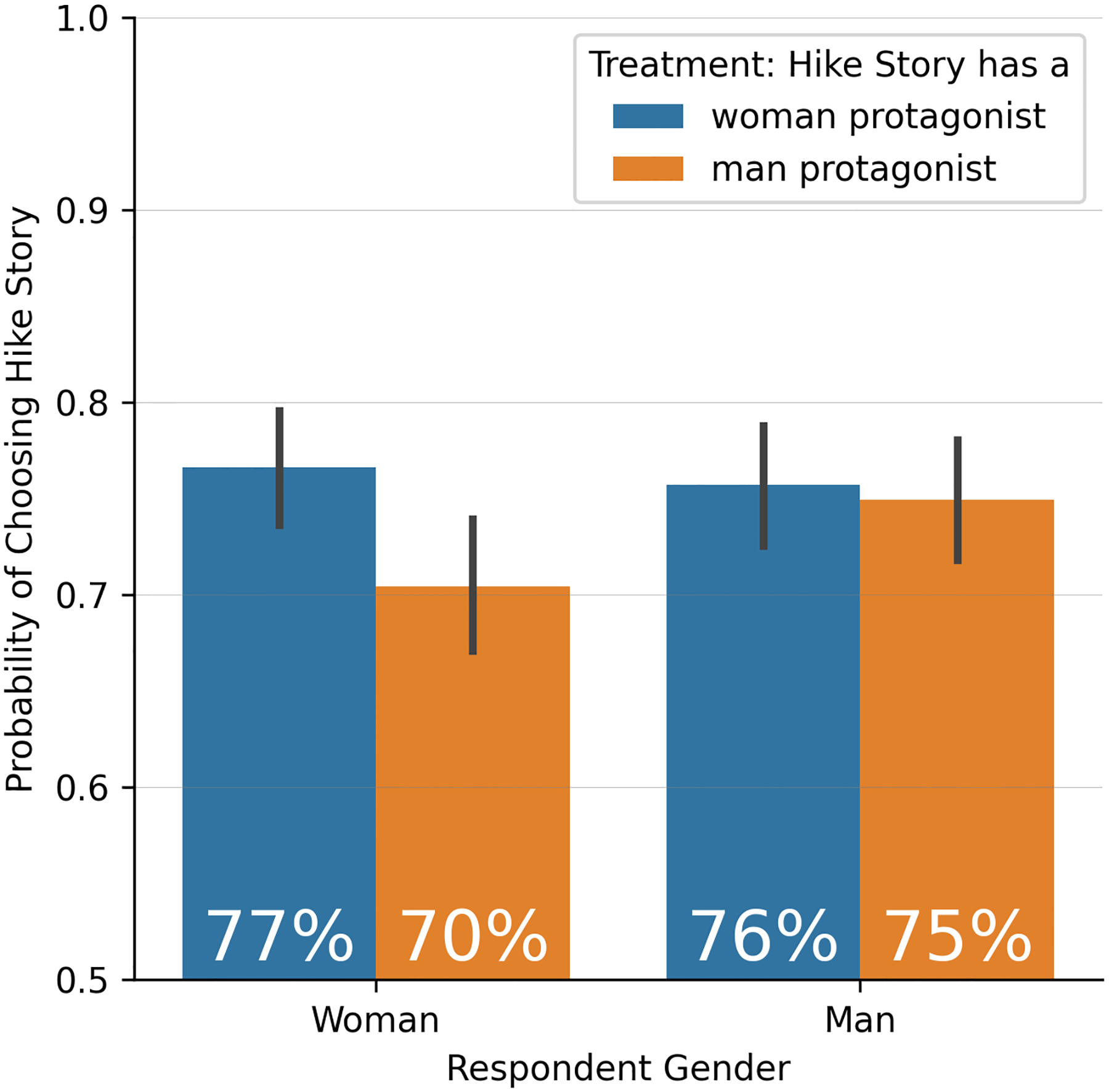 Figure 1
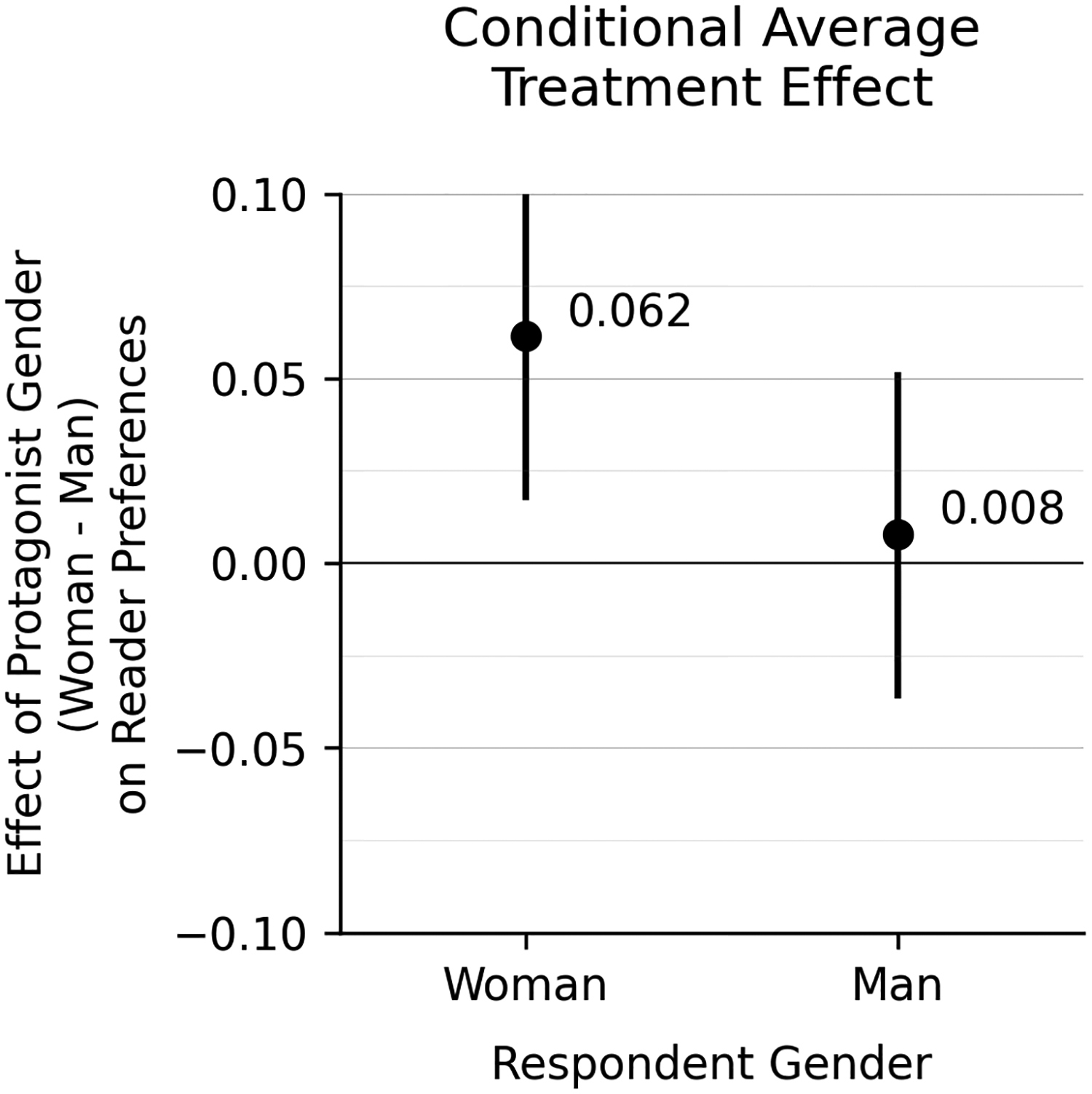 Figure 2
Peer Reviews
No public reviews on file for this paper yet. If you reviewed it on a platform where reviews are public (OpenReview, ICLR, NeurIPS, ICML), you can paste yours below so the community can read it here.
Videos
No videos yet. Explain this paper in a talk, walkthrough, or lecture? Add one.
Taxonomy
TopicsGender Studies in Language · Media, Gender, and Advertising · Names, Identity, and Discrimination Research
Introduction
1
Literary fiction was long dominated by men. From the early nineteenth century until very recently, most published novels were written by men [28]. Books by men devoted the majority of their narrative attention to male characters, while books by women were more equally balanced [15; 29]. These asymmetries produced a literary marketplace that supplied far more stories of men’s experiences than of women’s. Similar discrepancies have existed in book reviewing (mostly performed by men on books authored by men that told stories about men) and in the distribution of literary prizes [2; 17; 18; 20; 23; 27].
In recent years, the gender composition of published literature has shifted significantly. Women now make up the majority of published authors and women are more likely to read books—and to read them intensively—than are men [30]. These shifts have provoked anxiety among a subset of male authors and other commentators that literary fiction has become a “largely female pursuit,” with purportedly deleterious effects on boys’ academic achievement and on men’s civic engagement [1; 7; 8; 19].
Most analysis of gender and literary publishing has focused on the relatively strong gender assortment between authors and readers. But it is unclear why men are more likely to read books by men and women books by women [9; 24]. One potential causal mechanism is an assumed but understudied asymmetry between men and women as readers, namely that men prefer to read stories about men, while women are comparatively indifferent to the gender of the characters in the books they read. If this assumption is correct, it incentivizes a literary mix enriched in stories about men relative to the gender composition of readership, since any individual book could maximize its potential readership by centering male characters.
There is limited evidence that children prefer stories about characters who share their gender identity or other aspects of their social self-perception, even as children’s books (like their adult counterparts) remain enriched in stories about men and boys [12]. While [16] found no statistically significant differences in fourth-grade students’ reading behavior based on protagonists’ gender, both [3] and [4] find that adolescents and fifth-grade students prefer stories with protagonists of their own gender identity. [14] argues that, although boys and girls like men protagonists more overall, protagonist’s age is a more powerful variable in relation to story preference than is gender.
Existing research on character gender and adults’ reading preferences is scarce and limited. In an interview study of 29 men and 29 women, [26] finds that the majority of men prefer books with men protagonists, whereas the majority of women express no preference between men and women protagonists. On the other hand, [5] finds that, among 110 college students, both men and women prefer stories with men protagonists.
It is thus unclear whether and to what extent readers’ preferences are influenced by the ascribed gender of the characters they encounter. To address this commercially and socially important gap in knowledge, we address the existence, strength, and polarity of gender preferences among readers by measuring the causal effect of varying protagonist gender on readers’ desire to continue reading a short story.
Data and methods
2
In order to measure the average causal effect of character gender on reader preferences we employ a paired-choice vignette experiment with forced choice. Participants read two stories, one with a woman character and one with a man character, and are asked to choose which one they would continue reading. We randomize which story features the woman character to control for confounding effects due to participants’ preferences for specific narrative themes.
Our design is similar to a broad literature on vignette factorial surveys and conjoint experiments [11; 31], in which people choose between a pair of options with attributes (e.g., gender) that have been randomized. These designs capture human preferences that align with those observed in real-world decisions [10]. Our design is a particularly simple case: gender is randomly assigned across a pair of stories presented in random order. This design identifies the causal effect of protagonist gender among a pair of stories.
We recruit 3000 people currently residing in the United States from the crowd-sourcing platform Prolific. Using Prolific’s pre-screening feature, we select 1500 women and 1500 men. However, this pre-screening can be imprecise, as gender identity is self-reported and may change from the pre-screen values recorded in Qualtrics to the report the respondent provides in our survey. We operationalize gender as the respondent’s self-report within our survey. We exclude participants of other gender identities from our experiment due to the inability to collect a satisfactory quantity of reliable data about them using Prolific. Consequently, we remove 17 responses from participants who self-report other gender identities (8 in the women’s response collection and 9 in the men’s response collection). We obtain a total of 2983 responses (W = 1492, M = 1491).
Experimental design
2.1
After consenting to participate in the study, respondents are shown two stories, each about 500 words in length. Due to their length, the stories are displayed in succession over two different web pages. One story is about a hike, the other is about a coffee shop. One story, selected at random, features a woman character (as indicated by the pronouns “she” and “her”) and the other features a man character (“he”/”him”). We do not modify the names of the characters but instead assign names without strong gender associations to both stories: Sam for the protagonist of the hike story, and Alex for the protagonist of the coffee shop story. To control for confounding due to topic preferences and display order, we randomize both which story features the woman character and which story appears first. Respondents are then required to answer correctly four reading comprehension questions about the stories to continue the study. This ensures that the participant processed and understood the stories. After the comprehension check, respondents are asked to express their reading preference by choosing which story they would continue reading. Finally, participants respond to a few questions to collect demographic data. The full text of the stories and of the survey is available in Appendix A.
Outcomes
2.2
After reading the two assigned stories and completing the reading comprehension check, we ask respondents the following question: “Suppose you had both novels in your hand. Which one would you continue reading?” Participants have the option to answer “Novel A” or “Novel B,” and are required to supply an open-ended explanation of their choice (minimum length 200 characters).
Demographics
2.3
We collect the respondents’ self-reported age, gender, family income, country of origin, US zip code, and political orientation. For the complete text of these questions, see Appendix A. The demographic characteristics of our sample are typical of online samples: 66% are age 45 or younger, 51% describe themselves as liberal or very liberal compared with 22% conservative or very conservative, and 68% report incomes below $100,000 per year. While evidence from our online sample may not generalize to other populations, a countervailing strength of this sample is the high statistical power that comes from our ability to recruit many respondents online.
Causal identification
2.4
Let Yi indicate whether the respondent chose the hiking story. Let Ai = Woman versus Ai = Man indicate the gender of the protagonist in the hiking story that was randomly assigned to respondent i. Let and be potential outcomes indicating whether respondent i would choose the hike story if it was about a woman or a man, respectively. We observe when Ai = Woman and when Ai = Man. Because the treatment Ai is randomized, the expected potential outcome if assigned to a condition equals the expected observed outcome among those factually assigned to that condition, P(Y ^a^ = 1) = P(Y = 1 | A = a). We report the probability of choosing the hiking story if it is about a woman and if it is about a man, and the causal effect that is the difference of these two estimates. We estimate separately by respondent gender.
Results
3
Against the expectations of many publishing industry stakeholders, we do not find evidence that men readers have a preference for men characters. In our experiment, the effect of character gender among men participants is close to zero. Men participants show a 76% probability of choosing the hike story when it features the woman character and a 75% probability of choosing the hike story when it does not feature the woman character. Being randomly assigned to have a woman protagonist in the story thus increases men’s probability of choosing the story by 0.008 [CI −0.036, 0.051]. This result is not statistically distinguishable from zero.
Women participants show a slightly stronger preference for a story with a woman protagonist. We find a 77% probability of choosing the hike story when it features a woman character compared with a 70% probability when it does not feature the woman character. The estimated treatment effect for women is small but significantly positive, at 0.062 [CI 0.017, 0.106].
While participants show an overall preference for the hike story over the coffee story, this fact does not influence our results. Since participants were randomly assigned to reading the hike story with either the woman or man character, the preference for the hike story does not confound our estimation of the effect of character gender on reader preferences.
Discussion
4
The strong correlation between author and reader gender has often been attributed to the assumption that male readers prefer stories with male protagonists. To test the validity of this belief, our study randomly assigns protagonist gender across a pair of stories and estimates its effect on reader preferences. By isolating the causal effect of protagonist gender, we produce a surprising result: protagonist gender has almost no effect on reader preferences.
Contrary to previous qualitative or lower-powered studies [5; 26], we do not find evidence of a strong preference for either same-gender characters or for men characters by adult readers. Instead, we find a small but non-zero effect of character gender on reader preferences, such that readers (particularly women) show a slight preference for stories randomized to have a woman protagonist.
While our results are limited to this particular pair of stories, they are powerful because the stories are fixed and only the gender of the protagonist is randomized. By showing that having a woman protagonist does not reduce men’s inclination to read a story in this setting, we undermine the pervasive belief that men might be alienated from reading as the representation of women and girls as protagonists increases [1; 7; 8; 19]. Our results suggest that participants in the publishing ecosystem need not assume that writing about women will cost them their audience, and fiction editors should let go of their reservations about publishing books with woman protagonists.
Limitations and future work
5
Our results leave some unanswered questions, such as why men might read more stories by men, which predominantly feature men characters [9; 15; 29]. This might be the case, for example, if men and boys tend to read genres (e.g., mysteries) in which men and boys are over-represented as protagonists. Our results suggest that if an author in one of these genres replaced a man protagonist with a woman protagonist, then men might still read that book at the same rate. Genre is held constant in our study; future work that randomizes genre would be needed to understand how the genre of writing affects men’s and women’s reading habits.
Similarly, a second open question is why men and boys read less in general than women and girls. Our results are compatible with the hypothesis that men’s comparatively low rates of reading are caused not by character gender but by gendered expectations and socialization processes that discourage boys from reading at rates equal to girls [13; 21; 22; 33].
Future work could also investigate whether other features of literary texts, such as author gender or gender-conformity, may affect reader behaviors. Scientific work on these features is paramount: men reviewers and readers read more books by men than by women [2; 9; 25]. There is preliminary evidence that boys are more interested in reading about girl characters when those characters engage in activities usually ascribed to boys [6; 32]. No evidence is available regarding the effect of gender conformity in the case of adult readers.
In addition, future work could include readers of other gender identities. One of the limitations of this study is the exclusion of gender-nonconforming participants and characters from the study population due to the scarcity of available data on this group. These readers may exhibit different reading behaviors in relation to character gender than what we have observed in this study.
Lastly, this study utilized unpublished short stories created specifically for this experiment. Future research could explore whether reading preferences change in the case of excerpts from published fiction. However, using well-known texts in an experimental setting may be infeasible. If a participant were randomly assigned to read, for example, a modified passage from Harry Potter featuring Sally Potter, the participant would be able to guess the purpose of the study, potentially biasing their responses. Our use of unpublished short stories limits our external validity but aids strong internal validity by reducing participants’ suspicion about the study’s objectives.
While this study could not investigate all the possible interactions between gender and fiction readership, we hope that our findings will inspire researchers, readers, and authors to engage with the expanding universe of women characters. One need only think about the past to recognize that both men and women can connect with powerful women characters, from Celie in The Color Purple to Katniss Everdeen in The Hunger Games, from Circe in the eponymous book to June in The Handmaid’s Tale. Demonstrating that men want to read about women characters is only a first step toward a more robust and equitable publishing industry.
The reference list from the paper itself. Each links out to its DOI / PubMed record.
- 1Appleyard Bryan. “Elizabeth Strout warns of the dangers of women writers dominating fiction”. en. Oct. 2021. (Visited on 03/10/2025).
- 2Bamman David. “Attention in By the Book”. Aug. 2018.
- 3Beyard-Tyler Karen C. and Sullivan Howard J. “Adolescent Reading Preferences for Type of Theme and Sex of Character”. In: Reading Research Quarterly 16, no. 1 (1980). Publisher: [Wiley, International Reading Association], pp. 104–120. ISSN: 0034–0553. DOI: 10.2307/747350. (Visited on 06/04/2024). · doi ↗
- 4Bleakley Mary Ellen, Westerberg Virginia, and Hopkins Kenneth D. “The Effect of Character Sex on Story Interest and Comprehension in Children”. en. In: American Educational Research Journal 25, no. 1 (Jan. 1988). Publisher: American Educational Research Association, pp. 145–155. ISSN: 0002–8312. DOI: 10.3102/00028312025001145. URL: https://doi.org/10.3102/00028312025001145 (visited on 06/04/2024). · doi ↗
- 5Bortolussi Marisa, Dixon Peter, and Sopčák Paul. “Gender and reading”. en. In: Poetics 38, no. 3 (June 2010), pp. 299–318. ISSN: 0304422 X. DOI: 10.1016/j.poetic.2010.03.004. (Visited on 06/04/2024). · doi ↗
- 6Brooks David. “Opinion | The Gender Gap at School”. en-US. In: The New York Times (June 2006). ISSN: 0362–4331. (Visited on 06/05/2024).
- 7Croft Ethan. “Are young male novelists really an endangered species?” en. Apr. 2022. (Visited on 03/10/2025).
- 8Dazed. “Where have all the young male novelists gone?” en. Section: Life & Culture. Nov. 2021. (Visited on 03/10/2025).