Predictive Performance of Bayesian Methods to Forecast Vancomycin Concentration for Therapeutic Drug Monitoring in Critically Ill Pediatric Patients
Ha T. Pham, Cuc T. Nguyen, Tien T. N. Nguyen, Linh H. Hoang, Minh N. Tran, Thao P. Nguyen, Tuan N. Do, Ha T. H. Nguyen, Anh H. Nguyen, Phuc H. Phan, Dien M. Tran, Hoa D. Vu

TL;DR
This study compares Bayesian methods and a first-order pharmacokinetics approach to predict vancomycin levels in critically ill children, finding that a weighted-flattened Bayesian method performs best.
Contribution
The study introduces a weighted-flattened Bayesian algorithm that improves prediction accuracy for vancomycin concentrations in pediatric patients.
Findings
The weighted-flattened Bayesian algorithm reduced relative bias by 12.66% compared to the conventional Bayesian model.
Using one or two blood concentration measurements in Bayesian forecasting yielded similar prediction accuracy.
The first-order PK method had lower bias than conventional Bayesian algorithms but higher than the weighted-flattened approach.
Abstract
Background: This study aimed to evaluate different Bayesian algorithms and the first-order pharmacokinetics (PK) equation approach for forecasting vancomycin concentrations in critically ill pediatric patients and to identify influencing factors. Methods: A cohort of 110 patients with 568 therapeutic drug monitoring (TDM) blood samples was included. Three Bayesian algorithms, i.e., conventional, flattened, and weighted-flattened, using one or two historical values of either blood concentrations measured at the peak, trough, or middle (mid) of the dosing interval, were applied to forecast the concentrations of the next TDM occasion. The first-order PK approach, according to the Sawchuk–Zaske method, was used with two levels. The forecasting performance was assessed via relative bias (rBias) and relative root mean squared error (rRMSE) between the forecasted and observed levels. A…
Genes, proteins, chemicals, diseases, species, mutations and cell lines named across the full text — each resolved to its canonical identifier and authoritative record.
Click any figure to enlarge with its caption.
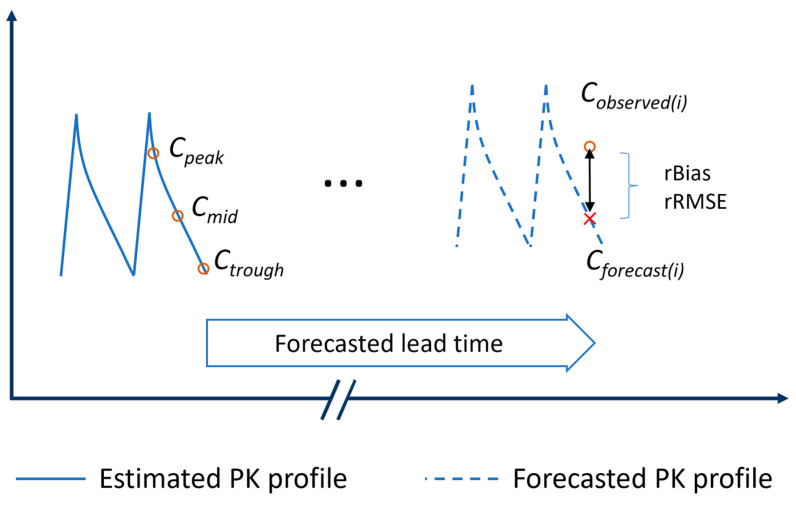 Figure 1
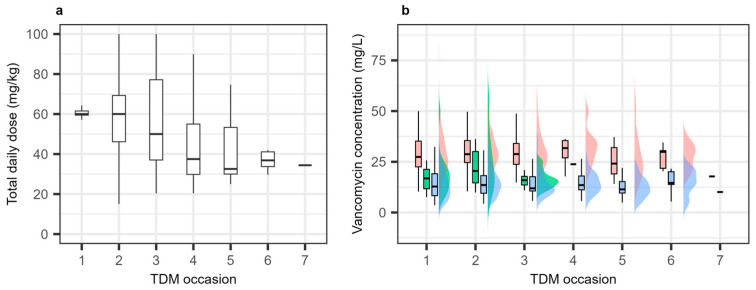 Figure 2
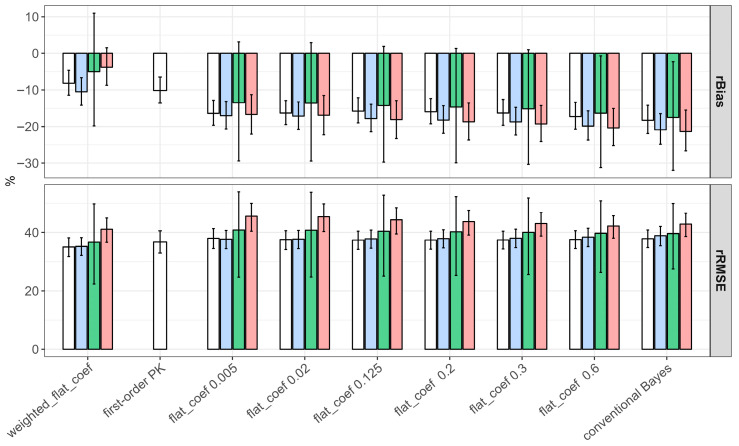 Figure 3
Peer Reviews
No public reviews on file for this paper yet. If you reviewed it on a platform where reviews are public (OpenReview, ICLR, NeurIPS, ICML), you can paste yours below so the community can read it here.
Videos
No videos yet. Explain this paper in a talk, walkthrough, or lecture? Add one.
Taxonomy
TopicsAntibiotics Pharmacokinetics and Efficacy · Antimicrobial Resistance in Staphylococcus · Sepsis Diagnosis and Treatment