Assessing High-Intensity Acceleration Efforts Using Local Positioning System—Introducing the Concept of the Relative Acceleration Threshold to Ice Hockey
Christian Bielmann, Karin Fischer-Sonderegger, Quirin Söhnlein, Wolfgang Taube, Markus Tschopp

TL;DR
This paper introduces a new method to assess high-intensity acceleration efforts in ice hockey by adjusting for initial skating speed, leading to more accurate evaluations.
Contribution
The novel contribution is the introduction of the relative acceleration threshold (relthreshold) to account for initial skating speed in assessing acceleration efforts.
Findings
The fixthreshold_2 method reported significantly more accefforts than the relthreshold_75% method.
Only one-third of accefforts identified by fixthreshold_2 exceeded the neuromuscularly intense threshold defined by relthreshold_75%.
The relthreshold_75% method assessed a notable percentage of accefforts at high skating speeds where fixthreshold_2 failed.
Abstract
Current methods for assessing acceleration efforts (accefforts) in ice hockey do not account for the influence of initial skating speed on maximal voluntary acceleration capacity, which may lead to a biased evaluation of acceffort intensity. In this study, we introduce the conceptual approach of the relative acceleration threshold (relthreshold) to ice hockey and outline its potential benefits for the assessment of accefforts. Locomotion data derived from observations of 17 players across 10 official games were used to model the initial-skating-speed-dependent maximal voluntary acceleration capacity (amax–vinit capacity), from which a team-specific relthreshold was determined (relthreshold_75% = 3.23 − 0.365vinit), and, subsequently, applied to assess accefforts alongside a fix threshold set at 2 m·s−2 (fixthreshold_2). Differences in accefforts depended on the method used…
Genes, proteins, chemicals, diseases, species, mutations and cell lines named across the full text — each resolved to its canonical identifier and authoritative record.
Click any figure to enlarge with its caption.
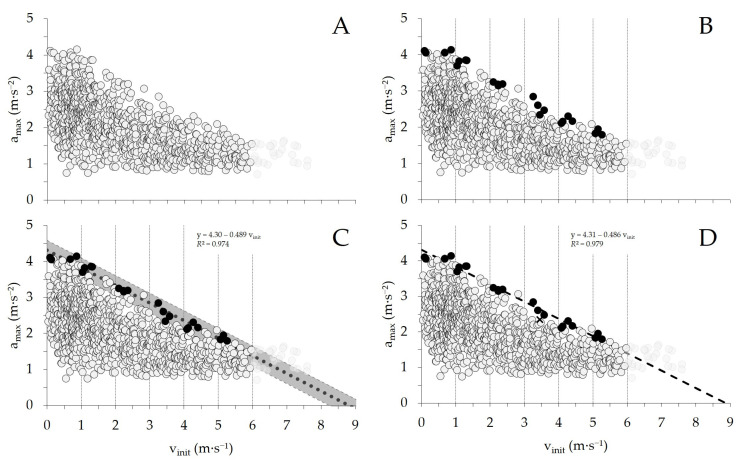 Figure 1
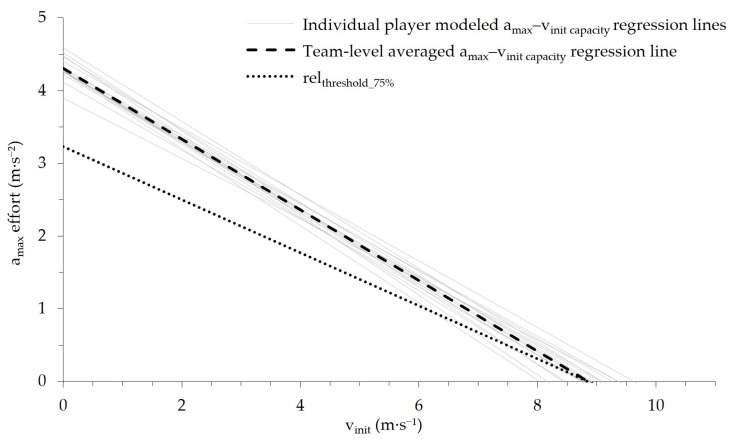 Figure 2
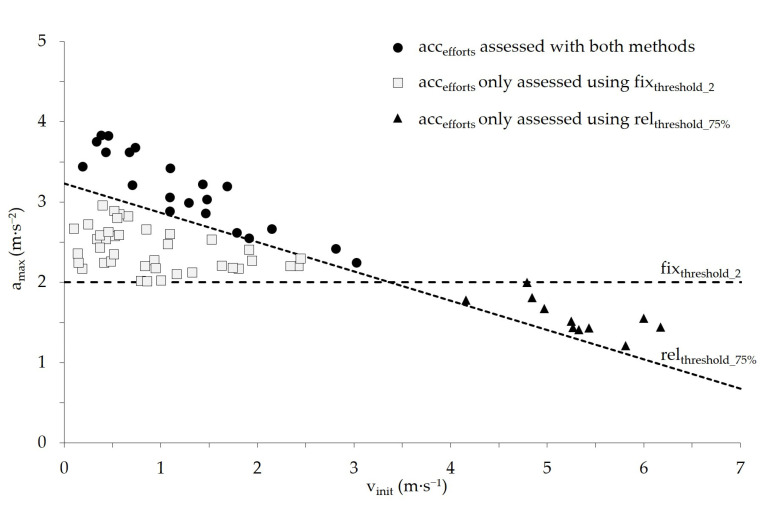 Figure 3
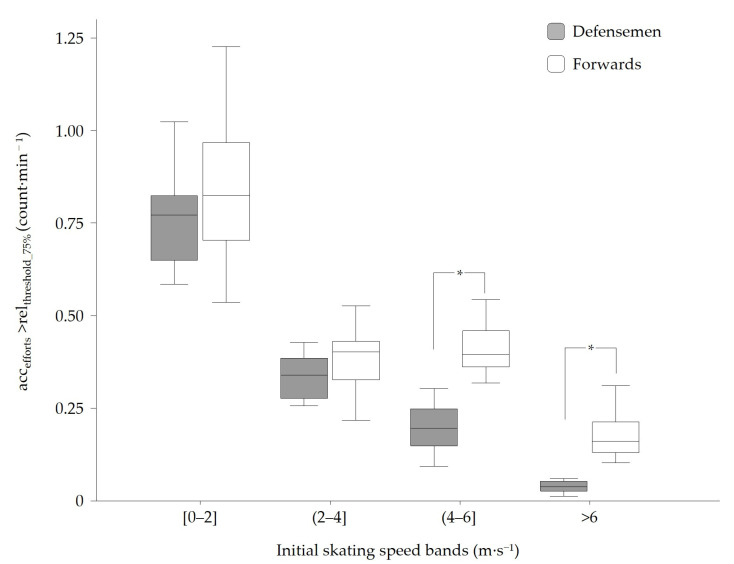 Figure 4
Peer Reviews
No public reviews on file for this paper yet. If you reviewed it on a platform where reviews are public (OpenReview, ICLR, NeurIPS, ICML), you can paste yours below so the community can read it here.
Videos
No videos yet. Explain this paper in a talk, walkthrough, or lecture? Add one.
Taxonomy
TopicsSport Psychology and Performance · Sports Performance and Training · Motor Control and Adaptation