Deep Learning for Freezing of Gait Detection: Cross-Dataset Validation Reveals Critical Deployment Gaps Between Laboratory and Daily Living Wearable Monitoring
Wei Lin, Sanjeet S. Grewal

TL;DR
This study shows that algorithms for detecting freezing of gait in Parkinson's patients work well in labs but fail in real-world settings, highlighting a major gap in wearable monitoring systems.
Contribution
The study introduces a framework for evaluating real-world deployment readiness of FoG detection systems and identifies a critical performance gap between lab and daily living settings.
Findings
Cross-dataset validation revealed an 83% performance gap between laboratory and daily living FoG detection.
F1-based early stopping outperformed AUC-based stopping by 47% in handling class imbalance.
Combining multiple imbalance corrections paradoxically degraded precision to 33% due to over-weighting the minority class.
Abstract
Freezing of gait (FoG) affects 38–65% of advanced Parkinson’s disease patients, yet automated detection algorithms are often validated solely on laboratory datasets. This study quantifies the critical performance gap between laboratory and real-world performance—a prerequisite for clinical deployment. Using temporal convolutional networks (TCNs), we trained models on two public datasets representing ecological extremes: a daily living dataset (Figshare; n = 35, single-sensor) and a laboratory dataset (DAPHNET; n = 10, multi-sensor). We compared five training configurations to address class imbalance. Results showed that F1-based early stopping outperformed Area Under the Curve (AUC)-based stopping by 47% (F1: 0.55 vs. 0.37, p = 0.0008). Combining multiple imbalance corrections (focal loss, weighting, sampling) paradoxically degraded precision to 33% due to a ~60-fold over-weighting of…
Genes, proteins, chemicals, diseases, species, mutations and cell lines named across the full text — each resolved to its canonical identifier and authoritative record.
Click any figure to enlarge with its caption.
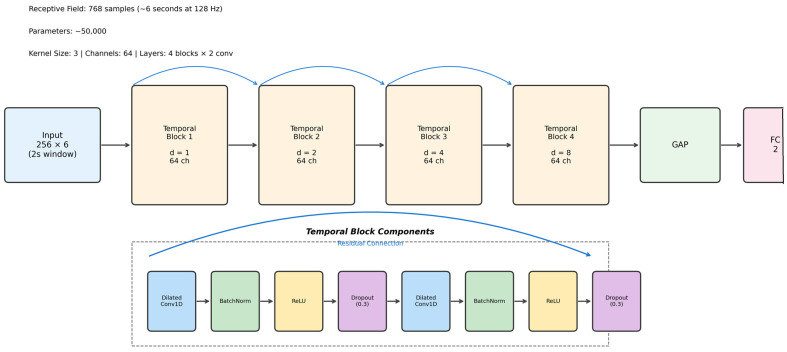 Figure 1
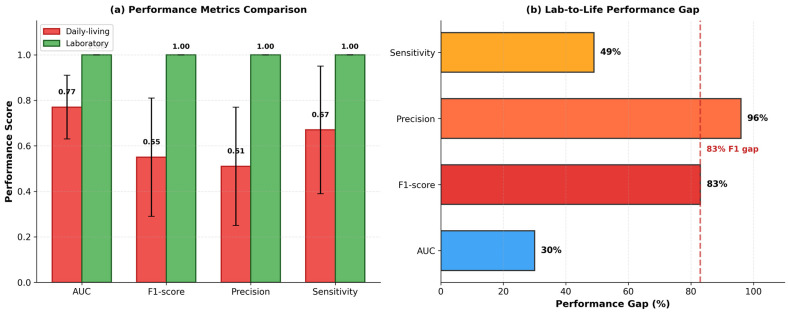 Figure 2
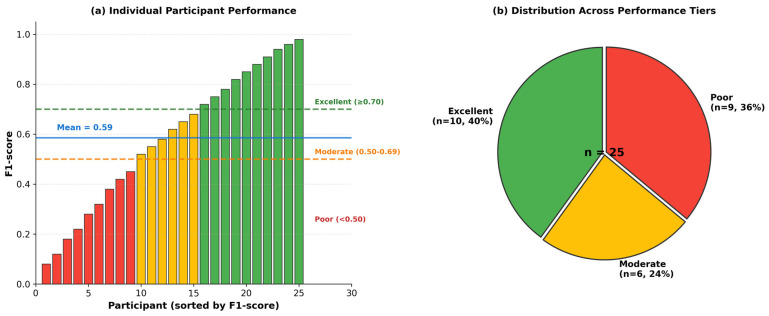 Figure 3
Peer Reviews
No public reviews on file for this paper yet. If you reviewed it on a platform where reviews are public (OpenReview, ICLR, NeurIPS, ICML), you can paste yours below so the community can read it here.
Videos
No videos yet. Explain this paper in a talk, walkthrough, or lecture? Add one.
Taxonomy
TopicsBalance, Gait, and Falls Prevention · Context-Aware Activity Recognition Systems · Gait Recognition and Analysis