Improving Individual-Specific SSVEP-BCI with Adaptive Channel and Subspace Selection in TRCA
Hui Li, Guanghua Xu, Shanzheng Feng, Chenghang Du, Chengcheng Han, Jiachen Kuang, Sicong Zhang

TL;DR
This paper introduces AS-TRCA, a new method for SSVEP-based BCIs that improves performance by using individual-specific channels and subspaces.
Contribution
AS-TRCA introduces adaptive selection of subject-specific channels and subspaces for SSVEP-BCI, enhancing decoding accuracy.
Findings
AS-TRCA outperformed traditional methods by improving average accuracy by up to 7.70%.
Combining AS-TRCA with advanced decoding methods further enhanced their performance.
AS-TRCA adaptively determines the optimal number of task-related subspaces for each subject.
Abstract
The individual-specific steady-state visual evoked potential (SSVEP)-based brain–computer interface (BCI) is characterized by individual calibration data, resulting in satisfactory performance. However, existing individual-specific SSVEP-BCIs employ generalized channels and task-related subspaces, which seriously limit their potential advantages and lead to suboptimal solutions. In this study, AS-TRCA was proposed to develop a purely individual-specific SSVEP-BCI by fully exploiting individual-specific knowledge. AS-TRCA involves optimal channel learning and selection (OCLS) as well as optimal subspace selection (OSS). OCLS aims to pick the optimal subject-specific channels by employing sparse learning with spatial distance constraints. Meanwhile, OSS adaptively determines the appropriate number of optimal subject-specific task-related subspaces by maximizing profile likelihood. The…
Genes, proteins, chemicals, diseases, species, mutations and cell lines named across the full text — each resolved to its canonical identifier and authoritative record.
Click any figure to enlarge with its caption.
 Figure 1
 Figure 2
 Figure 3
 Figure 4
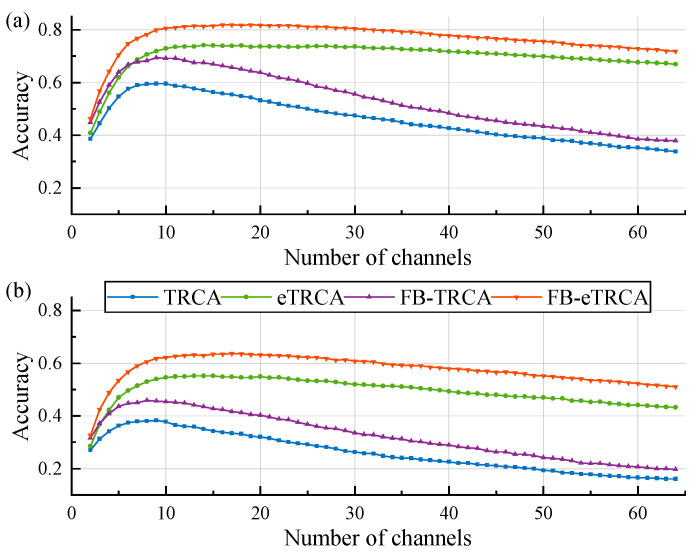 Figure 5
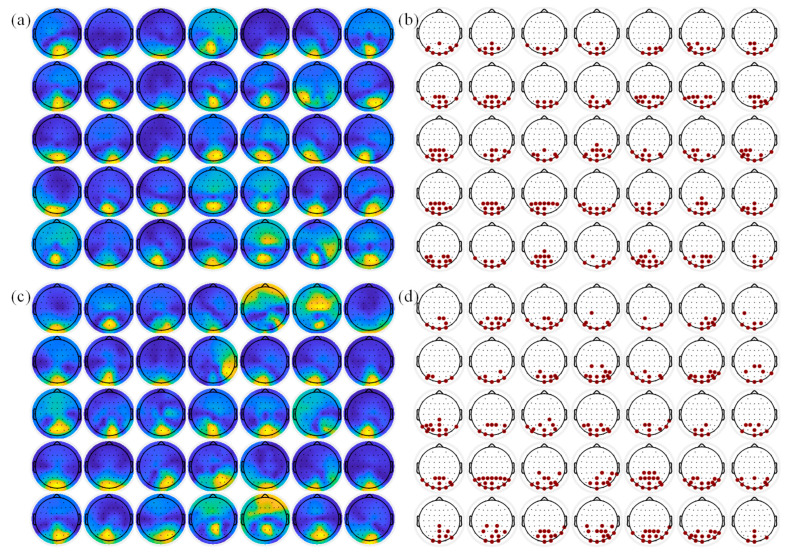 Figure 6
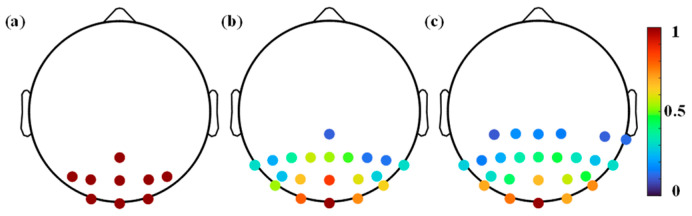 Figure 7
Peer Reviews
No public reviews on file for this paper yet. If you reviewed it on a platform where reviews are public (OpenReview, ICLR, NeurIPS, ICML), you can paste yours below so the community can read it here.
Videos
No videos yet. Explain this paper in a talk, walkthrough, or lecture? Add one.
Taxonomy
TopicsEEG and Brain-Computer Interfaces · Functional Brain Connectivity Studies · Gaze Tracking and Assistive Technology