Multifunctional Roles of Extrafloral Nectaries in Shaping Plant–Insect Interactions
Eduardo Soares Calixto, Renan Fernandes Moura, Denise Lange, Estevao Alves Silva, Helena Maura Torezan-Silingardi, Kleber Del-Claro

TL;DR
Extrafloral nectaries help plants interact with ants in complex ways, balancing protection and distraction depending on context.
Contribution
The paper introduces a nuanced framework for understanding EFNs as multifunctional structures with context-dependent roles.
Findings
EFNs can serve both protective and distracting roles depending on their location and ant behavior.
The ecological functions of EFNs shift in space and time based on plant traits and interacting species.
A continuum-based perspective is proposed to better understand EFN evolution and plant-insect interactions.
Abstract
Understanding the net outcomes of ecological interactions by examining the costs and benefits of organism associations is central to ecology. The mutualistic relationship between ants and plants mediated by extrafloral nectaries (EFNs) has long been viewed as protective, with ants defending plants from herbivores in exchange for nectar. However, alternative hypotheses, like the ant-distraction and flower-distraction, highlight the multifunctionality of EFNs. The flower-distraction hypothesis proposes that EFNs evolved to divert ants from flowers, reducing ant impact on pollination. Recent studies reveal that EFN interactions with ants are highly context-dependent, shaped by factors such as EFN location and ant behavior. Although EFNs often occur on vegetative tissues, they are sometimes located near flowers, raising the possibility that they serve both protective and distracting roles.…
Genes, proteins, chemicals, diseases, species, mutations and cell lines named across the full text — each resolved to its canonical identifier and authoritative record.
Click any figure to enlarge with its caption.
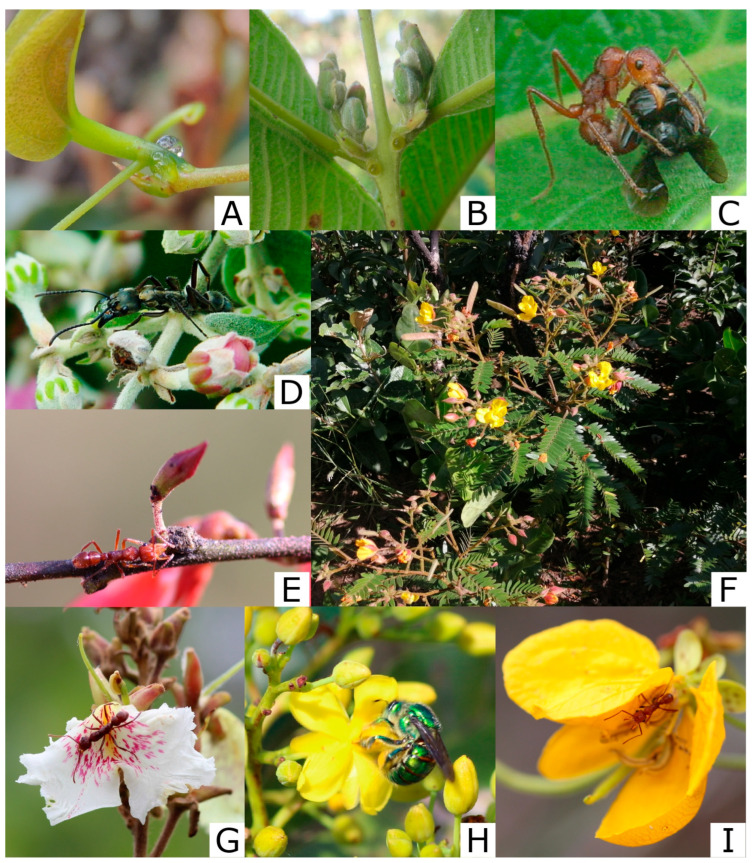 Figure 1
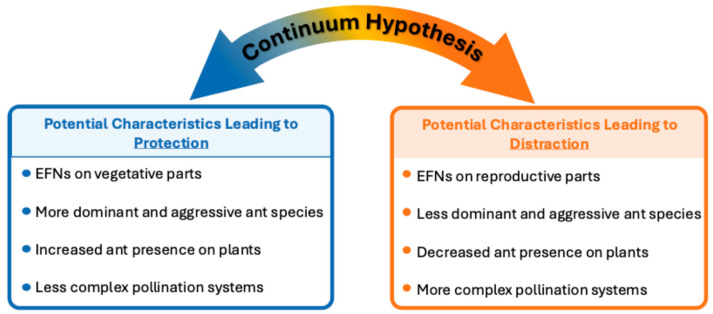 Figure 2
Peer Reviews
No public reviews on file for this paper yet. If you reviewed it on a platform where reviews are public (OpenReview, ICLR, NeurIPS, ICML), you can paste yours below so the community can read it here.
Videos
No videos yet. Explain this paper in a talk, walkthrough, or lecture? Add one.
Taxonomy
TopicsInsect and Arachnid Ecology and Behavior · Plant and animal studies · Plant and Biological Electrophysiology Studies