Development and validation of cardiorespiratory fitness prediction equations from 6-minute walk test: the Coronary Artery Risk Development in Adults (CARDIA) study
Bjoern Hornikel, Erin E Dooley, Christopher Barrett Bowling, Baojiang Chen, Pablo Martinez-Amezcua, David R Jacobs, Mercedes Carnethon, Barbara Sternfeld, Cora E Lewis, Stephen Sidney, Priya Palta, Kelley P Gabriel

TL;DR
Researchers developed new equations to estimate cardiorespiratory fitness using a 6-minute walk test, which is easier to perform than traditional methods.
Contribution
The study introduces sex-specific prediction equations for VO2max and GXTd from 6MWT data, improving accuracy over existing models.
Findings
The CARDIA equations explained 53% and 57% of VO2max variance in men and women, respectively.
Compared to existing equations, CARDIA models showed stronger correlations and less bias.
Abstract
Assessing maximal oxygen consumption (VO2max), the gold standard for assessing cardiorespiratory fitness, is often impractical in large-scale studies. We derived sex-specific VO2 max and graded exercise test duration (GXTd) prediction equations from 6-minute walk test (6MWT) performance. Data were from 564 Coronary Artery Risk Development in Young Adults (CARDIA) participants (mean age: 61.5 years; 58% women; 40% Black) who completed the 6MWT and symptom-limited modified Balke treadmill graded exercise test at the Year 35 (2021-2022) follow-up exam. Sex-stratified samples were randomly split (2/3 for training, 1/3 for testing) to derive and evaluate prediction equations. Stepwise linear regression identified predictors of VO2max and GXTd from 6MWT distance. Sex-specific VO2max CARDIA equations were compared with Burr and FRIEND equations. Models’ accuracies were evaluated by comparing…
Genes, proteins, chemicals, diseases, species, mutations and cell lines named across the full text — each resolved to its canonical identifier and authoritative record.
Click any figure to enlarge with its caption.
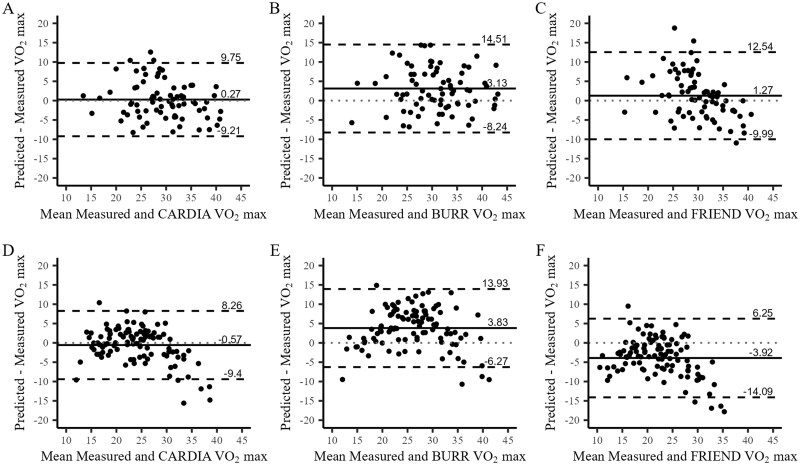 Figure 1
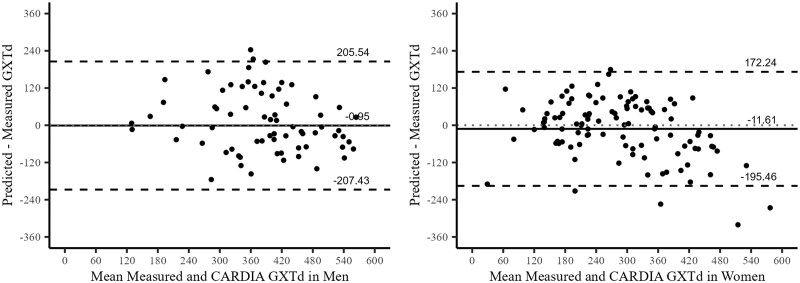 Figure 2
Peer Reviews
No public reviews on file for this paper yet. If you reviewed it on a platform where reviews are public (OpenReview, ICLR, NeurIPS, ICML), you can paste yours below so the community can read it here.
Videos
No videos yet. Explain this paper in a talk, walkthrough, or lecture? Add one.
Taxonomy
TopicsCardiovascular and exercise physiology · Cardiovascular Effects of Exercise · Cardiovascular Function and Risk Factors