Pairwise Comparison of Effects of Linear vs. Change of Direction Short Bout Sprint Intervals on Physical Performance of Youth Male Soccer Players
Peter Sagat

TL;DR
This study compares the effects of sprint interval training with and without change of direction on physical performance in young male soccer players over 12 weeks.
Contribution
The study provides empirical evidence that change of direction sprint intervals improve physical performance more effectively than linear sprint intervals in youth soccer players.
Findings
The RS–CoD group showed greater improvements in agility (93639 test) compared to RS–LiN and SOC groups.
RS–CoD led to larger gains in explosive power (SJ and CMJ) and sprint performance (5 m and 20 m) than other groups.
Change of direction sprint intervals were found to be more effective training stimuli for youth soccer players.
Abstract
Our study aimed to examine and compare the effects of 12-week repeated sprint intervals with change of direction and linear sprint intervals on physical performance in young soccer players. In this randomized, parallel three-group study, we included 60 male soccer players assigned to (i) a sprint interval with change of direction group (RS–CoD; n = 20); (ii) a linear sprint interval group (RS–LiN; n = 20); and (iii) a soccer group (SOC; n = 20). Physical performance included explosive power (countermovement jump [CMJ] and squat jump [SJ]), agility (T505, 93,639, 20Y), speed (sprints over 5 m, 10 m and 20 m), anaerobic capacity (the Running-Based Anaerobic Sprint Test [RAST]) and maximal oxygen uptake (VO2max). Over the 12 weeks, the RS–CoD group displayed significantly beneficial effects in the 93639 test (effect size [ES] = 0.42), compared to the RS–LiN (ES = 0.18) and SOC (ES = 0.12)…
Genes, proteins, chemicals, diseases, species, mutations and cell lines named across the full text — each resolved to its canonical identifier and authoritative record.
Click any figure to enlarge with its caption.
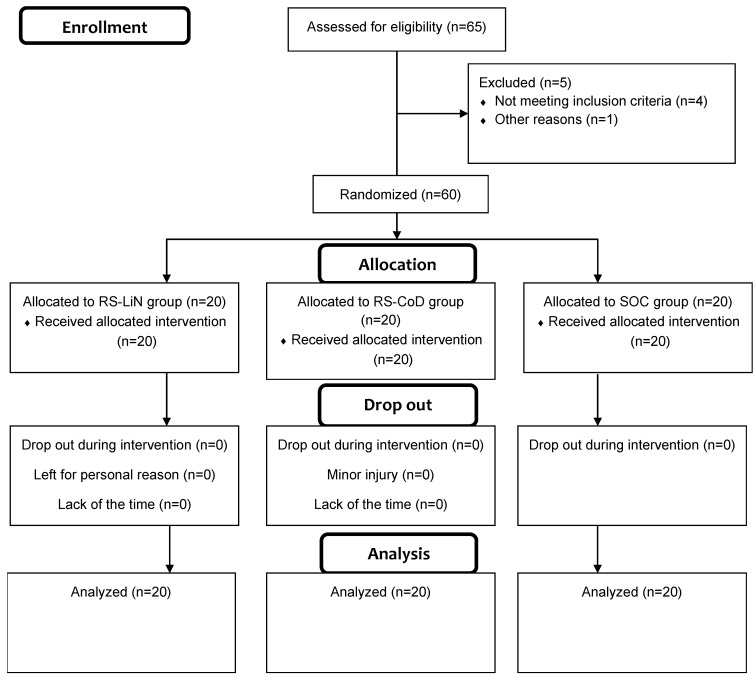 Figure 1
Peer Reviews
No public reviews on file for this paper yet. If you reviewed it on a platform where reviews are public (OpenReview, ICLR, NeurIPS, ICML), you can paste yours below so the community can read it here.
Videos
No videos yet. Explain this paper in a talk, walkthrough, or lecture? Add one.
Taxonomy
TopicsSports Performance and Training · Cardiovascular and exercise physiology · Genetics and Physical Performance