Preliminary Screening for Ophidiomyces ophidiicola in Pet Snakes from Italy and Exploratory Evaluation of Droplet Digital PCR Assay
Matteo Riccardo Di Nicola, Simona Sciuto, Daniele Marini, Luca Colla, Giacomo Vanzo, Gabriele Carsana, Emanuele Scanarini, Luana Dell’Atti, Giulia Milanese, Martina Alessandra Gini, Maria Claudia Palazzolo, Jean-Lou C. M. Dorne, Maria Goria, Silvia Colussi, Pier Luigi Acutis

TL;DR
This study tested pet snakes in Italy for a fungal disease and evaluated a new PCR method for detecting low levels of the pathogen.
Contribution
The study introduces an exploratory evaluation of ddPCR for low-template diagnostics of Ophidiomyces ophidiicola in pet snakes.
Findings
No Ophidiomyces ophidiicola was detected in 97 pet snakes from 31 species across Italy.
Both PCR methods showed consistent amplification up to a 1:1000 dilution.
ddPCR detected positive partitions at higher dilutions (up to 1:8000) compared to real-time PCR.
Abstract
Ophidiomyces ophidiicola, the agent of ophidiomycosis, has recently been reported in wild snakes in Italy, but the status of captive populations remains unknown. We carried out an opportunistic survey of pet snakes from private collections and, in parallel, performed an exploratory evaluation of a droplet digital PCR (ddPCR) assay adapted from an established probe-based real-time PCR. Non-invasive skin swabs were collected by 32 private owners from 97 snakes, representing 31 species across ten Italian regions. All swabs tested negative for O. ophidiicola by both methods, including samples from four snakes that showed cutaneous lesions at the time of sampling. Both assays yielded consistent amplification up to the 1:1000 dilution (ddPCR 0.38 to 0.94 copies/µL for the culture-derived control and 0.24 to 0.33 copies/µL for the field-derived control at 1:1000), while ddPCR retained positive…
Genes, proteins, chemicals, diseases, species, mutations and cell lines named across the full text — each resolved to its canonical identifier and authoritative record.
Click any figure to enlarge with its caption.
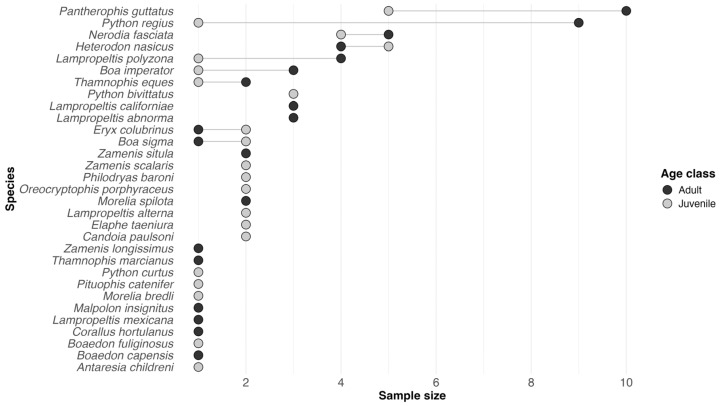 Figure 1
Peer Reviews
No public reviews on file for this paper yet. If you reviewed it on a platform where reviews are public (OpenReview, ICLR, NeurIPS, ICML), you can paste yours below so the community can read it here.
Videos
No videos yet. Explain this paper in a talk, walkthrough, or lecture? Add one.
Taxonomy
TopicsTurtle Biology and Conservation · Amphibian and Reptile Biology · Nail Diseases and Treatments