Sperm DNA Fragmentation Is Associated with Impaired Directional Motility and Kinematic Efficiency: A CASA-Based Study
Ioana Cristina Rotar, Richard Buda, Adelin Marcu, Petronela Naghi, Liliana Sachelarie, David Călin Buzlea, Anca Huniadi, Mircea Ioan Sandor

TL;DR
Higher sperm DNA fragmentation is linked to worse sperm movement efficiency and direction, not just overall motility, according to a study using computer-assisted analysis.
Contribution
The study reveals that sperm DNA fragmentation specifically affects directional motility and kinematic efficiency, not just general motility.
Findings
Sperm DNA fragmentation is associated with reduced straight-line velocity, linearity, and straightness.
Fragmentation is an independent predictor of impaired movement efficiency after adjusting for traditional semen parameters.
Curvilinear and average path velocities are less affected by DNA fragmentation compared to directional metrics.
Abstract
Background and Objectives: Sperm DNA fragmentation (SDF) has emerged as an important marker of male reproductive potential; however, its relationship with sperm kinematic performance remains incompletely understood. While conventional semen analysis primarily evaluates sperm concentration and motility, computer-assisted semen analysis (CASA) enables a more detailed assessment of sperm motility parameters, including velocity, path length, and directionality. Materials and Methods: This observational study included 183 semen samples, stratified by SDF levels into control (1–15%), mild (15.01–25%), moderate (25.01–50%), and severe (>50%) fragmentation groups. Sperm kinematic parameters were assessed using CASA, including curvilinear velocity (VCL), straight-line velocity (VSL), average path velocity (VAP), linearity (LIN), straightness (STR), and wobble (WOB). Group comparisons were…
Genes, proteins, chemicals, diseases, species, mutations and cell lines named across the full text — each resolved to its canonical identifier and authoritative record.
Click any figure to enlarge with its caption.
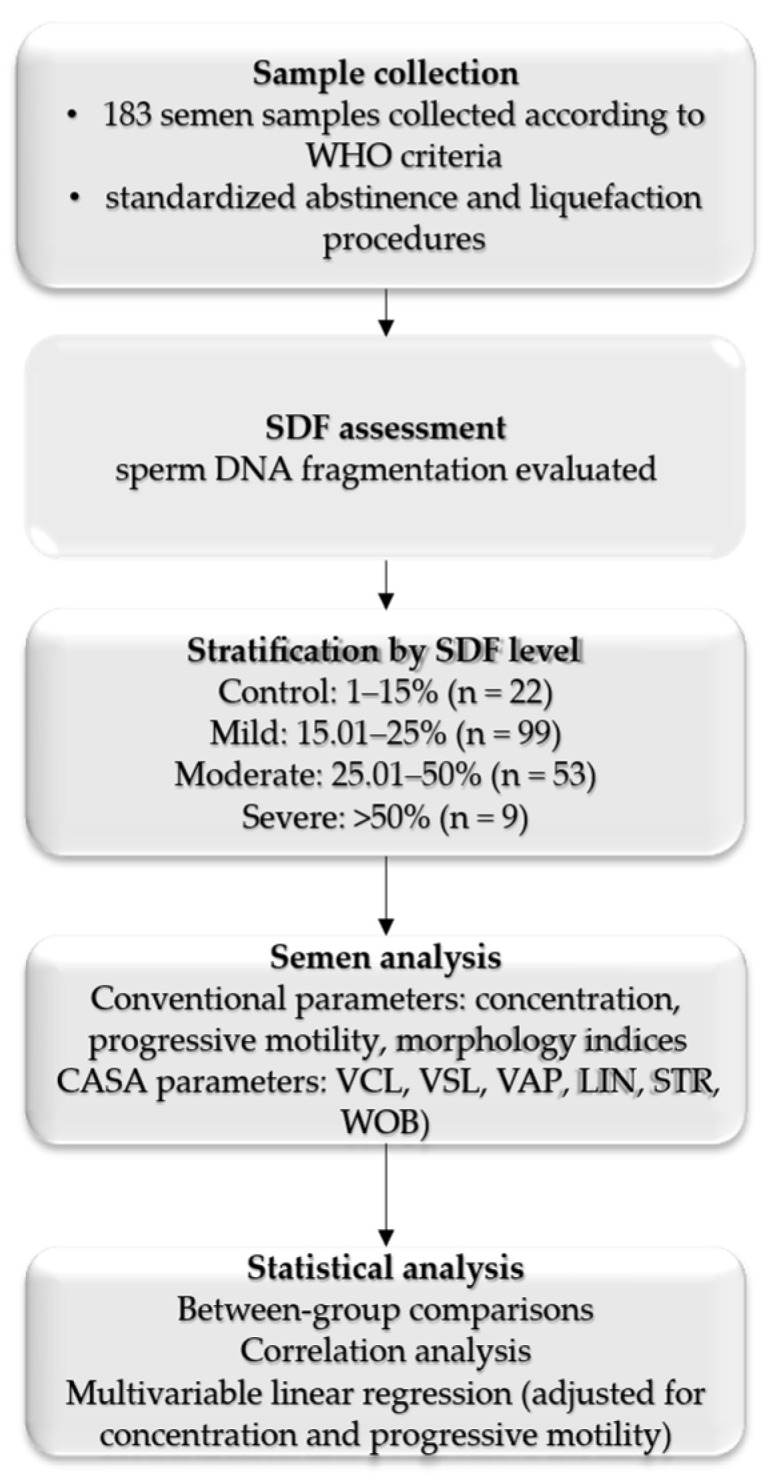 Figure 1
Peer Reviews
No public reviews on file for this paper yet. If you reviewed it on a platform where reviews are public (OpenReview, ICLR, NeurIPS, ICML), you can paste yours below so the community can read it here.
Videos
No videos yet. Explain this paper in a talk, walkthrough, or lecture? Add one.
Taxonomy
TopicsSperm and Testicular Function · Reproductive biology and impacts on aquatic species · Plant Reproductive Biology