Comparative Evaluation of [68Ga]Ga-DOTA.SA.FAPi and [18F]FDG PET/CT in Metastatic Breast and Lung Cancer: Semiquantitative, Volumetric and Prognostic Assessment
Sulochana Sarswat, Sanjana Ballal, Madhav Prasad Yadav, Madhavi Tripathi, Prabhat Singh Malik, Sandeep R. Mathur, Frank Rösch, Chandrasekhar Bal

TL;DR
This study compares two PET/CT imaging methods for detecting metastases in breast and lung cancer and finds that [68Ga]Ga-DOTA.SA.FAPi offers better detection of brain metastases and prognostic insights.
Contribution
The study introduces the comparative diagnostic and prognostic value of [68Ga]Ga-DOTA.SA.FAPi PET/CT in metastatic breast and lung cancers.
Findings
[68Ga]Ga-DOTA.SA.FAPi PET/CT detected more brain metastases than [18F]FDG PET/CT in both breast and lung cancer patients.
FAPi-derived volumetric parameters showed strong inverse correlations with progression-free survival in breast cancer.
In lung adenocarcinoma, FAPi PET/CT provided low background uptake and stromal metrics with modest but significant prognostic value.
Abstract
Objective: To compare metastatic lesion detection on [68Ga]Ga-DOTA.SA.FAPi and [18F]FDG PET/CT in metastatic breast and lung cancers and to assess the relationship between PET-derived imaging parameters and progression-free survival (PFS). Methods: In this prospective dual-cohort study, 45 patients (23 breast cancer, 22 lung adenocarcinoma) underwent paired [68Ga]Ga-DOTA.SA.FAPi and [18F]FDG PET/CT within four weeks. Semiquantitative (SUVmax, SUVmean) and volumetric (MTV, TLG, STV, TLF) PET parameters were measured. Metastatic detection was compared, and correlations with PFS were assessed. Results: In breast cancer, [18F]FDG demonstrated higher primary tumor uptake, whereas [68Ga]Ga-DOTA.SA.FAPi showed lower background activity, resulting in higher tumor-to-background ratios for brain and bone metastases. Whole-body volumetric indices (wbTLG, wbTLF) showed strong inverse correlations…
Genes, proteins, chemicals, diseases, species, mutations and cell lines named across the full text — each resolved to its canonical identifier and authoritative record.
Click any figure to enlarge with its caption.
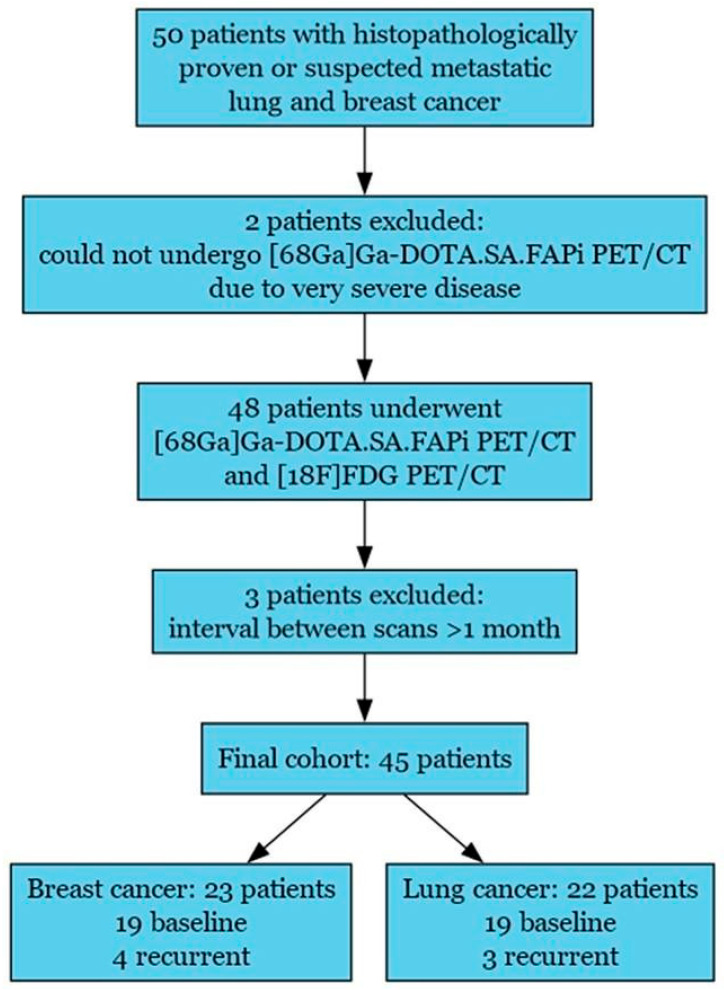 Figure 1
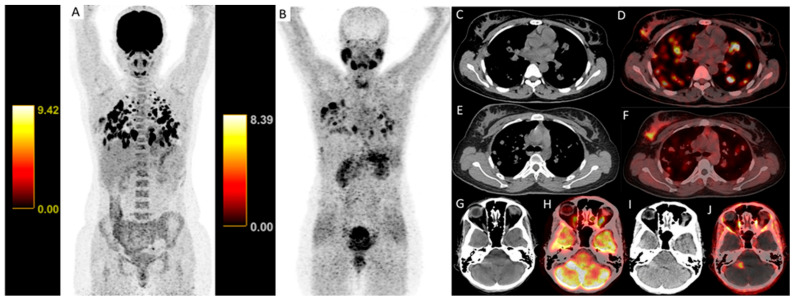 Figure 2
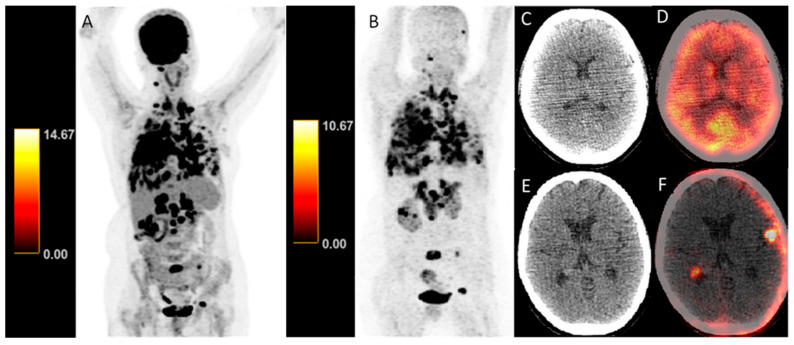 Figure 3
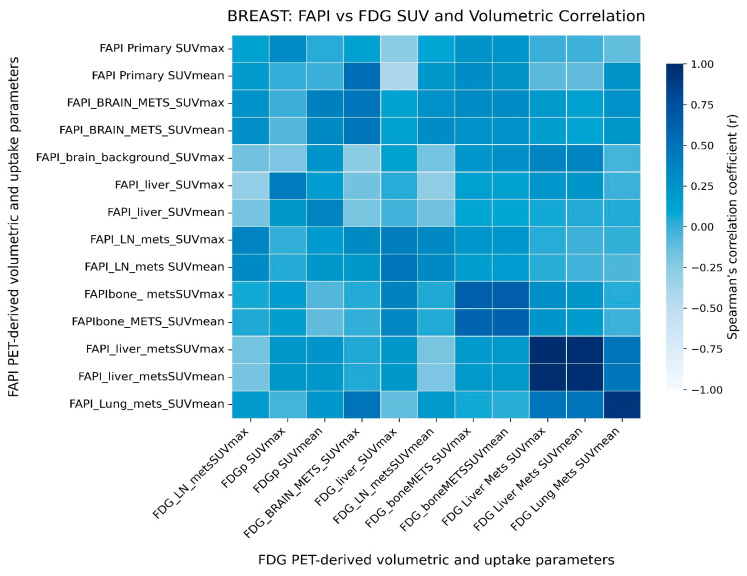 Figure 4
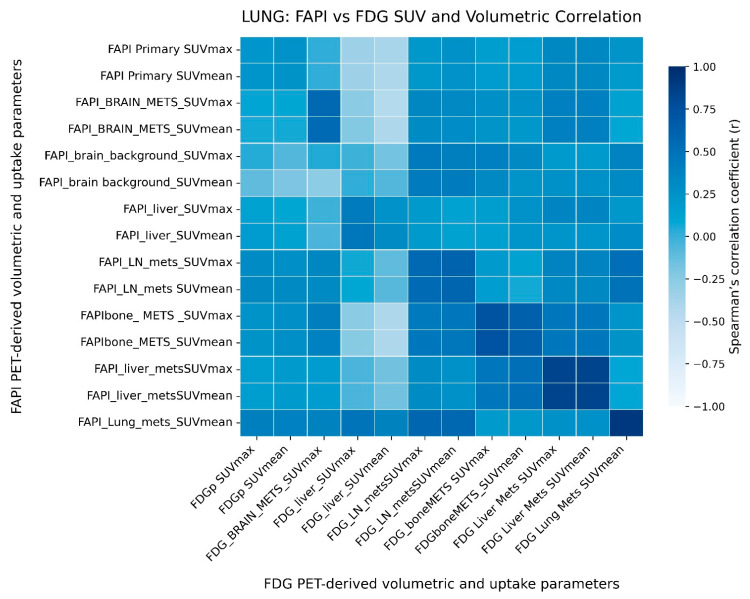 Figure 5
Peer Reviews
No public reviews on file for this paper yet. If you reviewed it on a platform where reviews are public (OpenReview, ICLR, NeurIPS, ICML), you can paste yours below so the community can read it here.
Videos
No videos yet. Explain this paper in a talk, walkthrough, or lecture? Add one.
Taxonomy
TopicsPeptidase Inhibition and Analysis · Radiopharmaceutical Chemistry and Applications · S100 Proteins and Annexins