Carvone-Rich Essential Oils and Their Agrobiological Interactions: A Review
Agnieszka Krajewska, Grace Azeez, Asgar Ebadollahi, Danuta Kalemba, Agnieszka Synowiec

TL;DR
Carvone-rich essential oils show promise as natural alternatives to synthetic chemicals for managing agricultural pests, pathogens, and weeds.
Contribution
This review highlights the agrobiological potential of carvone-rich essential oils and their formulation advancements for sustainable agriculture.
Findings
Carvone-rich EOs effectively inhibit phytopathogenic fungi and show insecticidal and acaricidal activity.
These oils suppress weed germination and nematode activity, acting as natural herbicides.
Formulation technologies like nanoemulsification improve the stability and delivery of these volatile oils.
Abstract
Carvone-rich essential oils (EOs), and carvone specifically, exhibit a broad spectrum of protective effects against major agricultural threats. They display strong antifungal and moderate antibacterial effects, effectively inhibiting numerous phytopathogenic fungi. EOs exhibit significant insecticidal, acaricidal, and repellent activity against various insects and mites, and some EOs are highly effective against agricultural nematodes, suppressing mobility and egg hatching. Crucially, the EOs demonstrate a strong capacity to suppress the germination and initial growth of different weed species, highlighting their viability as natural herbicides. This review analyzes the chemical composition, biological effects, and potential agricultural applications of carvone and carvone-rich essential oils, primarily sourced from Mentha spicata (Lamiaceae), Carum carvi (Apiaceae), and Anethum…
Genes, proteins, chemicals, diseases, species, mutations and cell lines named across the full text — each resolved to its canonical identifier and authoritative record.
Click any figure to enlarge with its caption.
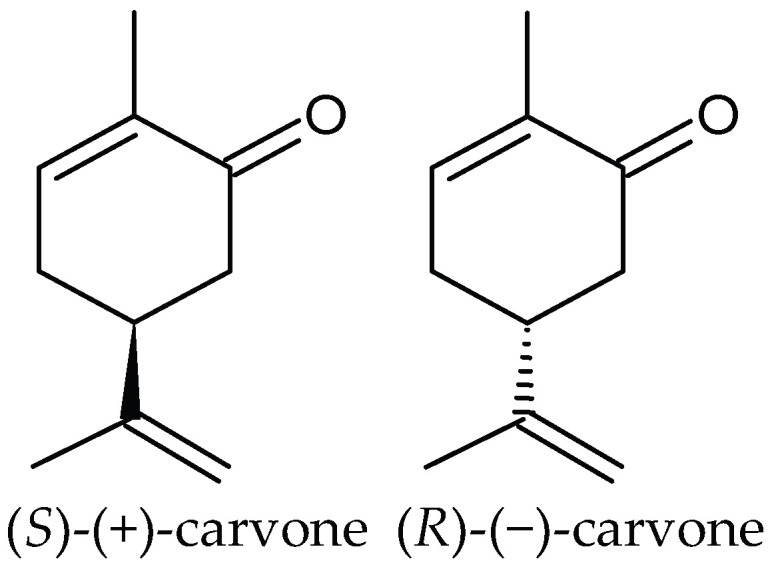 Figure 1
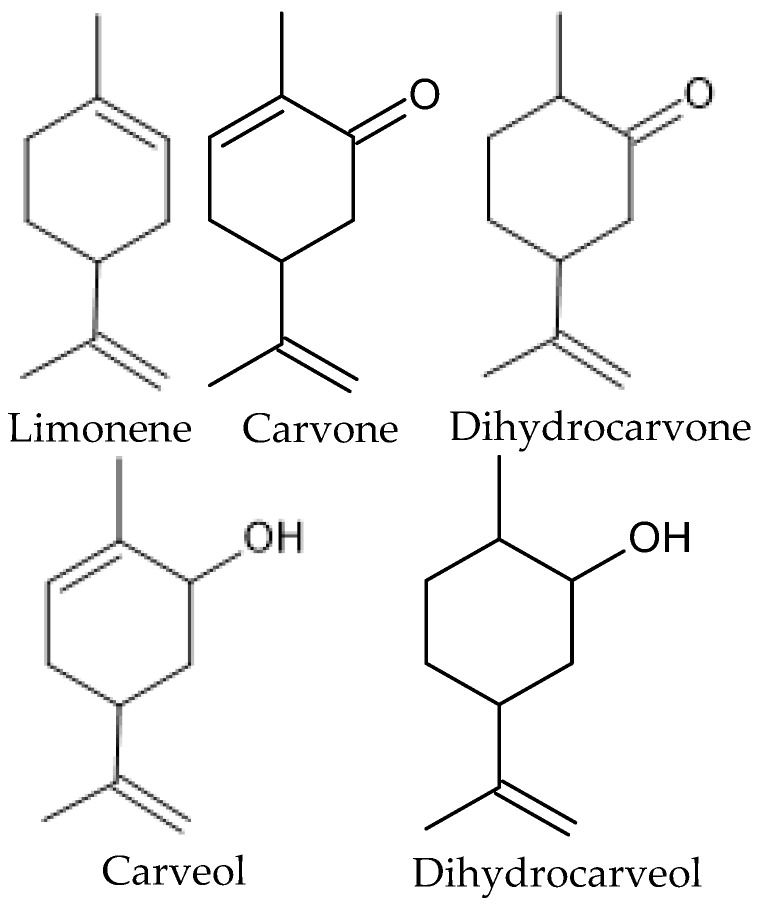 Figure 2
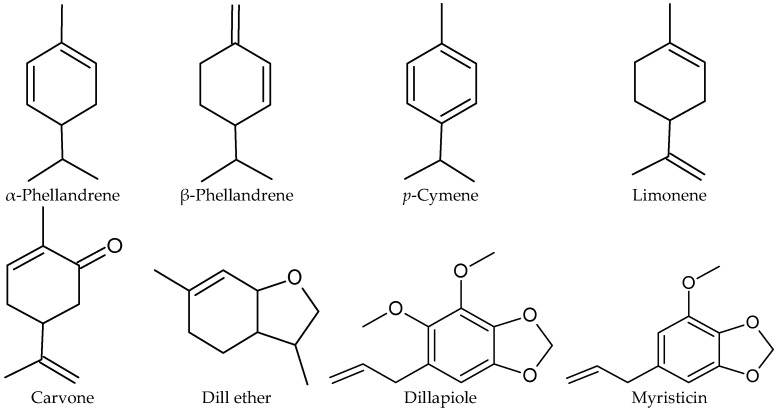 Figure 3
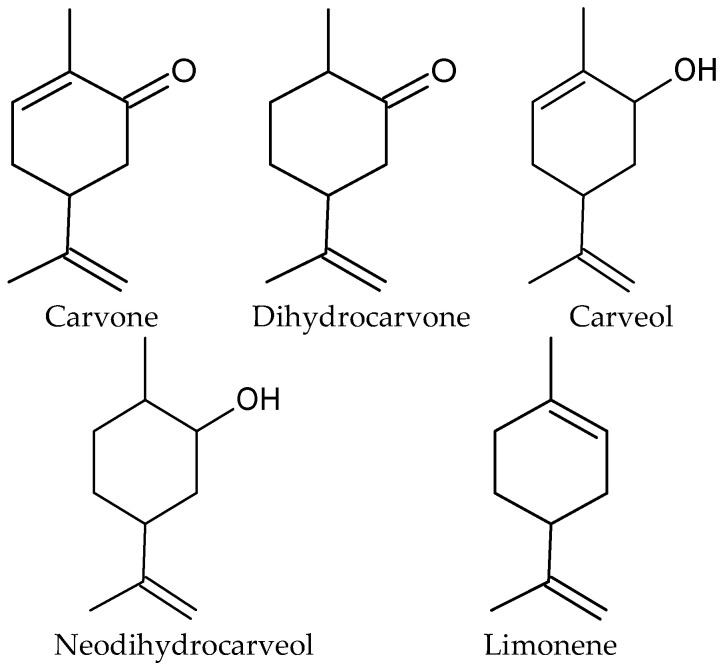 Figure 4
| Fungi | Compound | Results | Methods | Ref. |
|---|---|---|---|---|
|
| carvone | MIC 0.8 μL/mL | Mycelial growth in serial broth dilution, spore germination on solid medium, in situ on corn flour and peanuts | [ |
|
| ( | MIC 1.0% | Mycelial growth and conidia germination on solid medium | [ |
| carvone | EC50 0.028%, EC90 0.08% | Mycelial growth on solid medium | [ | |
|
| ( | EC50 120.0 mg/L | Serial dilution on solid medium | [ |
|
| (+/−)-carvone [25 monoterpenes] | EC50 550 mg/L | Serial dilution on solid medium | [ |
|
| (−)-carvone and (−)-carvone-PLGA-composite | IR 35% and 60% at 0.25 mg/mL | Mycelial growth inhibition on solid medium at 4 concentrations, in situ on lettuce and wheat seedlings | [ |
| ( | IR 77% and 100% at 20% solution | Vapor diffusion in a solid medium at 5 µL of 4 concentrations | [ | |
|
| carvone and carvone in chitosan nanoemulsion | MIC 0.8 and 0.5 μL/mL | Serial dilution in a liquid medium | [ |
|
| CCEO: carvone 69.9, limonene 13.6 | MIC 0.7 µL/mL | Not reported | [ |
|
| CCEO: carvone 54.9, limonene 43.6 | MIC 0.12%, MFC 0.25% | Broth dilution (CCEO), agar diffusion, and in situ on baby carrot (CCEO pullulan film) | [ |
|
| CCEO: carvone 69.9, limonene 13.6 | MIC 0.7 g/L and 0.25 g/L | Serial dilution in a liquid medium | [ |
|
| ( | MIC 1500 µg/mL and >2000 µg/mL | Serial dilution on a solid medium | [ |
|
| CCEO: carvone 46.6, limonene 45.5 | MIC 0.25 µL/mL, MFC 0.25 µL/mL | Microdilution in broth | [ |
|
| CCEO: carvone 57.7, limonene 35.5 | MIC 2% | Broth dilution at 4 concentrations | [ |
| CCEO: carvone 72.1, limonene 23.3 | MIC 1.5 µL/g, MFC 4.5 µL/g | Agar dilution | [ | |
|
| CCEO: carvone main compound | IR 95% at 0.6% | Agar disk diffusion | [ |
|
| CCEO: carvone 52.2, limonene 41.2 | MIC 125 µL/L of air | Mycelial growth on solid medium in vapor phase | [ |
|
| CCEO: carvone, limonene | IR 85.4% at 4% | Mycelial growth on solid medium at 3 concentrations | [ |
|
| carvone | 1 mg/mL | Serial broth dilution | [ |
|
| CCEO: carvone 54.9, limonene 43.6 | MIC 0.12%, MFC 0.25% | Broth dilution (CCEO) | [ |
|
| AGEO: dill apiole 33.8, carvone 27.2, limonene 13.8 | MIC 1.2 µL/mL | Serial dilution in a liquid medium | [ |
|
| AGEO: dill apiole 33.8, carvone 27.2, limonene 13.8 | IR 100% and 100% at 1.2 µL/mL | Mycelial growth on solid medium at the MIC dose | [ |
|
| AGEO: carvone 55.2, limonene 16.6, dill apiole 14.4 | IR 86% and 83% at 6 µL/plate | Mycelial growth inhibition by inverted Petri plate and poison food methods at 3 doses | [ |
|
| AGEO: carvone 41.5, limonene 32.6, apiol 16.8 | 2.0 µL/mL | Poisoned food technique | [ |
|
| IR 57.7% at 500 µg/mL/8 days | Mycelium growth on solid medium at 3 concentrations after 2–8 days | [ | |
|
| AGEO: carvone 41.2, limonene 23.1, camphor 9.3 | ED50 0.38 mg/mL, ED90 1.65 mg/mL | Spore germination inhibition | [ |
|
| AGEO: apiol 32.8, carvone 31.0, limonene 21.3, piperitone 6.1 | MIC 1/1500 ( | Mycelial growth on solid medium, inhibition of sporulation and germination | [ |
|
| AGEO: carvone 87.9, limonene 3.1 | EC50 317 mg/L | Mycelium growth on solid medium at 4 concentrations | [ |
|
| AGEO: carvone 45 | IR 69% at 1000 ppm | Mycelial growth inhibition on solid medium | [ |
|
| AGEO: carvone 39.4, limonene 33.5 | MIC 5 µL/mL, 5 EC50 1.6 µL/mL | Serial dilution in a solid medium | [ |
|
| AGEO: carvone 33.2, limonene 19.9, dill apiole 17.6 | EC50 408.4 µL/L | Mycelium growth on solid medium at serial dilution | [ |
|
| (+)- and (−)-carvone/(+) and ASEO and MSEO | IZ 17 and 12 and 7 and 6 mm | Agar disk diffusion (5 µL) and broth serial dilution | [ |
|
| AGEO | MIC 1.25 µL/mL | Poisoned food technique | [ |
|
| MSEO: carvone 59.6, limonene 25.6 | 100% at 1.0 µL/mL | Serial dilution in a liquid medium | [ |
|
| MIC 1.25 µL/mL, MFC 2.25 µL/mL | Mycelial growth inhibition on solid medium | [ | |
|
| IR 100% at 1.25 µL/mL | Mycelial growth inhibition on solid medium | [ | |
|
| MSEO/carvone/cis-carveol | MIC 0.07/0.03/0.03 mg/mL | Broth microdilution and disk diffusion positive test for flumequine | [ |
|
| MSEO summer: carvone 59.5, limonene 10.5 | MIC 122 µg/mL, 133 µg/mL | [ | |
|
| MSEO: carvone 57.7–65.6, germacrene D 9.4–12, limonene 4.2–9.6 | MIC 30 µg/mL, MFC 60 µg/mL | Broth microdilution | [ |
|
| MSEO: carvone 62.9, limonene 8.5 | MIC 1.25 µL/mL, MFC 5 µL/mL | Broth microdilution | [ |
|
| MSEO: carvone 58.7, limonene 10.7 | MIC 1.0, MFC 1.0 mg/mL | Serial dilution in solid medium, MIC/MFC | [ |
|
| MSEO: carvone 49.5, menthone 21.9, limonene 5.8 | MIC 1.0–2.5 and 3.5–5 µL/mL | Broth microdilution and macrodilution in solid medium, vapor test, positive control bifonazole | [ |
| carvone | MIC 0.25–1.0 µL/mL | Serial broth microdilution and macrodilution on solid medium, positive control bifonazole | [ | |
| carvone 52.2, limonene 21.6 | MIC 10 µL/mL, MFC 10 µL/mL | Broth microdilution | [ | |
|
| carvone and | Growth 0% and 0% at 10 µL/disk | Disk diffusion at 3 doses, mycelial growth in respect to the control | [ |
|
| MSEO: carvone 42.0, trans-carveol 15.6, dihydricarvyl acetate 12.7, neodihydrocarveol 12.5 | IR 100% at 16 µL/dish | Vapor test on a Petri dish | [ |
|
| MSEO: carvone 51.3, limonene 21.3 | IR 92% at 150 μL/L | Vapor test on a solid medium | [ |
|
| ( | IR 100% at 1000 µL/L | Mycelial growth inhibition on solid medium at 500 and 1000 µL/L | [ |
|
| ( | MIC 0.1/0.2/0.2./0.2 mL/100 mL | Serial dilution on a solid medium | [ |
|
| ( | MIC 1600/1600/2400 µL/L | Serial dilution on a solid medium and vapor test on Petri dishes | [ |
| ( | MIC 1000/1000/2000 µL/L | Serial dilution on a solid medium and vapor test on Petri dishes | [ | |
|
| MIC 71 µL/L air (mycelial growth) | Vapor test at serial dilutions | [ | |
|
| ( | MIC 1000 µL/L | Serial dilution on a solid medium | [ |
| ( | MIC 1000–3000/1000–3000 µL/L | Serial dilution on a solid medium, mycelial growth inhibition | [ |
| Bacteria | Compound | Results | Methods | Ref. |
|---|---|---|---|---|
|
| (−)-carvone and (−)-carvone-PLGA-composite | 400 μg/mL and 150 μg/mL | Positive control gentamycin and chloramphenicol | [ |
| CCEO: carvone 23.3, limonene 18.2, germacrene D 16.2, trans-dihydrocarvone 14.0 | MQ 682 µg/disk; 690 µg/disk | Agar diffusion at serial dilution | [ | |
|
| ( | MIC 125 μg/mL, MBC 1000 μg/mL | Broth dilution | [ |
|
| MSEO: carvone 73.4, limonene 3.5 | IZ 14.7 mm and 14.1 mm | Disk diffusion, 10 µL | [ |
|
| MSEO: carvone 49.5, menthone 21.9, limonene 5.8 | MIC 1.0–2.5 and 3.5–5 µL/mL | Disk diffusion and broth microdilution, positive control streptomycin and penicillin | [ |
| Insect(s) and Stage | EO: Main Components [%] | Insecticidal Effects | Methods | Ref. |
|---|---|---|---|---|
| CCEO: Carvone 61.9, limonene 38.1 | RI is 91.7% at 10 µL after 24 h | Repellent effect using a T-tube olfactometer | [ | |
| CCEO: Carvone 53.7, limonene 43.4 | 100% mortality at a concentration of 0.005 mg/mL air after 24 h | FT using treated filter papers in a glass cylinder | [ | |
| CCEO: Carvone 38.0, limonene 26.6, α-pinene 5.2, carveol 5.0, β-myrcene 4.7 | CT: 24 h-LD50 values are 3.07 and 3.29 μg/adult, respectively | CT by topically treating the dorsal thorax of the pest, FT using treated filter papers in a glass vial | [ | |
| CCEO: Carvone 61.5, limonene 32.7, myrcene 3.2 | CT: 24 h-LC50 is 126.0 μg/cm2 | CT using the arsal test | [ | |
| CCEO: Carvone 40.8, limonene 27.1 | 48 h-LC50 value is 2.5 mg/L | FT using treated filter paper in a glass cylinder | [ | |
| CCEO: Carvone 67.6, limonene 28.5 | 24 h-LC50 is 41.451 μL/L | FT using treated filter papers in the cup as a fumigation chamber | [ | |
| CCEO: Carvone (68.22 ± 0.62), limonene (21.80 ± 0.54) | 48 h-LC50 values are 3.3 and 4.0 μL/mL, respectively | FT using treated filter papers in a glass cylinder | [ | |
| CCEO: Carvone 46.2, | FT: 24 h-LC50 values are 2.99 and 0.42 μL/L, respectively | FT using a cylindrical container | [ | |
| CCEO: Carvone 47.3–74.4, limonene 25.2–51.9 | RI is 32% and 41% at 90 and 330 min, respectively | Repellent effect using a dual-choice bioassay with white cabbage | [ | |
| CCEO: Carvone 72.4, limonene 23.9 | 24 h-LC50 values are 28.0, 118.4, and 1.9.34 µL/L, respectively | FT using treated filter papers in Plexiglas bottles | [ | |
| AGEO: Carvone 40.8, limonene 22.8, dill ether 5.0, α-phellandrene 3.9, | 48 h-LC50 is 3.3 mg/L | FT using treated filter papers in a glass cylinder | [ | |
| AGEO: Carvone 84, β-phellandrene 14 | FDI (17.7 and 84.7%, respectively) and growth inhibition (32.5 and 81.2%, respectively) at 175 μg/cm2 after 48 h | Feeding deterrence and growth inhibition using the diet-no-choice method with corn leaves as food, CT using treated filter papers in Petri dishes, FT using treated filter papers in fumigation jars | [ | |
| 100% after 6 days at a concentration of 15 mg/mL, along with increased lifespan and decreased pupal weight | Egg hatching is inhibited by dipping in freshly prepared solutions of EO | [ | ||
| 24 h-LC50 is 18.0 µL/L | FT using treated filter papers in glass jars | [ | ||
| AGEO: Carvone 30.2, dihydrocarvone 22.9 | 100% mortality at a concentration of 40 μL/L after 24 h, along with enzymatic disruption; reduction in the activity of acetylcholinesterase, α- and β-carboxylesterase, and glutathione-s-transferase | FT using treated filter papers in glass vials | [ | |
| AGEO: Dillapiole 37.9, carvone 22.6, isolimonene 10.0, dihydrocarvone 6.9, camphor 5.1, α-phellandrene 2.8 | FT: 24 h-LC50 is 132.6 μL/L air | FT using treated filter papers in a cylindrical vial, repellent effect using the preferential zone method on filter paper | [ | |
| MSEO: Carvone 79.9, 1,8 cineole 4.3 | 100% mortality at the dose of 3.12% after 24 h | CT using treated filter papers | [ | |
| MSEO: Carvone 63.2, limonene 19.4, 1,8-cineole 1.8 | 100% mortality of larvae at a concentration of 0.005 mg/mL air after 24 h | FT using treated filter papers in a glass cylinder | [ | |
| MSEO: Carvone 59.4, ocimene 6.7, | 24 h-LC50 is 0.08 μL/mL | FT using treated filter papers in a glass jar | [ | |
| MSEO: Carvone 59.6, limonene 25.6, | 98.5% oviposition deterrence of adult females along with | FT using treated filter papers in a plastic jar, repellent effect using the Y-shaped olfactometer | [ | |
| MSEO: Carvone 67.1, limonene 14.3, γ-muurolene 2.3, myrcene 2.1 | 24 h-LC50 values of 896.5, 2277.6, 1824.3, and 0.5 μL/L for | FT using treated filter papers in glass jars | [ | |
| MSEO: Carvone 48.5, limonene 20.7, 1,8-cineole 5.4 | 43% mortality at a concentration of 2 μL/mL after 96 h | FT by the treatment of a bit of cotton in glass jars, repellent effect using treated filter papers in a Petri dish | [ | |
| MSEO: Carvone 54.1, limonene 21.9 | 40.3% mortality at 15 μL/L after 24 h | FT using treated filter papers in plastic jars | [ | |
| MSEO: Carvone 79.0, 1,8-cineole 12.0, menthol 2.0 | Feeding inhibitory against | Feeding/settling on the treated leaf disks | [ | |
| MSEO: Carvone 52.3, limonene 19.8, dihydrocarvone 11.1 | 24 h-LC50 is 0.19 μL/L, along with a significant acetylcholinesterase inhibitory effect | FT using treated filter papers in glass jars | [ | |
| MSEO: Carvone 63.4, limonene 21.3, 1,8-cineole 2.3. | FT: 24 h-LC50 are 1.9 and 2.4 μL/mL, respectively | FT using filter papers in glass desiccators | [ |
| Weeds/Crops | EO: Main Compounds [%] | MIC or % Inhibition | Methods | Ref. |
|---|---|---|---|---|
|
| ( | IR 88.8% at 2.5 µL | In vitro seed germination bioassay on wetted filter paper in Petri dishes. 2.5 µL of EOs or control was applied to seeds. | [ |
|
| Carvone | IR 21.7% | In vitro seed germination bioassay on wetted filter paper in Petri dishes. Essential oil was tested at 4 concentrations of 3, 6, 10, and 20 µL. Distilled water was used as a control. | [ |
| ( | EC100 0.1 mg/mL | In vitro seed germination bioassay at 4 concentrations: 0.001, 0.01, 0.1, and 1 mg/mL. Distilled water was used as a control. | [ | |
|
| ( | Carvone was able to suppress sprout growth during the whole storage period | Application of 50 to 100 mL of carvone per 1000 kg of potatoes at 1/6/9-week intervals during storage. Carvone treatment was compared with IPC/CIPC, a commercial sprout inhibitor. | [ |
|
| ( | Seed germination EC50 1.29 mM | In vitro seed germination assay at 6 concentrations of 1, 2, 3, 4, 6, and 8 mM. | [ |
|
| ( | Seed germination IR 96% at 10−3 M | Two methods: (1) dipping assessed antigerminative activity and (2) volatilization using 4 different concentrations of 10−6, 10−5, 10−4, 10−3 M. The control and negative control treatments were not indicated. | [ |
|
| CCEO: ( | IR 53.3% | In vitro seed germination bioassay on wetted filter paper in Petri dishes. Essential oil was tested at 4 concentrations: 3, 6, 10, and 20 µL. Distilled water was used as a control. | [ |
| CCEO: carvone 63.2, limonene 34.8 | It showed short-term herbicidal effects against the weeds, but PPEO was generally more herbicidal than CCEO | Foliar application of 4.25 g of essential oil emulsions at the 4–5 leaf stage for | [ | |
|
| CCEO: carvone 63.2, limonene 34.8 | MIC 200 kg/ha | EOs at 3 concentrations (0.75, 1.5, and 3 g per pot) were spread on the pot surface and mixed into the soil substrate. Two control treatments were used: soil substrate only and the soil substrate with MDX. | [ |
|
| CCEO: carvone 63.2, limonene 34.8 | ED50 0.2 g/L | In vitro seed germination bioassay on wetted filter paper in Petri dishes at 5 concentrations of each oil, 0.2, 0.6, 1.2, 2.4, and 7.2 g/L. The control treatment contained only water and acetone. | [ |
|
| CCEO: carvone, 66.4, limonene 32.5 | CCEO was effective on barnyard grass, causing leaf injuries and a reduction in biomass | Foliar application of 2 EO concentrations of 2.5 and 5% at the 3–4 leaves stage. The control plants were hand-sprayed with water only and water + adjuvant. | [ |
|
| CCEO: carvone 63.3, limonene 35.2 | ED10 at 2.0% | Foliar application of 5 concentrations, i.e., 1, 1.5, 2, 5, and 10%, of bio-nanoemulsions at the three-leaf stage. Three control treatments: surfactant only, distilled water only, and a commercial mixture of herbicides. | [ |
|
| CCEO: carvone 71.1, limonene 25.4 | IR 100% at 100 µL/mL | In vitro seed germination bioassay on wetted filter paper in Petri dishes with EOs at 5 concentrations of 5, 10, 50, 75, and 100 µL/mL. Control only the treatment of the water–methanol mixture. | [ |
|
| AGEO: carvone 59.2, limonene 14.2, cis-dihydrocarvone 6.3, trans-dihydrocarvone 7.5 | IR 70% at 100 µL/L | Germination inhibition test at 3 concentrations of 100, 300, and 600 µL/L of nanoemulsions of the EOs. | [ |
|
| AGEO: carvone 58.4, limonene 35.8 | ED 0.25 mg/mL | In vitro seed germination bioassay on wetted filter paper in Petri dishes with 6 concentrations of 2.5, 1.25, 0.625, 0.25, 0.125, 0.062 mg/mL. Negative controls were distilled water and acetone. | [ |
|
| AGEO: carvone 51.7, limonene 39.9 | IR 100% at 1% | In vitro seed germination bioassay on wetted filter paper in Petri dishes with 4 concentrations of 1, 0.5, 0.1, and 0.01% of essential oil. Water + Tween 20 was used as a control. | [ |
|
| AGEO: carvone 40.5, limonene 32.2 | Seed germination—IR 61.5% at 500 µL | In vitro seed germination bioassay on wetted filter paper in Petri dishes, measuring seed germination and shoot length using 5 mL of essential solution. The control solution was not indicated. | [ |
|
| MSEO: (−)−carvone, limonene | IR 53.3% | In vitro seed germination bioassay on wetted filter paper in Petri dishes. Essential oil was tested at 4 concentrations: 3, 6, 10, and 20 µL. Distilled water was used as a control. | [ |
|
| MSEO: carvone 47.4, β-phellandrene 11.3, menthol 5.5 | IR 10.3% at 1 mL/L (germination) | In vitro seed germination bioassay on wetted filter paper in Petri dishes. Two control groups: (1) distilled water alone and (2) a solution of Tween 20. Essential oil was suspended in distilled water at 1000 mg/L. | [ |
|
| MSEO: carvone 62.9, limonene 8.2, cis-dihydrocarvone 5.6, 1,8-cineole 5.4 | Mean germination reduction—14.97% | In vitro seed germination bioassay on wetted filter paper in Petri dishes at 3 concentrations of 0.2, 0.4, and 0.8 μL of essential oil. Water was used as a control. | [ |
Peer Reviews
No public reviews on file for this paper yet. If you reviewed it on a platform where reviews are public (OpenReview, ICLR, NeurIPS, ICML), you can paste yours below so the community can read it here.
Videos
No videos yet. Explain this paper in a talk, walkthrough, or lecture? Add one.
Taxonomy
TopicsInsect Pest Control Strategies · Essential Oils and Antimicrobial Activity · Allelopathy and phytotoxic interactions
1. Introduction
In the 21st century, the world is undergoing a significant shift from highly industrialized agroecosystems to agroecological systems, which explore the potential of the complexity and interconnections between agro-biocenosis and the agro-environment. In the European Union, this agricultural shift is strongly promoted and implemented through regulations that promote green techniques and ban synthetic pesticides, thereby relegating them to a marginal role [1,2]. While synthetic pesticides remain the primary method for controlling agricultural pests, their prolonged and widespread use has led to numerous adverse effects. These include environmental pollution, risks to human health, harmful effects on non-target organisms such as predators and parasitoids, the development of pesticide resistance, and secondary pest outbreaks [3,4]. Effective alternatives to synthetic pesticides include plant secondary metabolites, e.g., essential oils (EOs). The EOs are multicomponent mixtures of plant volatiles, obtained by steam- or hydrodistillation of different plant parts. EOs produced by aromatic plants can support numerous biological activities and play a vital role in the pharmaceutical, cosmetic, food, and agricultural industries. Essential oils and their components, such as carvone, are gaining popularity as consumers seek natural alternatives to synthetic substances. Furthermore, there is growing interest in using essential oils as alternative biocontrol products against plant pests, including phytopathogenic fungi, bacteria, insects, and weeds [5].
Essential oils have become widely used botanical pesticides in sustainable agriculture, with many studies documenting their toxicity to pests and pathogens. A broad view of the issue was presented in Raveau et al. [6], which reviews EOs as potential alternative biocontrol products against plant pathogens and weeds. Other interesting papers describe the EOs of Apiaceae species as sources of plant-based pesticides [7], as biopesticides [8], or as the subject of structure–activity relationships governing EOs’ phytotoxic effects [9]. One of the promising and intriguing major constituents found in the EOs of various plant species, with significant biological activity and underexplored in recent reviews, is carvone. What is interesting is that carvone is usually present in nature as a specific enantiomer, (R)- or (S)-carvone. The most important (R)-carvone-rich EO is spearmint oil (Mentha spicata L., Lamiaceae), while (S)-carvone is the main compound in caraway (Carum carvi L., Apiaceae) oil and dill (Anethum graveolens L., Apiaceae) oil.
In this paper, a critical review of the chemical composition of carvone-rich EOs and their agrobiological and pest control potential is presented, based on the recent scientific literature.
2. Research Methodology
This study collected qualitative and quantitative literature data using a semi-structured method based on the narrative review approach [10]. The literature on carvone and carvone-rich essential oils published between 2000 and 2025 was collected using scientific databases such as SciFinder, Scopus, Wiley Online, SpringerLink, ScienceDirect, and PubMed. The search incorporated keywords including “essential oils”, “carvone”, “Mentha spicata”, “Carum carvi”, “Anethum graveolens”, “plant pathogens”, “antifungal activity”, “insecticidal activity”, “acaricidal activity”, “nematicidal effect”, “allelopathy”, and “phytotoxicity”. This review examines the application of essential oils (EOs) for pest control in plants across both growth and post-harvest stages, as reported in the scientific literature. The review also briefly addresses new formulations designed to enhance the stability and efficacy of EOs. Studies focusing on foodborne pathogenic bacteria are excluded. Only articles reporting the composition of carvone-rich EOs (containing more than 30% of carvone) were included. Research employing methods that do not permit result comparison, particularly those using the disk diffusion test, was omitted. Older articles were cited only in exceptional cases.
3. Characteristics of Carvone and Carvone-Rich Essential Oils and Their Plant Representatives
Carvone (p-mentha-6,8-dien-2-one, C_10_H_14_O) is an optically active monoterpene ketone (Figure 1) widely distributed in the plant world with broad biological activity. It is a constituent found in many essential oils as a dominant compound (e.g., C. carvi, A. graveolens, M. spicata, Lippia alba) as well as a trace ingredient in other oils. Due to its single chiral center, carvone exists in two enantiomeric forms: (S)-(+)-carvone and (R)-(−)-carvone. Carvone enantiomers have the same physical and chemical properties, except for the sign of their optical rotation. However, the enantiomers may differ in terms of biological activity. In particular, they have a significantly different scent. (S)-carvone has a spicy aroma with rye notes like caraway seeds, whereas (R)-carvone has a sweetish, minty smell like spearmint leaves. The odor of both isomers is of medium strength. Carvone has a boiling point of approximately 231 °C, a density of around 0.959 g/mL at 25 °C, and is practically insoluble in water but soluble in alcohol and nonpolar environments [11].
The three most important carvone-rich EOs are obtained from raw materials that are well-known culinary spices worldwide: the fruits of two Apiaceae family members, Carum carvi L. and Anethum graveolens L., and the herb Mentha spicata L. (family Lamiaceae). Commercial caraway oil (CCEO) and dill oil (AGEO) contain similar levels of the two main optically active constituents, namely (S)-carvone and (R)-limonene. A. graveolens also provides EOs from its leaves and flowers that contain significantly lower amounts of carvone. Spearmint oil (MSEO) contains (R)-carvone.
Caraway (Carum carvi L.) is a biennial medicinal plant and a common spice in Europe, Asia, and Africa. Of the approximately 25 Carum species, only C. carvi is economically significant and is grown and used worldwide mainly for its fruit. Caraway fruit is a pharmacopeial material with many pharmacological properties [12]. The crescent-shaped light to dark brown fruits have a single seed with a warm, sweet, and slightly sharp flavor [13]. The most important active ingredient of caraway fruit is the essential oil, known as caraway oil (CCEO), obtained by the hydrodistillation of crushed fruit, with a yield of 3–7%. According to the European Pharmacopoeia 10th edition, the main components of caraway oil are: carvone (50–65%), limonene (30–45%), trans-carveol (max. 2.5%), trans-dihydrocarvone (max. 2.5%), and myrcene (0.1–1%) (Figure 2). (S)-carvone and (R)-limonene are present in high enantiomeric purity [14].
Seventeen selected caraway genotypes, originating from European botanical gardens, as well as one cultivar and two authors’ strains, have shown little variation in EO yield (3.4–5.2%) and in the content of the two main compounds (carvone 53–68%, limonene 28.5–40.5%) [15]. A similar composition was reported for caraway cultivated in Tunisia (carvone 76.4%, limonene 19.5%), Germany (77.4%, 16.2%), and Egypt (61.6%, 29.1%, respectively) [16]. Reversed proportions of two main CCEO compounds were observed in three ecotypes of annual caraway in Serbia: carvone (27.4–44.5%), limonene (54–70.3%) [17]. The content of EO in biennial caraway (3.9–5%) is higher than in annual caraway (2.8–3.3%) [18]. The yield of CCEO depends strongly on the form of fruit. Proper preparation of the seed and fruit for hydrodistillation includes crushing the plant material. This step is often omitted, resulting in yields of 1.4% [19,20] or even 0.48% [16]. Frequent minor constituents of the caraway oil are cis- and trans-dihydrocarvone, cis- and trans-dihydrocarveol, perillaldehyde, myrcene, γ-terpinene, and other mono- and sesquiterpene hydrocarbons. Minor compounds in total amounted to 3–4% in annual and 1.5–2.5% in biennial plants [18].
Caraway oil is sometimes confused with cumin oil isolated from Cuminum cyminum L. Both plants belong to the same Apiaceae family, and their fruits are used as culinary spices and in traditional therapies. Both fruits are rich sources of EOs, but their compositions differ significantly. In some papers, instead of declared caraway oil, cumin oil was researched [21,22,23,24] because the EOs tested contained mainly cuminaldehyde and γ-terpinene, which are the major components of EO from the fruits of C. cyminum [25,26]. Such papers are omitted in this review. To the contrary, other authors named EO from C. carvi as cumin oil [27]. What is more, these mistakes are repeated in reviews and other papers while discussing the antifungal activity. The structures of the main AGEO components are presented in Figure 2.
Dill (Anethum graveolens L.), a biennial or annual herb of the Apiaceae family, is native to Southwest Asia and Southeast Europe and has been cultivated since ancient times for its economic and medicinal value [18,28]. The only species in the genus Anethum is A. graveolens L. Its variant, known as East Indian dill or Sowa (A. graveolens var. sowa Roxb. ex, Flem., syn. A. sowa), is found in India and is grown as a cold-weather crop in the Malay Archipelago, Japan, and the Indian subcontinent for its leaves. The yellow blossom turns into umbels [29]. Dill has pseudo-seeds, the halves of schizocarps, which are tiny, dry fruits. The fruits have a flavor that is a little like caraway. Compared to caraway, the fruits are lighter, flatter, and smaller. They also have a nice and delicious scent [30]. Dill oil is obtained by hydrodistillation of the seed/fruit, flower, and leaf [28,31]. Seed and fruit represent the same raw material, as with caraway, where the small dry fruits are often mistaken for the seeds. The most popular commercial dill oil is obtained from the fruit. EO distilled from dill foliage differs markedly in yield and composition from dill seed oil. In this paper, the dill fruit EO (AGEO) is considered.
Many authors have reported the chemotypes of dill based on volatile compositions across plant parts and developmental stages. The oldest available and still relevant work on this subject analyzed the composition of pentane extracts from the seeds of 35 dill cultivars [32]. The presence or absence of carvone, myristicin, and dillapiole distinguished three chemotypes. The major components of the most numerous chemotypes (27 cultivars) were carvone (43.7–57.7%) and limonene (39.5–50.7%). Limonene (36.9–46.7%), carvone (17.8–45.6%), myristicin (0.2–20.3%), and dillapiole (8.0–22.3%) were the main components of five samples whereas carvone (25.1–47.4%), limonene (31.0–40.9%), and dillapiole (6.3–31.8%) were the main components of three samples [32]. In addition to these three chemotypes, 66 fruit seeds yielded some transition chemotypes [33].
Fruits of 26 commercially available dill cultivars yielded 3.4–4% AGEO. The content of components was presented in relation to the mass of fruit and, for the two main compounds, was 10.7–13.0 mg/g of carvone and 12.0–14.2 mg/g or 14.9–17.8 mg/g of limonene, depending on the harvest year. Apiole and myristicin were absent in most samples, but were detected at 0.2–11% in dill chemotypes where they were present. Minor components such as α-phellandrene, dill ether, and cis- and trans-dihydrocarvone were below 10% with an average of 7% [18]. The structures of the main AGEO components are presented in Figure 3.
Seven European dill cultivars belonged to carvone (81.4–90.0%)/limonene (9.6–18.0%) chemotypes, and the local Egyptian cultivar contains carvone (56.6%), limonene (18.8%), dillapiole (15.7%), and piperitone (7.4%) [34]. The same authors reported carvone (56.6%, 62.5%), limonene (18.8%, 14.6%), and dillapiole (15.7%, 19.5%) as the main compounds in fruit EO, which was isolated with a yield of 3.2% [35,36]. Dill herb at the vegetative stage yielded 0.08% of EO and contained α-phellandrene 46.3%, p-cymene 17.9%, limonene 13.7%, and ß-phellandrene 11.0%. In comparison, herb EO at the flowering stage (yield 1.1%) contained p-cymene (33.4%), dill ether (19.6%), and carvone (13.1%) [35].
Chahal et al. [31] in their review presented more examples of AGEO chemotypes, e.g., several containing 5–16% of dihydrocarvone isomers. However, it is worth noting that almost all dill fruit EOs contained carvone and limonene as the two main components.
Similar to caraway oil, AGEO is sometimes isolated from the whole fruit rather than crushed fruit, resulting in a very low yield of 0.8% [37].
Spearmint (Mentha spicata L.) belongs to the genus Mentha (family Lamiaceae) [38,39]. Three of the globally most extensively cultivated and economically important mint species produce essential oils that differ in the main constituents: in peppermint oil (M. x piperita L.) and cornmint oil (M. arvensis L.) (1R, 3S, 4S)-(−)-menthol is the main compound while in spearmint oil (MSEO) usually (R)-carvone dominates. Chemotypes of other naturally occurring mints can also produce carvone-rich EOs, e.g., M. cardiaca L., M. suaveolens Ehrh., and M. longifolia (L.). Huds. [38,40], andare included in this review. On the other hand, M. spicata exhibits different chemotypes, including pulegone, piperitone, and piperitenone oxide, which are not described in this review [39,41]. It is important that, among the 77 M. spicata EOs listed by Mahendran et al. [42], only the third was the carvone chemotype. This shows how important it is to determine the EO composition (especially in the genus Mentha) in all biological studies and confirms the validity of omitting from this review those articles that do not provide the EO composition.
M. spicata is a perennial mainly grown in the USA, preferring wet habitats like riverbanks. It has an erect, often red-flecked stem (50–90 cm), pointed green leaves, and flowers in pseudo-spikes at shoot tops. M. spicata has several popular cultivars originating from Europe and North Africa [43]. Spearmint is an aromatic and medicinal plant, and its herb and leaves are widely used in various applications and have been the subject of review papers [44]. Spearmint oil (MSEO) is produced by the hydrodistillation of fresh or dried herbs [42,45] with a yield of 0.23–3.24% [46]. Commercially exploited M. spicata plants always contain EO rich in (R)-carvone (30–85%) and (R)-limonene (5–28%) that are accompanied by smaller amounts of related compounds such as cis- and trans-dihydrocarvone, alcohols dihydrocarveol, cis- and trans-carveol and their acetates, linalool, terpinen-4-ol, 1,8-cineole, menthone, as well as mono- and sesquiterpene hydrocarbons [38,42]. The structures of the main AGEO components are presented in Figure 4.
4. Biological Activities
4.1. Antifungal and Antibacterial Activity
Research over the past two decades has shown that essential oils (EOs) and their components, such as carvone, exhibit antifungal and antibacterial effects. Studies often use agar diffusion (measuring inhibition zones, IZs) or serial dilution (measuring the minimal inhibitory concentration, MIC; minimal bactericidal/fungicidal concentrations, MBC/MFC; or the inhibition rate, IR). Negative and positive controls are ideal but not always included. However, comparing results across labs is difficult due to differences in test conditions and reporting methods. MIC, MFC, and IR values are more comparable between studies than inhibition zones. [47,48]. For this reason, only selected, well-documented studies that used this latter method will be presented. Often, along with the assessment of antifungal activity, the impact of EO on aflatoxin production is determined.
A broad range of phytopathogenic fungi (Table 1) and only a few phytopathogenic bacteria (Table 2) were tested for their susceptibility to carvone and carvone-rich EOs. Three aspects of antimicrobial activity in in vitro tests are reported in the literature: comparisons of carvone activity with other monoterpenes, comparisons between different EOs and compounds, and new formulations containing active substances. In the case of fungi, anti-aflatoxin activity was also assessed. Sometimes, in vitro tests are accompanied by research in in situ conditions, which are usually referred to as in vivo.
The current status of in vitro research indicates that carvone enantiomers generally show slight differences in antimicrobial activity, with the (R)-carvone isomer being more effective than the (S)-isomer. However, both carvone isomers are frequently more effective than other monoterpenes such as 1,8-cineole [49], isopulegol [50], or terpinene-4-ol, but less active than thymol [51,52]. For example, carvone has shown total mycelial growth inhibition at 0.8–1% for Colletotrichum gloeosporioides and C. musae, while successfully inhibiting the growth of Aspergillus flavus [50] and A. niger [49,53], and also aflatoxin B1 production at very low concentrations [54,55].
Caraway oil (CCEO) often proved more active against fungi than other EOs, e.g., coriander (Coriandrum sativum) EO [56], two citronella EOs [57], juniper EO [58], or many EOs [59]. CCEO effectively inhibited pathogens, including various Aspergillus species [27,57,60,61,62], Penicillium species [63,64,65], Sclerotium rolfsii [66], and Botrytis cinerea [67]. CCEO, when tested in mixtures with other EOs (clove oil and cumin oil), was more active against A. niger (MIC 1–2 mg/mL) than the single oils (MIC 1–3 mg/mL), suggesting a synergistic effect [68].
CCEO and its major constituent, carvone, also exhibited high antibacterial activity against Gram-positive genera, such as Clavibacter, and Gram-negative genera, such as Erwinia and Xanthomonas [25]. The bacteriostatic activity of CCEO and carvone was the same, while carvone showed better bactericidal efficacy and also demonstrated synergistic effects when combined with β-lactams [69].
Two primary chemotypes of dill essential oil (AGEO), characterized by carvone/limonene/dill apiol and carvone/limonene, exhibit nearly identical levels of antifungal activity. AGEO has demonstrated the ability to completely inhibit A. flavus growth at concentrations of 1.2–1.25 µL/mL [37,70]. Different methodologies yield varying results; for instance, AGEO achieved 100% inhibition of A. niger and Penicillium citrinum using the poison food technique, yet showed less than 15% inhibition against A. niger when using the inverted Petri plate method [65]. AGEO demonstrated high toxicity against a broad spectrum of common food-biodeteriorating fungi, with many strains suffering 100% inhibition at MIC doses [37]. It also showed promising activity against plant pathogens, including Alternaria triticina and Bipolaris sorokina [31]. Research on mushroom pathogens indicates that AGEO has the highest median ability among 11 EOs tested against Lecanicillium fungicola, while affecting the growth of the mushroom Agaricus bisporus at significantly higher concentrations [59]. AGEO inhibited the mycelial growth, sporulation, and germination of seven fungal species [71]. It should be stressed that, in studies testing many EOs, AGEO was among the more effective against many fungal strains [59,72,73].
The antifungal efficacy of AGEO varies significantly depending on the plant part used, with oils derived from fruits and seeds generally demonstrating superior activity compared to those from leaves or herbs [74].
Essential oil isolated from the herb or leaves of Mentha spicata, known as spearmint oil (MSEO), has been extensively researched for its chemical composition and biological activity, with recent reviews highlighting its various chemotypes, particularly those rich in carvone [46,75]. MSEO effectively inhibited the growth and aflatoxin B1 production in toxigenic A. flavus at concentrations of 1.0 µL/mL and 0.9 µL/mL, respectively. At a MIC value of 1.0 µL/mL, the oil showed broad fungistatic effects against 19 food-deteriorating molds, achieving 100% inhibition in nearly all species except Aspergillus luchuensis and A. terreus [64]. Similarly, Mentha cardiaca EO (carvone 59.6%) was effective against 20 fungal species identified in dry fruits. While most fungi were inhibited at an MIC of 1.25 µL/mL, Rhizopus stolonifer proved resistant [76]. Similar resistance in Rhizopus spp. was reported by Hussain et al. [77], who noted MIC values up to 157.8 µg/mL. Against Geotrichum citri-aurantii, MSEO showed medium activity (31% inhibition at 1000 µL/mL), significantly outperformed by its pure constituent (R)-carvone, which achieved 100% inhibition [78]. MSEO demonstrated activity against various fungal pathogens of Agaricus bisporus, though it was less effective than oregano or thyme oils [79]. In studies involving MSEO with high carvone (51.7%) and cis-carveol (24.3%) contents, pure carvone and cis-carveol were more effective than the whole oil against A. niger and Botryodiplodia theobromae [80]. The efficacy of MSEO is highly dependent on laboratory conditions. MIC values for the same EO were 1.0–2.5 μL/mL with ethanol as the solubilizer, but dropped to 0.5–1.5 μL/mL with Tween. At the same time, MICs assessed by the macrodilution method ranged from 3.5 to 5 µL/mL and by the microdilution method from 0.5 to 2.5 µL/mL. By the latter method, the MFC value was 1.5–2.5 µL/mL [81]. In vapor tests, MSEO achieved 100% inhibition of Verticillium dahliae at 16 µL/dish [82] and over 90% inhibition of Rhizopus stolonifer [83]. (R)-carvone generally demonstrates superior antifungal activity compared to (S)-carvone or the whole AGEO [78,81]. As a critique, some researchers [77] incorrectly claimed that EOs were more potent than standard drugs; in reality, the EOs required doses roughly 500 times higher to achieve comparable inhibition zones [80].
A few other plant species also produce carvone-rich EOs. The best known are two species of the genus Lippia: L. alba and L. scaberrima (family Verbenaceae). Leaf EOs of the L. alba carvone chemotype inhibited fungal growth, with (R)-carvone being more effective than EO [84,85]. The EO of aerial parts of L. scaberrima, along with carvone enantiomers and limonene, was tested using two methods for its activity against Botryosphaeria parva and C. gloeosporioides [86], as well as against Alternaria sp., C. gloeosporioides, and Lasiodiplodia theobromae [87]. Fungal strains were isolated from fruits, and the efficacy of EO in preventing fungal diseases was also tested. In a serial dilution on a solid medium, all substances showed very good activity. Two enantiomers of carvone exhibited stronger fungistatic activity than EO, whereas limonene and 1,8-cineole showed little antifungal activity. Additionally, the fungicidal activity of carvone and EO, but not of limonene, was observed [86,87].
Leaf EOs of the carvone (85.9%) chemotype of Aloysia polystachya tested by the fumigant method were more effective in inhibiting conidia germination (47.2 µL/L air) than mycelial growth (MIC 71 µL/L air) of B. cinerea [88].
Especially interesting were the studies that compared the activity of different carvone-rich EOs. MSEO, as well as its pure compound (R)-carvone, completely inhibited the mycelial growth of P. digitatum at a concentration of 1000 µL/L, while the EO of L. scaberrima at 3000 µL/L. The authors did not report the percentage compositions of the EOs [89]. In the next article of the Regnier team, CCEO, AGEO, MSEO, and L. scaberrima EO were included in a study of 18 EOs and seven compounds against 10 strains of six fungal species. Thyme oil and thymol were the most active (100% inhibition at concentration 500–1000 µL/L except for P. digitatum), followed by eugenol, carvone isomers, and carvone-rich EOs. MSEO was the most efficient among the four carvone-rich EOs, especially toward P. digitatum (1000 µL/L). EOs containing (R)-carvone were more effective than those containing the (S)-enantiomer [90]. On the other side, among the 15 tested EOs, only vapors of three EOs (thyme, cinnamon bark, and oregano) at the concentration 212 µL/L caused 100% inhibition of the mycelial growth of Galactomyces citri-aurantii and P. digitatum, while MSEO and CCEO in the tested concentration range (27–212 µL/L) exhibited a slight stimulatory effect [91].
Recently, in vitro research has increasingly been complemented by experiments conducted in real-world settings, referred to as in vivo or in situ methods. In addition, several articles present only in situ studies and include the standard fungicides. On the other side, new formulations with EOs are tested in both types of studies. In situ studies on carvone and carvone-rich EOs, as well as studies with new EO formulations, are shown in Table 1, where the details are reported.
In laboratory conditions, CCEO, in solution or emulsion form, appeared to be effective in inhibiting the growth of A. flavus contaminating peanuts and corn flour [92]. The combination of pre-harvest foliar spraying with salicylic acid, followed by post-harvest CCEO coating emulsion, considerably decreased post-harvest chilling injury in stored sweet pepper fruit [67]. CCEO and MSEO were shown to be alternative preservation methods for Jerusalem artichoke tubers during storage, resulting in a lower severity of Sclerotium tuber rot, sprouting percentage, and weight loss [61,66]. AGEO was strong at inhibiting green mold on citrus fruit inoculated with P. digitatum [73]. Vapors of AGEO were efficient in the reduction in A. alternata and A. niger on inoculated cherry tomatoes [93] and reduced Rhizopus rot on strawberry and peach fruits, both uninoculated and inoculated [83]. Vapors of the carvone-type EO of Aloysia polystachya were efficient in reducing the symptoms of gray mold on cherry tomatoes infected with B. cinerea [88]. Vapors of MSEO (1.0 µL/mL air) caused effective protection of chickpea against A. flavus [94]. Mentha viridis EO (carvone 58%) was shown to be highly effective in reducing the growth of Fusarium graminearum and F. culmorum, and in the biosynthesis of mycotoxins in inoculated maize seeds [95].
In several studies, the protective effect of coatings enriched with EOs has been demonstrated. Pullulan films containing 8% and 10% CCEO tested as edible coatings on baby carrots during storage significantly reduced the population of A. niger inoculated on carrots [61]. MSEO and L. scaberrima EOs incorporated at 2500 µL/L into commercial wax coatings provided excellent disease control on oranges treated with P. digitatum, comparable to the control treatment with synthetic fungicides [89]. While tested on avocado fruit inoculated with three fungi, the coatings with MSEO and L. scaberrima performed equally well, or better, than conventional disease control using synthetic fungicides [87]. Similarly, commercial wax coatings enriched with the EO of L. scaberrima were significantly more effective at treating infection by two pathogenic fungi on inoculated mango fruit than coatings alone [86].
A few in situ studies were carried out using carvone-rich EOs–chitosan nanoemulsions as fumigants. CCEO–chitosan nanoemulsion caused efficient protection in inoculated Withania somnifera root against fungal infestation by four Aspergillus species and Penicillium purpurogenum [19]. AGEO–chitosan nanoemulsion preserved rice seeds uninoculated or inoculated by A. flavus [37]. Conversely, encapsulation in copper nanoparticles did not enhance AGEO’s activity against Colletotrichum nymphaeae; instead, the standard EO remained more effective at inhibiting both mycelial growth and germination [96].
MSEO and carvone encapsulated in two polymers, when added to a box containing kumquats, significantly reduced disease incidence caused by citrus post-harvest pathogens, P. digitatum and Geotrichum citri-aurantii, for 2 weeks, whereas neat carvone and MSEO were active for only 1 week [97].
Very rarely have carvone-rich EOs been tested under greenhouse and under field conditions. Emulsified CCEO used as a coating of faba bean seeds significantly reduced bean root rot incidence and protected seeds against pathogenic fungi better than the fungicide Rhizolex-T [60]. In another study, the strong antifungal activity and modest antibacterial activity of carvone and the carvone–PGLA composite were demonstrated in a greenhouse test on lettuce and wheat seedlings infected with a carvone–PLGA composite which was more effective [98].
A special example of in situ studies has been conducted using fresh leaves of essential oil-bearing plants. In an in vitro study, volatiles released from the leaves of the carvone chemotype of M. spicata were the most effective among seven herbs in inhibiting the growth of F. oxysporum and Pythium aphanidematum [99]. In the study, under pot culture and field conditions, a significant reduction in the severity of damping-off in tomato crops was observed following exposure to the volatiles of M. spicata, with relatively abundant control of P. aphanidematum [100].
Many in situ studies showed that treating with EOs reduced aflatoxin levels [19,37,95] or other mycotoxin levels [95].
It is very important that it was proven that the use of EO formulations for the protection of fruit and vegetables does not affect organoleptic parameters [89]; on the contrary, it resulted in improved quality, reduced weight loss, and the retention of firmness and biochemical features, e.g., capsaicin content in sweet pepper fruit [67], and improved visual acceptability of baby carrots [61].
The specific mechanisms by which EOs act on fungal cells remain poorly elucidated. The antifungal targets of EOs and their constituents are mainly the cell wall, plasma membrane, mitochondria, and antioxidant enzymes [101]. In-depth insights into these mechanisms, conducted using carvone and carvone-rich EOs, supported this statement. Das et al. [54] and Wei et al. [55] assessed the antifungal and anti-aflatoxin B1 mechanisms of carvone (isomer not reported) on A. flavus, and showed that carvone disrupted the integrity of the cell wall and membrane, induced reactive oxygen species accumulation, caused DNA damage, triggered cell autophagy, and reduced ATP levels, which ultimately led to cell death. Carvone inhibited spore formation of A. flavus by suppressing the transcription of spore development-related genes. Similar effects were observed when A. flavus was treated by AGEO, CCEO, and M. cardiaca EO [76]. The antifungal activity of AGEO results from its ability to disrupt the plasma membrane permeability barrier and reduce mitochondrial enzyme activity, leading to ROS accumulation [70]. CCEO altered the permeability of A. flavus cells, leading to increased leakage of essential cellular ions [62]. MSEO disrupted the membrane integrity of R. stolonifer [83].
In summary, comparative studies indicate that carvone and carvone-rich EOs exhibit better antifungal activity than many other EOs and their components. However, carvone is less active than thymol, and, consequently, EOs rich in phenols are usually more active than carvone-rich EOs. Usually, both carvone isomers were more effective compared to EOs containing them. It is interesting to note that, in studies with both carvone enantiomers, the (R)-isomer showed better antifungal activity than the (S)-isomer. Carvone-rich EOs inhibited spore germination and mycotoxin production more effectively than mycelial growth and were more potent toward fungi than bacteria.
4.2. Biological Effects on Arthropod Pests
Arthropods make up over 80% of animal species [110]. Some, like insects and mites, are major agricultural pests, causing crop losses and food contamination. Controlling these pests is vital in agriculture, medicine, and veterinary science.
4.2.1. Insecticidal Effects
Data on the insecticidal activity of EOs derived from C. carvi, A. graveolens, and M. spicata are presented in Table 3. EOs have demonstrated significant insecticidal properties against a wide range of insect orders, including Coleoptera, Diptera, Hemiptera, Isoptera, and Lepidoptera [7,111]. The target species include major agricultural pests, such as aphids, beetles, flies, moths, termites, thrips, weevils, and whiteflies. Treatment with CCEO, AGEO, and MSEO has been shown to induce acute lethal effects on insect pests. The lethality of these pests was assessed using three bioassay methods: contact toxicity, fumigant toxicity, and oral toxicity (Table 3). These findings underscore the potential of these EOs for managing insect pests in both outdoor and indoor environments, including fields, orchards, storage facilities, greenhouses, and even residential areas. Moreover, the toxicity of these EOs has been demonstrated across various life stages of insect pests. For instance, fumigation with MSEO at a concentration of 0.1 μL/mL resulted in a 100% ovicidal effect [99], 88.8% larvicidal activity, and 72.9% pupicidal activity against C. chinensis [64].
In addition to acute lethality, numerous sublethal and chronic effects of carvone-rich EOs on insect pests have been reported. The repellent effect is one of the well-documented sublethal effects of carvone-rich EOs. For example, Kłyś et al. [112] reported that CCEO and its main compound, carvone, exhibit considerable toxicity and adult repellency against S. oryzae. In the study of Girardi et al. [113], the repellent activity of EOs isolated from three different accessions of C. carvi was evaluated against the green peach aphids Myzus persicae (Sulzer). It was found that the repellent activity of CCEO depends on the proportions of carvone and limonene. Specifically, EO with a similar limonene-to-carvone ratio (53% and 46%, respectively) demonstrated higher and more stable in-time repellency. More examples of the repellency of CCEO, AGEO, and MSEO against insect pests are presented in Table 3. The repellent effects of insecticides play a significant role in insect pest management, as they prevent insects from being attracted to host or protected areas, thereby reducing pest populations and the damage they cause. These effects can reduce the need for frequent insecticide use and the development of insecticide resistance.
Feeding deterrence is one of the different sublethal effects of EOs. For example, treatment of C. chinensis adults with MSEO at 0.1 μL/mL resulted in 100% mortality of adults and eggs, complete repellency, and a 100% feeding deterrence index [64]. According to Dancewicz et al. [114], CCEO has a significant feeding deterrent effect on M. persicae, which is attributed to its main component, carvone. Rosa et al. [115] reported that AGEO and its main compound, carvone, exhibit considerable insecticidal effects, including acute contact toxicity, fumigant toxicity, and repellency, and are antinutritional to adults of S. zeamais. According to Kostić et al. [116], the nutritional indices of fourth instar larvae of L. dispar, including AD (approximate digestibility), ECD (efficiency of conversion of digested food), ECI (efficiency of conversion of ingested food), RCR (relative consumption rate), RGR (relative growth rate), and RMR (relative metabolic rate), were reduced by AGEO. The compounds in EOs likely disrupt the signaling pathways that stimulate feeding in the pest. More examples of EOs’ potential as feeding deterrents are presented in Table 3.
The inhibitory effects of EOs on detoxification enzymes and the antioxidative defense system of insect pests have also been proven. For example, according to Petrović et al. [117], the decreased activities of catalase, superoxide dismutase, and glutathione-S-transferase in T. confusum and T. molitor adults exposed to CCEO indicate that, in addition to its direct fumigant action, the oil also provokes significant oxidative stress. In the other study, the use of AGEO (LC_50_ 17.32 μg/μL) significantly reduced the activity of detoxification enzymes, including acetylcholinesterase, α- and β-carboxylesterase, and glutathione S-transferase, in R. dominica adults [118]. In a similar study with AGEO, diverse insecticidal effects, including lethal contact toxicity, fumigant toxicity, repellency, oviposition inhibition, and reduction in acetylcholinesterase activity, were reported [119]. The same results on the acetylcholinesterase inhibitory effects of MSEO and carvone against R. dabieshanensis were also reported [120]. Given that detoxifying enzymes play a significant role in the development of resistance in insect pests to insecticides [121], inhibiting their activity through plant EOs can reduce the likelihood of resistance emerging in pest insects.
Compatibility with other insecticidal agents is another advantage of using EOs and carvone in insect pest management. For example, Yoon et al. [122] demonstrated a synergistic repellent effect between carvone and limonene against adults of S. oryzae. Their study found that carvone alone was strongly repellent to the pest at 6 and 12 µL after 24 h, while limonene was effective only at 8 µL, showing no activity at 4 µL. However, the equal combination of the compounds resulted in significantly enhanced efficacy, achieving repellency rates of 93.3% and 96.7% at 10 µL and 20 µL, respectively. You et al. [123] found that (R)-carvone synergizes with perillaldehyde toxicity in Tribolium castaneum, linking this effect to a suppression of detoxification and elimination mechanisms. In an evaluation of the synergistic effects of 12 monoterpenoids against Poratrioza sinica (Hemiptera: Psyllidae) by Yang et al., (R)-carvone was identified as the most effective synergist. Furthermore, its binary mixtures with dihydrocarvone, cuminaldehyde, cuminyl alcohol, (S)-carvone, and estragole showed significant potential as control agents for this pest [120]. In another study, Jayaram et al. [124] reported that MSEO has synergistic effects on the toxicity of the EO of Tagetes minuta L. against adults of the pulse beetles, C. chinensis and C. maculatus. The 24 h-LC_50_ values of T. minuta EO against these pests were 3.5 and 3.4 µL/mL, respectively, and were reduced to 1.5 and 2.4 µL/mL by combination with MSEO. The compatibility of such agents will enable their combined application in pest management.
A recent study by Mondal et al. [125] demonstrated that the nanoemulsification of MSEO and its main constituent carvone (81.9%) is a novel and effective method for developing potent aphicides against the corn aphid, Rhopalosiphum maidis (L.), and the wheat aphid, Sitobion avenae (F.). It was found that the nanoemulsion and carvone had significant toxicity (24 h-LC_50_ values of 2.87–2.81 and 0.87–1.94 mg/mL, respectively) and acetylcholinesterase inhibitory effects (IC_50_ values of 1.66–5.34 and 0.07–3.83 mg/mL, respectively) against both aphids. It was found that MSEO-loaded chitosan nanoparticles have strong insecticidal efficacy against adults of C. maculates (LC_50_ = 56 μL/L) and S. granarius (LC_50_ = 47 μL/L) [126]. In the other study, Prabhakar et al. [127] evidenced the significant insecticidal potential of the Ocimum gratissimum L. The EO (thujone 29.4%) and MSEO (carvone 59.0%) combination (1:1 ratio) was incorporated into the polylactic acid polymer matrix as a composite against S. oryzae and the sawtoothed grain beetle (Oryzaephilus surinamensis (L.)) in sorghum and pearl millet. Therefore, novel formulations, including nanoemulsions and polymeric composites, represent a highly effective strategy for deploying carvone-rich EOs in insect pest management.
4.2.2. Acaricidal Effects
The acaricidal activity of carvone-rich EOs isolated from C. carvi and M. spicata has been documented in recent studies. Spider mites (Trombidiformes: Tetranychidae) are among the most important pests of agricultural, horticultural, and ornamental plants worldwide due to their ability to produce silk, wide host range, high reproductive capacity, and resistance to numerous pesticides [145,146]. Recent studies indicate that EOs have high potential for managing spider mites [147,148,149,150]. For example, CCEO and MSEO were toxic to the chlorpenapyr (24 h-LC_50_ = 34.4, 12.1, and 42.2 μg/cm^3^, respectively), fenpropathrin (24 h-LC_50_ = 46.2, 18.5, and 44.8 μg/cm^3^, respectively), pyridaben (24 h-LC_50_ = 44.1, 16.6 and 44.5 μg/cm^3^, respectively), and abamectin-resistant (24 h-LC_50_ = 48.0, 20.3, and 49.0 μg/cm^3^, respectively) two-spotted spider mite, Tetranychus urticae Koch [151]. Furthermore, it was indicated that the predator mite Neoseiulus californicus McGregor was 1–2 times more tolerant than T. urticae to EOs. Yu et al. [152] reported that CCEO at 1000 ppm, containing 73.3% carvone, repels 92.2% of T. urticae adults. In another study with CCEO rich in carvone (66.7%), significant contact toxicity to adult T. urticae was reported, with a 24 h-LC50 of 13,437.8 ppm [153]. In the study by Sertkaya et al. [154], MSEO, dominated by carvone (59.4%), exhibited promising fumigant toxicity against adults of the carmine spider mite, Tetranychus cinnabarinus (Boisd.), with a 24 h-LC_50_ of 1.8 μg/mL. At a higher concentration of 10.0 μg/mL, MSEO achieved 100% mortality of the pest. MSEO was also toxic to the eggs and adults of T. urticae with 24 h-LC_50_ values of 19.7 and 21.0 μL/L, respectively [155]. The carvone was also dominant in this EO (55.0%). Kheradmand et al. [156] demonstrated that MSEO, which contains high levels of carvone (59.4%), has significant fumigant toxicity against both eggs and adults of T. urticae, reporting LC_50_ values of 9.0 and 7.5 μL/L, respectively. Furthermore, a concentration of 4.5 μL/L significantly repelled the adults, with a mean repellence index of 0.76 after 24 h.
The varroa mite (Varroa destructor (Anderson and Trueman) (Mesostigmata: Varroidae) is one of the most important pests of honeybees worldwide, attacking larvae, pupae, and adults in colonies, causing extensive economic damage [157]. It was found that the CCEO can be used to treat honeybees infected with the varroa mite, as a safe way to control the mite and protect the honeybees. According to [158], the carvone-rich CCEO (35.4%) can significantly reduce varroa mite infestation levels on adult and brood workers, with no statistical difference compared with the conventional synthetic acaricide Apistan. Furthermore, bioassays performed on worker honeybees as a biomarker of DNA damage indicated a significant increase in DNA damage with Apistan (20.1%) and infested bees with varroa mites (21.6%) compared with the corresponding treatments with CCEO (12.4%). A concentration of 1% AGEO and MSEO caused mortality of V. destructor within three (98.3 and 82.5%, respectively), which was significantly more toxic than the other eight tested EOs [159]. Accordingly, these EOs can be considered eco-friendly and safe agents for the management of the varroa mite.
In addition to their acaricidal potential against agricultural pests, the EOs show promising efficacy against veterinary and human ticks. For example, the lone star tick (Amblyomma americanum (L.) (Ixodida: Ixodidae) was repelled by AGEO with 43.2% carvone [160]. This mite can transmit dangerous diseases such as Ehrlichiosis and Tularemia to humans, and Cytauxzoonosis to animals. The susceptibility of the Mediterranean Hyalomma tick (Hyalomma lusitanicum Koch (Ixodida: Ixodidae)) and the sheep tick (Ixodes ricinus (L.) (Ixodida: Ixodidae)) to carvone-rich MSEO was also reported [144,161]. The use of EOs to control such mites as a healthy and aromatic agent also appears very promising.
4.2.3. Relation of Insecticidal and Acaricidal Effects with Chemical Composition
A survey of the literature indicates a relationship between carvone and other terpenes and the insecticidal activity of EOs. For instance, López et al. [162] demonstrated that the toxicity of CCEO against S. oryzae adults was linked to its chemical profile, specifically its high carvone content. In the study by Seo et al. [163], carvone (48.7%) and limonene (24.2%) in the CCEO and carvone (35.6%), limonene (20.5%), and α-phellandrene (4.9%) in the AGEO were the dominant compounds. They found that all compounds had fumigant toxicity against Japanese termite R. speratus, with carvone showing the greatest toxicity (100% mortality at 0.25 mg/filter paper after 7 days). They also concluded that the insecticidal effects of CCEO and AGEO were related to their pure components, such as carvone. Fang et al. [129] concluded that the insecticidal effects of CCEO against S. zeamais and T. castaneum adults were related to its chemical composition, particularly the (R)-carvone and limonene content, as evidenced by the strong contact and fumigant toxicity. It was also indicated that the carvone-rich MSEO (52.3%) had significant fumigant toxicity and acetylcholinesterase inhibitory activity on adult workers of R. dabieshanensis. Similarly, carvone and the other dominant terpene, limonene, showed considerable fumigant toxicity and acetylcholinesterase inhibitory activity. Furthermore, it was found that carvone, with an IC_50_ value of 2.4 μL/mL, was the most effective compound and that, in a binary treatment with limonene for acetylcholinesterase inhibition, a synergistic effect was observed [120]. It was concluded that the insecticidal efficacy of MSEO was due to its active ingredient, particularly carvone.
Different parts of a plant selected for EO isolation can exhibit diverse pesticidal effects, which can be attributed to variations in their chemical profiles. According to the study by Sousa et al. [135], the EOs isolated from green infrutescences and mature fruits of A. graveolens exhibit distinct chemical profiles, with carvone (67 and 84%, respectively) and β-phellandrene (25 and 14%, respectively) as the dominant components. Furthermore, the insecticidal effects from contact (88.3 and 100% mortality, respectively, at 250 μg/cm^2^ after 24 h) and fumigant (90.0 and 100% mortality at 250 μg/cm^3^, respectively, after 24 h) toxicity to feeding deterrence (17.7 and 84.7%, respectively, at 175 μg/cm^2^ after 48 h) and growth inhibition (32.5 and 81.2%, respectively, at 175 μg/cm^2^ after 48 h) were also different between EOs. It was also found that (S)-carvone, one of the identified compounds in AGEO, exhibited significant insecticidal activity.
The findings emphasize that carvone exhibits significant toxicity against a wide range of insect pests. Park et al. [128] indicated that (R)-carvone and (S)-carvone have considerable fumigant toxicity against the larvae of L. ingenua, in which 100% mortality was observed with a concentration of 0.005 mg/mL after 24 h. It was interesting that the same concentration of the synthetic insecticide Dichlorvos resulted in only 42% larval mortality. The insecticidal effects of carvone were also well-documented in the other related studies: probing and feeding deterrents to M. persicae [114], fumigant toxicity against D. melanogaster [164], toxicity, repellency, and acetylcholinesterase inhibitory to S. oryzae [112,131], contact and fumigant toxicity, repellency, antinutritional and acetylcholinesterase inhibitory against S. zeamais [85,115,165], toxicity and acetylcholinesterase inhibitory against R. dabieshanensis [120], fumigant toxicity against C. chinensis and C. maculatus [124], and repellency to R. dominica and S. granarius [166]. Furthermore, Abdelgaleil et al. [167] indicated that carvone can enhance the insecticidal potential of a natural pesticide, spinosad, against S. oryzae, in which 100% mortality of adults was attained in wheat treated with 0.5 mg/kg of spinosad + 2.0 g/kg of carvone after 21 days. Furthermore, no progeny of S. oryzae survived the combined treatment (0.5 mg/kg of spinosad + 2.0 g/kg of carvone) at 45 and 90 days.
Additionally, the acaricidal effects of carvone were also documented. For example, the acaricidal activity of (S)-carvone and (R)-carvone (with LC_50_ values of 527.1 and 285.4 ppm, respectively) against adult T. urticae was reported [148]. In the study of Sabahi et al. [168], the acaricidal effect of four terpenes, including carvone, citral, cineole, and limonene, against adult females of V. destructor was evaluated and compared with the synthetic acaricide tau-fluvalinate. The results indicated that carvone (4 h LC_50_ = 272.7 μg/mL), which did not differ significantly from tau-fluvalinate (4 h LC_50_ = 272.30 μg/mL), was more toxic to the mites than the other compounds. Furthermore, carvone had low toxicity to honeybee workers (Apis mellifera L.). They concluded that the high selectivity ratio of carvone for honeybees indicates its great potential for managing varroa mites.
Accordingly, the acaricidal and insecticidal potential of EOs may be due to the predominant presence of the monoterpene carvone. However, other dominant terpenes and/or low-quantity compounds can be toxic to the arthropod pests. Indeed, the biological activity of essential oils may be affected by their chemical profiles, ranging from the direct effects of the main compounds to the synergistic or antagonistic effects of minor ones.
4.3. Nematicidal Effects
Previous studies have demonstrated that the EOs exhibit promising nematicidal effects against harmful nematodes [169,170,171,172]. For example, the susceptibility of the Panagrolaimus genus, known for its ability to survive extreme drying, freezing, and cryptobiosis, to AGEO and MSEO was assessed by Zouh, with LC_50_ values of 0.4 and 0.5 µL/mL, respectively. Interestingly, the toxicity of AGEO and MSEO against Panagrolaimus sp. juveniles was better than that of several assessed EOs [173].
Based on the scope of the present review paper, the key findings regarding the nematicidal effects of the carvone-rich EOs of C. carvi and M. spicata are summarized in Table 4. The nematode groups most susceptible to these EOs belong to the order Tylenchida and the families Heteroderidae and Hoplolaimidae, which include some of the most destructive agricultural pests. For instance, most research on the nematicidal activity of these EOs has focused on root-knot nematodes of the genus Meloidogyne. Oka et al. [174] reported that the CCEO and MSEO, containing 50.0% and 58.0% carvone, respectively, exhibited significant nematicidal activity against Meloidogyne javanica (Treub) Chitwood (Tylenchida: Heteroderidae). The observed effects included increased immobility of second-stage juveniles (J2), reduced egg hatching, and fewer galls on cucumber plants. Treatment with 500 µL of either essential oil within 2 days resulted in 100% immobility of M. javanica J2, an efficacy that was significantly higher than that of the 21 other conventional EOs tested.
4.4. Herbicidal Activity
The herbicidal potential of carvone-rich EOs represents natural allelochemicals that negatively impact seed germination and seedling development by interfering with fundamental physiological processes [180]. The results of investigations focused on the herbicidal effects of the EOs are compiled in Table 5.
Extensive in vitro research has identified these compounds as potent pre-emergence tools, primarily through seed germination bioassays. Razavi et al. [99] demonstrated that (R)-carvone achieves the complete inhibition of Amaranthus retroflexus and Portulaca oleracea at concentrations exceeding 0.1 mg/mL, while Goudarzvande Chegini et al. [181] highlighted (R)-carvone as a highly potent inhibitor for Echinochloa crus-galli with an EC_50_ of 1.29 mM. These findings are supported by the model study of Vokou et al. [182], who, in a comprehensive study of 47 monoterpenoids on Lactuca sativa, ranked ketones—including both carvone stereoisomers and dihydrocarvone—as the most inhibitory class, resulting in seedling growth of less than 0.5% of the control. Among the EOs, caraway oil (CCEO) frequently exhibits the highest activity due to its significant (S)-carvone (63–71%) and limonene (25–35%) contents, effectively suppressing weeds such as Sinapis arvensis and Sonchus oleraceus [183]. Marichali et al. [184] also observed the complete inhibition of Phalaris canariensis at 100 µL/mL. Dill oil (AGEO) showed moderate to strong herbicidal effects. Hamidian et al. [185] found that it inhibited A. retroflexus germination by 67% at 600 µL/L, though it was less potent than EOs rich in carvacrol or thymol. It is particularly effective against parasitic weeds like Cuscuta spp., achieving 94–100% inhibition at 1% concentration [186]. Spearmint EO (MSEO), despite its lower carvone content, strongly inhibits A. retroflexus [183]. Rolli et al. [187] noted that it is more effective on seedlings than seeds, with significant root length inhibition (64.2%) at 1 mL/L.
The transition from laboratory assays to in situ and greenhouse evaluations has shifted the focus toward foliar application, post-emergence efficacy, and crop selectivity. Goudarzvande Chegini et al. [181] reported that (R)-carvone foliar sprays reduced shoot growth in barnyard grass by up to 83.3% at a 2% concentration. Synowiec et al. [188] observed that while CCEO showed short-term herbicidal effects against Chenopodium album and Avena fatua, its efficacy was lower than that of peppermint oil. Moreover, the short-term nature of these effects, due to rapid evaporation, remains a technical challenge [188]. A significant breakthrough in this field is the discovery of inherent crop selectivity. Synowiec et al. [189] and Rys et al. [190] demonstrated that caraway oil emulsions and bio-nanoemulsions can selectively target E. crus-galli in maize crops without compromising the biomass or efficiency of the photosynthetic apparatus of the Zea mays seedlings. This selectivity is mirrored in cereals, where Turgut and Coskun [191] observed high tolerance in wheat species to Mentha piperita EO, suggesting a niche for broadleaf weed control in grain production. Beyond field applications, (S)-carvone has also proven to be an effective sprout inhibitor for stored potatoes, performing as well as, or better than, synthetic IPC/CIPC mixtures when applied at regular 6-week intervals [192].
Carvone-rich EOs are established as potent botanical leads for both pre-emergence (germination inhibition) and post-emergence (foliar damage) applications. Carvone-rich oils exhibit multifaceted biological activity (mechanisms of action), as they disrupt mitochondrial respiration, inhibit DNA synthesis, compromise cell membrane integrity, and suppress photosystem II function, thereby preventing seedling growth [190,193] and making them valuable tools for resistance management. Despite the established herbicidal status of these oils, several technical problems persist, most notably the high volatility and environmental sensitivity of monoterpenes, which often lead to inconsistent field performance and necessitate high application doses [185]. Future perspectives center on adopting innovative delivery systems to overcome these limitations. The shift toward carvone–PLGA composites [90], emulsification [188], and nanoemulsification [191] represents a critical transition toward precision formulations. These advanced technologies enhance the stability of volatile components, improve leaf adherence, and increase the overall bioavailability. By transforming volatile EOs into stable, durable products, these formulations offer a viable path toward commercially competitive, environmentally safe bioherbicides for integrated crop protection.
5. Summary
Based on the available research, carvone and carvone-rich essential oils (EOs) show high efficacy against diverse fungal and bacterial plant pathogens, phytophagous invertebrates, and weeds. These natural compounds offer significant potential for managing diseases before and after harvest. As a result, they represent a viable alternative to synthetic chemicals. One clear advantage is that these EOs are generally recognized as safe (GRAS) and carry a low risk for microbial resistance development. This makes them ideal candidates for integrated pest management systems.
In diverse biological assays, the stereochemistry of carvone strongly affects its efficacy. The (R)-enantiomer (L-carvone or (-)-carvone) usually shows stronger biological activity than the (S)-enantiomer. For antifungal activity, (R)-carvone often achieves the complete inhibition of pathogens, such as Geotrichum citri-aurantii. In contrast, the (S)-isomer usually shows much lower activity. As a result, essential oils containing (R)-carvone (such as MSEO and other mint EOs) are more effective than those with the (S)-enantiomer (such as CCEO and AGEO). This strength also appears in acaricidal and insecticidal tests. For example, (R)-carvone is more toxic to the two-spotted spider mite (Tetranychus urticae) and acts as a highly effective synergist. Its herbicidal activity is also strong, especially against weed germination and root growth, such as barnyard grass (Echinochloa crus-galli). However, this activity can be species-specific. For example, (S)-carvone is more effective in some tests, such as Lactuca sativa seed bioassays, and both isomers can have identical minimum inhibitory concentrations (MICs) for certain microorganisms.
Several challenges restrict the commercial use of carvone-rich EOs. The main issue is the lack of comparability between research results. This lack of standardization results from a complex mix of technical, biological, and chemical factors. Methodological differences, such as comparing inhibition zones in diffusion methods with MIC values from macro- or microdilution methods, yield conflicting results. The results are also affected by the biological variability of target organisms, their life stages, and the unique chemical makeup of EOs from different plant parts or chemotypes. Technical challenges, such as differences in microorganism sensitivity to lab solubilizers (e.g., ethanol versus Tween) and variations in bioassay protocols, further complicate data comparison. For example, larval fumigant toxicity tests versus adult contact toxicity tests use different units for EO concentrations, making the synthesis of global data difficult.
While searching the literature, we found many articles relevant to this topic that were unsuitable for citation. Many were of low quality or contained serious errors. The first group of articles did not provide the composition of the EO used. Such articles should not be published. The second group had mistakes in identifying the plant from which the oil was isolated. Worse, some of these mistakes appeared in several review articles. These problems result from the absence or poor use of research standards. Every study on the biological activity of EOs should include a thorough analysis of their composition.
In addition to research barriers, practical use faces hurdles. High volatility, low polarity, and sensitivity to oxygen, light, and humidity all limit their application.
Recent advancements in formulation science offer promising solutions to these limitations by improving the stability, bioavailability, and efficacy of EOs. Currently, nanoemulsification and nanoencapsulation are the most effective techniques for agricultural applications [199]. Encapsulation in chitosan is now the most frequently used method [200]. These approaches have proven successful in recent studies on pure carvone and carvone-rich EOs, such as caraway, dill, and spearmint oils. New delivery systems enhance the stability and effectiveness of volatile components, protect against evaporation and environmental harm, and improve bioavailability. They also enable controlled release, so lower doses are required than with pure EOs. Importantly, encapsulated EOs used for fruit and vegetable preservation do not alter the organoleptic properties of the produce.
In summary, carvone-rich EOs are a promising and safe alternative to synthetic pesticides. They have a good environmental record and carry less risk of resistance. Still, challenges remain. Most studies are lab-scale in vitro or in situ experiments with pure EOs. Although the results are promising, there are not enough studies on how new EO formulations perform in real-world settings. In addition to developing standard tests, more field trials are needed. This is vital for cost-effective, energy-efficient, biodegradable EO formulations.
The reference list from the paper itself. Each links out to its DOI / PubMed record.
- 1Synowiec A. Czekaj M. Verdeguer M. De Barreda D.G. Campillo-Cora C. Vieites-Álvarez Y. López-González D. Sánchez-Moreiras A.M. Fernández-Calviño D. Nocito F.F. Herbicides in Use: Current Status and Perspectives in the Different Biogeographic Regions of Europe J. Agric. Food Chem.202573220892210910.1021/acs.jafc.5c 0386740856753 PMC 12426928 · doi ↗ · pubmed ↗
- 2Tataridas A. Kanatas P. Chatzigeorgiou A. Zannopoulos S. Travlos I. Sustainable Crop and Weed Management in the Era of the EU Green Deal: A Survival Guide Agronomy 20221258910.3390/agronomy 12030589 · doi ↗
- 3Wan N.F. Fu L. Dainese M. Kiær L.P. Hu Y.Q. Xin F. Goulson D. Woodcock B.A. Vanbergen A.J. Spurgeon D.J. Pesticides Have Negative Effects on Non-Target Organisms Nat. Commun.202516136010.1038/s 41467-025-56732-x 39948065 PMC 11825942 · doi ↗ · pubmed ↗
- 4Zhou W. Li M. Achal V. A Comprehensive Review on Environmental and Human Health Impacts of Chemical Pesticide Usage Emerg. Contam.20251110041010.1016/j.emcon.2024.100410 · doi ↗
- 5Verdeguer M. Sánchez-Moreiras A.M. Araniti F. Phytotoxic Effects and Mechanism of Action of Essential Oils and Terpenoids Plants 20209157110.3390/plants 911157133202993 PMC 7697004 · doi ↗ · pubmed ↗
- 6Raveau R. Fontaine J. Lounès-Hadj Sahraoui A. Essential Oils as Potential Alternative Biocontrol Products against Plant Pathogens and Weeds: A Review Foods 2020936510.3390/foods 903036532245234 PMC 7143296 · doi ↗ · pubmed ↗
- 7Sousa R.M.O.F. Cunha A.C. Fernandes-Ferreira M. The Potential of Apiaceae Species as Sources of Singular Phytochemicals and Plant-Based Pesticides Phytochemistry 202118711271410.1016/j.phytochem.2021.11271433845406 · doi ↗ · pubmed ↗
- 8Isman M.B. Miresmailli S. Mac Hial C. Commercial Opportunities for Pesticides Based on Plant Essential Oils in Agriculture, Industry, and Consumer Products Phytochem. Rev.20111019720410.1007/s 11101-010-9170-4 · doi ↗