Neospora caninum: Recent Progress in Host-Pathogen Interactions, Molecular Insights, and Control Strategies
Karim Debache, Andrew Hemphill

TL;DR
This paper reviews recent advances in understanding Neospora caninum, a parasite causing cattle abortion, focusing on host interactions, molecular mechanisms, and new control strategies.
Contribution
The paper highlights novel diagnostic tools, CRISPR-based gene editing, and nanoparticle drug delivery systems for controlling Neospora caninum.
Findings
New diagnostic tools with improved sensitivity and specificity have been developed for Neospora caninum detection.
CRISPR/Cas9 and high-throughput sequencing have provided insights into parasite gene regulation and virulence factors.
Nanoparticle-based drug delivery and immunomodulatory strategies show promise in reducing parasite burden and transmission.
Abstract
Neospora caninum, the causative agent of abortion in cattle, has a major economic impact worldwide. This review aims to provide an overview of key advances over the last 10 years in understanding host−pathogen interactions, molecular mechanisms, and emerging control strategies and puts them into a context with previously published important findings. More recently, novel diagnostic tools with improved sensitivity and specificity have been developed. These have supplemented the already existing methods to detect infection in clinical cases and are essential for investigations on parasite distribution, disease incidence and prevalence, and transmission of N. caninum. Epidemiological studies have revealed the influence of environmental, genetic, and ecological factors on parasite transmission dynamics, and emphasized the importance of integrated “One Health” strategies. Characteristics of…
Genes, proteins, chemicals, diseases, species, mutations and cell lines named across the full text — each resolved to its canonical identifier and authoritative record.
Click any figure to enlarge with its caption.
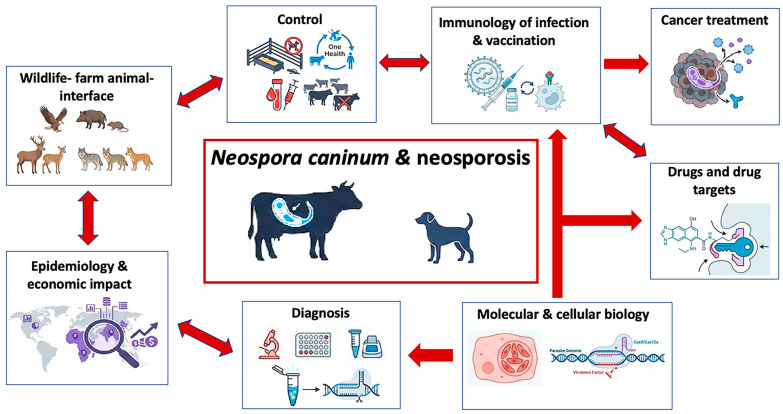 Figure 1
- —Swiss National Science Foundation
Peer Reviews
No public reviews on file for this paper yet. If you reviewed it on a platform where reviews are public (OpenReview, ICLR, NeurIPS, ICML), you can paste yours below so the community can read it here.
Videos
No videos yet. Explain this paper in a talk, walkthrough, or lecture? Add one.
Taxonomy
TopicsToxoplasma gondii Research Studies · Microbial infections and disease research · Parasitic Infections and Diagnostics
1. Neospora caninum and Neosporosis
Neospora caninum is an apicomplexan parasite that was isolated from dogs with encephalomyelitis and myositis [1]. After its discovery, it has emerged as a significant pathogen causing abortion and stillbirth in cattle and neurological disorders in dogs. Canids such as dogs, coyotes, gray wolves, and dingoes act as definitive hosts [2,3], while with respect to intermediate hosts N. caninum infects a diverse range of other farm animals and wildlife species [4,5,6]. This broad host range contributes to parasite persistence in various ecosystems and complicates control efforts.
The life cycle of N. caninum includes three distinct invasive stages. The rapidly proliferating tachyzoite stage causes acute disease and can invade and replicate in many tissues and cell types [7]. In vitro culture allows the visualization of tachyzoites, their interactions with the host cells, and their intracellular development by different microscopical techniques. Surface antigens (SAGs) mediate the first contact between host cell surface and parasite membrane, closely followed by the secretion of three types of secretory organelles crucially involved in host cell invasion. Initially, micronemes and rhoptries sequentially secrete MIC and ROP proteins, respectively, through the apical tip of the parasites. MIC and ROP proteins interact with host cell surface receptors and are involved in the formation of a gliding junction, which allows the parasite to invade by pushing the host cell surface membrane into the cytoplasm, until the parasite is located intracellularly and proliferates within a parasitophorous vacuole (PV), delineated by a parasitophorous vacuole membrane (PVM) [2,3].
Host cell invasion is followed by the secretion of dense granule (GRA) proteins into the lumen of the PV, some of which form the intravacuolar tubular network, modify the PVM or cross the PVM and enter the host cell nucleus to act as transcription factors. Several MIC, ROP, and GRA proteins constitute virulence factors and have been exploited as vaccine candidates [7,8]. In an immunocompetent host, tachyzoites will differentiate into slowly replicating bradyzoites that form tissue cysts and cause chronic infection. Tissue cysts are found mainly in the central nervous system (CNS) and in muscle tissue without causing symptoms. They are orally infectious for a carnivorous host. The third invasive stage is the sporozoites that are formed in the environment following the sexual development and oocyst formation that takes place in the intestinal tissues of the definitive host.
The life cycle of N. caninum starts by accidental uptake of infective oocysts containing sporozoites through contaminated food or water or ingestion of meat containing N. caninum tissue cysts formed by bradyzoites. These stages lead to the infection of enterocytes and proliferation within intestinal epithelial cells. Parasites multiply and undergo egress, followed by invasion of cells of the reticulo-endothelial system, including antigen-presenting dendritic cells, in which they further disseminate into other locations and tissues in the body as tachyzoites [9]. Infection goes largely unnoticed, but the inflammatory immune response eliminates a large part of the parasite population. The associated physiological stress triggers tachyzoite-to-bradyzoite differentiation in a subset of these parasites, resulting in the formation of tissue cysts, which finally persists mainly in the CNS and in skeletal muscle [10]. Ingestion of tissues containing bradyzoites by a definitive host can then lead to sexual development and oocyst formation in the intestine [6].
In pregnant animals, tachyzoites can be vertically transmitted and infect the fetus. Vertical transmission is highly relevant in cattle but has been reported also in several other animal species [6,8]. Transplacental vertical transmission can occur through the exogenous route following a primary infection during pregnancy or endogenously in chronically infected animals upon recrudescence of bradyzoites and conversion into tachyzoites during pregnancy. In both cases, parasites exploit the pregnancy-associated impairment of inflammatory immunity normally serving to protect the developing fetus, while at the same time increasing the risk of fetal infection. Vertical transmission rates vary significantly between host species [6,7], with fetal infection often resulting in abortion [11]. In intermediate hosts, particularly cattle, endogenous transplacental transmission can occur repeatedly through successive pregnancies. This process of interconversion between developmental stages is crucial for both parasite persistence and transmission, involving complex immunological interactions during both acute and chronic phases of infection [12]. The molecular mechanisms controlling the tachyzoite-bradyzoite-stage conversion in N. caninum are not well understood, as reliable in vitro models to study bradyzoite development have not been set up. In vitro stage conversion has been initiated by specific stress conditions such as pH changes and nitric oxide exposure [13,14,15], but the efficiency of these methods is limited [16].
The clinical manifestations of neosporosis vary, depending on the host species. In cattle, the primary impact is on reproductive health. Abortion mostly occurs in the second trimester of pregnancy, but neosporosis can also lead to birth of weak offspring or persistently infected calves devoid of any clinical signs. However, in subsequent pregnancies, these healthy offspring can transmit the parasite to the next generation, which represents a severe complication for the introduction of control measures [17]. Thus, early and accurate diagnosis is crucial for the effective management. In dogs, N. caninum infection can cause severe neuromuscular disease [1]. Neurological manifestations are often multifocal with predominantly cerebello-vestibular signs. The prognosis is generally poor, with complete clinical improvement in only about 6% of cases and a relapse rate of >25% [18]. Clinical presentations vary with age. In dogs under six months, manifestations primarily involve the peripheral nervous system with more generalized neuromuscular disorders including decreased spinal reflexes, tetraparesis, progressive weakness, muscle loss, and myalgia. In dogs over one-year old, the central nervous system appears affected to a higher degree, with cerebellar ataxia, head tremors, vestibular syndrome, and facial nerve deficits. Additional manifestations can include mega-esophagus, hyperthermia, and hepatomegaly [19]. In puppies, particularly those infected transplacentally, the infection can be particularly severe and often leads to death [20]. N. caninum imposes substantial economic burden most notably on the global cattle industry. Thus, vaccine development remains a primary research focus. Overall, traditional vaccine approaches have shown limited efficacy, but significant advances in reverse vaccinology, incorporating modern in silico methods and advanced genomic analyses, offer new opportunities for identifying promising vaccine candidates [7,21]. The complex nature of N. caninum transmission necessitates a One Health approach, recognizing the interconnections between livestock, wildlife, and human activities. This approach requires sustained international collaboration and coordinated surveillance, while considering ecological contexts and environmental factors [22]. To visualize the interconnected research domains and translational pathways discussed in this review, a schematic framework integrating diagnosis, epidemiology, molecular and immunological mechanisms, intervention strategies, and future directions is presented in Figure 1.
In this review, we summarize information on key advances in the field over the last 10 years and relate them to important findings published earlier.
2. Diagnosis of N. caninum Infection
The diagnosis of N. caninum infection relies on indirect serological detection of infection and direct demonstration of the parasite via molecular tools and immuno-histopathology. Serological techniques such as enzyme-linked immunosorbent assay (ELISA) and indirect fluorescent antibody test (IFAT) have been widely used in different animal species [6,23]. ELISA, using crude antigens or subcellular fractions, offers high throughput for large-scale screening, while IFAT on intact tachyzoites provides high specificity. However, ELISA may present cross-reactivity issues, and IFAT is labor-intensive. In addition, a plethora of different PCR-based techniques were established. A brief overview of the diagnostic laboratory methods that have been developed since the discovery of N. caninum is shown in Table 1.
More recently, improvements in ELISA have been achieved through the development of chimeric antigens, such as a recombinant antigen based on the two surface antigens NcSRS2 and NcSAG1 and the dense granule antigen NcGRA7 [34], achieving high sensitivity (86.7%) and specificity (96.1%) in detecting N. caninum antibodies in cattle. Udonsom et al. [35] evaluated the immunodiagnostic performances of specific recombinant proteins including NcPrx2, NcMIC4, and NcSAG1, with NcSAG1 and NcMIC4 demonstrating particular promise as reliable diagnostic markers. Fereig et al. [36] validated a NcSAG1-based immunochromatographic test (ICT) for the detection of N. caninum infection in cattle, which demonstrated high sensitivity (84.2%) and specificity (93.5%). This ICT is a rapid tool for on-site diagnosis, representing a significant advancement in field-applicable diagnostics for neosporosis control. To complement traditional diagnostic approaches and to identify active infections, quantification of pro-inflammatory cytokines such as IL-12 and IFN-γ can aid in distinguishing chronic and active infections [37], which is relevant given that N. caninum can establish persistent infections with varying levels of immune response at different stages.
Histopathological examination, particularly immunohistochemistry (IHC), remains the gold standard for definitive diagnosis. In cases of abortion, examination of both placental and fetal tissues is crucial. Advances in immunodiagnostics have improved the ability to differentiate between N. caninum and T. gondii in tissue samples. Lepore et al. [38] developed species-specific polyclonal antibodies targeting recombinant proteins (rNcSRS2 and rTgSRS2) that achieved 90.1% agreement between IHC and PCR testing. This advancement addresses a critical challenge in diagnostic specificity, particularly in abortion cases. While IHC is highly useful and informative, the quality and reliability of results depend significantly on several factors including infection stage, tissue preservation methods, and timing of sample collection. The characterization of stage-specific immunodominant antigens has further enhanced our understanding of diagnostic targets. For instance, evaluation of monoclonal and polyclonal antibodies against different parasitic stages demonstrated that antibodies directed against NcSAG1 specifically recognized N. caninum tachyzoites, while antibodies directed against the bradyzoite antigen NcSAG4 displayed broader cross-reactivity among parasite stages [39]. These findings have important implications for the development of stage-specific diagnostic tools and highlight the need to consider developmental stages when designing diagnostic tests.
N. caninum diagnosis has significantly benefited from advances in molecular techniques, providing unparalleled sensitivity and specificity. Quantitative PCR (qPCR) targeting the Nc5 gene enables detection of as few as 5 copies/µL in complex samples [40]. Building on qPCR technology, a high-resolution melting (HRM) assay developed by Gouvias et al. [41] enabled simultaneous detection of ten abortifacient pathogens including N. caninum in one sample, providing a cost-effective diagnostic solution for multiple pathogen screening. Optimized multiplexed qPCR assays allow simultaneous detection of N. caninum and T. gondii with a detection limit of less than a single tachyzoite [42]. Droplet digital PCR (dPCR) could be a further improvement to enhance diagnostic precision. In the case of T. gondii, dPCR achieved absolute quantification, with strong concordance (96.7%) with qPCR results and detection limits as low as 0.07 copies/µL [43], highlighting the potential application of dPCR also for N. caninum diagnostics. Emerging platforms, such as Loop-Mediated Isothermal Amplification (LAMP) and CRISPR-based systems, continue to push the boundaries of diagnostic innovation. LAMP demonstrated field applicability with sensitivity and specificity exceeding 90% [44,45]. Further validation of LAMP technology comes from Liu et al. [46], who developed a colorimetric detection method that enables reliable visual identification of N. caninum DNA without specialized equipment. In addition, CRISPR-based detection platforms have shown increasing promise, such as a recombinase polymerase amplification (RPA)-CRISPR/Cas12a-based detection using fluorescent readouts [47].
Numerous commercial diagnostic kits for serological and molecular detection of N. caninum infection are available on the market. However, bridging the gap between the laboratory- and field-based diagnosis by the integration of CRISPR and especially LAMP into portable kits could enormously advance sensitive and timely diagnosis. Importantly, each diagnostic technique exhibits its distinct advantages for specific applications. PCR-based molecular methods, while technically demanding, provide highly sensitive and specific detection of N. caninum [48], with advanced multiplexed qPCR systems achieving detection limits of less than one tachyzoite [42]. IFAT serves as a reference method, though its labor-intensive nature limits large-scale applications and subjective interpretation can be a problem [35]. ELISA provides a practical tool for herd-level screening despite varied kit agreement [49]. Emerging platforms such as RPA-CRISPR-based detection show high sensitivity with detection limits of one parasite/mL using fluorescent systems [47], while LAMP, not requiring extensive infrastructure, offers field applicability [45].
3. Distribution and Transmission of Neosporosis in Farm Animals
Earlier studies had shown that N. caninum infection in cattle is distributed worldwide with prevalence rates ranging from 10% to 60% (reviewed in [6]). Intensive farming systems generally showed a higher risk of infections with prevalence rates appearing to be influenced by management practices and animal husbandry.
In Europe, varying levels of N. caninum prevalence have been recorded in the last 5 years. In Switzerland, an overall low seroprevalence of 4.2% was observed in female cattle, with 16.2% of farms having at least one seropositive animal [50]. In Portugal, the animal-level seroprevalence was 17.2% and the herd-level seroprevalence was 68.6%, with notable differences between production systems—dairy farms showed a higher prevalence of 26.8%, compared to beef farms (14.4%) [51]. A large-scale study carried out on dairy cows in Northern Italy discovered significant regional variations in N. caninum prevalence. Analysis of bulk tank milk from 586 dairy herds showed an overall seroprevalence of 30.7%, with a higher prevalence in small−medium farms and older animals. Environmental factors such as temperature and altitude, as well as land use patterns, significantly influenced prevalence rates in different areas [52]. Studies on Neospora seroprevalences in bulk milk were also carried out in Canada, where a seasonal study in Alberta showed fluctuating prevalence rates throughout the year, ranging from 7.4% to 18.2% [53]. In Colombia, an overall seroprevalence of 20.6% was reported, with notably higher rates in beef herds compared to dairy herds [54]. In China, comprehensive meta-analyses were carried out. For instance, a nationwide review found an overall seroprevalence of 12.2% (20.9% in Southern China, 9.4% in Northwest China) [55]. Another meta-analysis examining the results obtained from 33,945 cattle from 51 studies across mainland China found an overall prevalence of 13.69% [56]. At the provincial level, significant variations were observed, with particularly high rates in Hebei Province where 37.34% of dairy cows tested positive [57], while lower rates were found in Hunan Province with 2.1% seroprevalence in beef cattle [58]. In Central India, a study of 576 cattle revealed a seroprevalence of 24.8%, with risk factors including age, movement of dogs on farms, drinking pond water, and history of abortion [59]. The first molecular study carried out in Bangladesh [60] identified N. caninum in aborted fetuses by nested PCR, with infection rates of 16.0% in cattle, 14.8% in sheep, and 11.8% in goats. Contrasting patterns between regions were also found on the African continent. In Egypt, two studies showed consistently high seroprevalence rates: 28.9% in Northern governorates [61] and 24.6% in the Beheira region [62]. In contrast, South Africa demonstrated much lower rates with an overall seroprevalence of 2.3%, although significant regional variations ranging from 7.5% in KwaZulu-Natal to 0.1% in Western Cape were observed [63]. In Somalia, a comprehensive survey revealed a seroprevalence of 3.6% in ruminants, with cattle showing the highest prevalence (6.2%), followed by goats and sheep (both 2.2%) [64]. An unpublished serological survey was conducted in the Biskra and Aures regions of Algeria. Of 64 serum samples obtained from female cattle, 8 were found positive (Debache et al., unpublished findings). Although serological screening can be informative, the antibody titers in persistently infected animals can fluctuate considerably. A recent study from De Oliveira et al. [65] demonstrated significant alterations in N. caninum antibody titres throughout pregnancy in naturally infected crossbred cows, with notable increases in serological titration per trimester. These findings suggest that pregnancy influences antibody levels and that serological testing from the sixth month of gestation onwards may reduce false negative results. In South America, bovine neosporosis represents a serious veterinary and economic problem. Neosporosis accounts for approximately 9% of bovine abortions in Buenos Aires Province, and epidemiological studies across Argentina revealed a high distribution of Neospora infections not only in dairy but also in beef cattle, with seroprevalence rates of 16.6–88.8% and 0–73%, respectively [66]. One study carried out in Brazil identified N. caninum as the primary cause of bovine abortion in 53.8% of cases, with PCR confirmation in 71.4% of positive samples [67]. Further epidemiological studies in Brazil’s southern region have revealed important environmental risk factors, with the presence of dogs being the most important one. In Santa Catarina State, Remor-Sebolt et al. [68] reported a 4.2% seroprevalence in canine populations, with housing conditions and outdoor exposure significantly influencing infection rates. A study of free-roaming dogs in Ecuador found a seroprevalence of 6.8%, with no significant differences between urban and rural areas, highlighting the widespread distribution of N. caninum in canine populations across diverse environments [69]. In contrast, lower seroprevalences in dogs and cats were measured in urban settings in Poland, with rates of 1.0% in dogs and 3.3% in cats [70]. This highlights the importance of environmental factors in N. caninum transmission, particularly in areas where dogs have unrestricted access to outdoor spaces and can thus influence the transmission dynamics.
N. caninum is transmitted either vertically from the dam to the fetus or horizontally through the ingestion of oocysts containing sporozoites or infected meat containing tissue cysts and bradyzoites. Vertical transmission represents the predominant route in both domestic and wild hosts and remains the most critical barrier to effective control. In one study on Iranian dairy cattle, vertical transmission resulted in 13.6% infection rates among offspring of seropositive dams, with 94.1% of aborted fetuses being N. caninum-positive [11]. Lagomarsino et al. [71] reported horizontal transmission rates of N. caninum reaching 22.7% in dairy cattle in an endemic region in Argentina. In South American deer, transmission rates of >80% were recorded [72], and in goats, rates reached up to 100% across successive generations [65]. Studies with wild ungulates in Northern Italy demonstrated an efficiency of congenital transmission reaching 87.5% [73], highlighting the significance of this pathway in maintaining parasite populations.
Horizontal transmission through ingestion of sporulated oocysts or the oral uptake of meat infected with N. caninum tissue cysts is influenced by environmental factors and host diversity. In Brazilian cattle, the access of dogs to pastures and improper disposal of fetal remains were key risk factors [74], and environmental factors such as altitude, precipitation, and temperature significantly affected N. caninum seropositivity rates [75]. Management practices focusing on preventing definitive host access to cattle feed and water sources remain critical for controlling horizontal transmission. The complexity of transmission dynamics, involving both domestic and wildlife cycles, necessitates integrated approaches to disease control. In this respect, a 2023 meta-analysis revealed a global seroprevalence of 5% in rodents, confirming their potential role as reservoir hosts [76].
The worldwide prevalence of neosporosis has a considerable economic impact. An earlier systematic review by Reichel et al. [77] estimated global losses exceeding US 842.9 million) incurred by the dairy industry. Ribeiro et al. [78] reported that N. caninum-infected cattle were 2.66 times more likely to experience abortion, highlighting the direct link between infection rates and economic losses. A more recent report from Turkey [79] estimated costs associated with Neospora infection of approximately 710 US110 million [80,81], while in Argentina the annual economic impact amounts up to US$33 million in the dairy cattle and 12 million in the beef cattle industry [66]. Financial losses through neosporosis are particularly pronounced in regions with intensive cattle production systems, and respective assessments are not straightforward, due to the differences in surveillance capabilities across regions. Despite the importance of livestock production for food security and livelihoods in many communities, comprehensive surveillance data for abortifacient pathogens including N. caninum remain limited in many parts of Africa and Asia [82]. This gap in surveillance suggests that the true global economic impact may be substantially underestimated, highlighting the need for improved monitoring and control strategies.
4. The Farm Animal−Wildlife Animal Interface and Control
Due to its implications for livestock health, the role of wildlife as reservoirs for N. caninum has garnered increasing attention. The presence of N. caninum was reported in migratory birds, underscoring their potential as long-distance vectors contributing to the geographic spread of the parasite [73]. Other studies identified elevated transmission risks in regions where domestic animals interact closely with wildlife [83]. In addition, wild ungulates acting as intermediate hosts were suggested to contribute to the presence of N. caninum in livestock [84]. Additional wildlife reservoirs were identified by Haydett et al. [85] and Zanet et al. [73] in wild pigs and birds of prey. In a long-term study lasting 18 years, the seroprevalence of N. caninum in wild rabbits was shown to be >6%, with significant seasonal variations and peak rates during spring, most likely related to prolonged oocyst survival [86]. Huaman et al. [81] detected a 3.7% seroprevalence in wild deer across Southeastern Australia, and Baldini et al. [72] demonstrated an 81.25% vertical transmission rate of N. caninum in South American deer. Thus, control approaches for N. caninum should also take into account the contribution of the sylvatic cycle.
Spatial analyses in endemic regions of the Amazonas in Brazil have revealed significant heterogeneity in parasite distribution, with seroprevalences ranging from 2.2% to 69.2% [87]. Similarly, epidemiological studies in Argentina revealed seroprevalence rates ranging from 16.6% to 88.8% in dairy cattle and 0% to 73% in beef cattle, demonstrating dramatic regional differences. Thus, it is important to integrate genetic, environmental, and management factors into tailored intervention strategies to mitigate the diverse impacts of N. caninum [66]. Key risk factors for neosporosis were identified, including dairy farming systems, mixed land use patterns, water source management, and the presence of domestic dogs, with the latter as a continuous source of environmental contamination with oocysts [78,87]. Another factor that influences the epidemiology of neosporosis is genetic variability. A study on N. caninum isolates from aborted bovine fetuses carried out in Northern Italy showed that spatial distance between sampling sites can be linked to genetic variation [88]. Thus, localized adaptation can potentially lead to genetic divergence. In the Amazonian region of Brazil, environmental factors such as high humidity, extensive floodplains, and dense livestock−wildlife interfaces significantly impact parasite transmission [87].
Host−pathogen interactions further complicate integrated control strategies. Holstein cattle show increased susceptibility to N. caninum-induced abortion compared to beef breeds [89], while embryo transfer studies demonstrate that donor seropositivity can affect embryo quality without direct transmission [90]. In Argentina, selective breeding strategies and embryo transfer have demonstrated efficacy in reducing vertical transmission and seroprevalence in dairy herds, providing a promising avenue for mitigating reproductive losses [66]. Experimental infections of Texel sheep with N. caninum at different stages of gestation demonstrated vertical transmission of the parasite to the fetus, but absence of abortions and other clinical signs suggested that Texel sheep may potentially have resistance to N. caninum-induced abortion [91]. These findings suggest that genetic and reproductive management strategies must be considered alongside broader epidemiological interventions.
5. Molecular and Cellular Biology of N. caninum
Significant progress in molecular techniques has revolutionized our understanding of N. caninum through multiple technological breakthroughs. High-throughput sequencing analysis has already earlier revealed novel insights into the genome of N. caninum, such as the presence of an expanded repertoire of SAG1-related proteins compared to T. gondii [92]. More recent studies have employed high-throughput RNA sequencing to study microRNAs (miRNAs) involved in the regulation of gene expression in parasites and host cells. For instance, Liu et al. [93] identified 300 miRNAs in N. caninum tachyzoites, and bioinformatics analyses showed that 10 were conserved among metazoan miRNA families, while 290 were novel miRNAs. In another bioinformatics study, Das et al. [94] performed a homology search on 336 non-redundant Expressed Sequence Tags (ESTs) of the N. caninum genome to identify conserved miRNAs. A total of 1041 mature miRNAs of reference organisms were employed; one putative miRNA “nca-miR-9388-5p” of 19 nucleotides was identified, and 16 potential target genes associated with different protozoal physiological functions were identified. This work has been complemented on the host cell side by temporal transcriptomic analyses of miRNA expression in caprine endometrial epithelial cells infected with N. caninum at 24 h and 48 h post-infection, identifying numerous up- and downregulated miRNAs at both time points. Bioinformatically predicted targets are genes involved in host immune responses, metabolism, and multiple signaling pathways. One upregulated chi-miR-146a was found to promote tachyzoite proliferation [95].
A pivotal breakthrough in genetic manipulation tools came with the implementation of CRISPR technology. Arranz-Solís et al. [96] established an efficient gene disruption system using CRISPR/Cas9 plasmids earlier developed for T. gondii, successfully targeting GFP in a reporter strain and disrupting NcGRA7 through pyrimethamine-resistance cassette (mdhfr-ts) insertion. However, it was recognized that CRISPR/Cas9 mutagenesis is not free of off-target effects that can lead to integration of multiple mdhfr-ts copies into other sites of the genome. Thus, TaqMan-quantitative PCR assays were developed that allowed determination of the copy numbers of the integrated selectable markers in CRISPR/Cas9-generated N. caninum KO strains [97]. To prevent multiple insertions, another highly efficient genetic manipulation system was established by Mineo et al. [98] through disrupting the ku80 gene in the N. caninum-Liverpool reference strain. This modification led to improved homologous recombination efficiency and enabled precise gene targeting with shorter homology regions, bringing the manipulation capabilities closer to those available for T. gondii.
The work by Arranz-Solis et al. [96] was closely followed by Nishikawa et al. [99] who reported that NcGRA7 KO strains exhibit a reduced virulence and that this protein is involved in modulation of the immune response [99]. The same was shown in the pregnant neosporosis mouse model [100]. In addition, NcGRA7 was shown to interact with cellular immune factors in mice, such as mediating the aggregation of IRGa6—an interferon-inducible GTPase—at the PVM, which affects the pathogenicity of N. caninum [101]. However, cross-species translation of results such as from mice to farm animals should be done with caution. The basic features of murine and bovine immunity, including transplacental passage of immunoglobulins, Th1- and Th2-immunity, the composition of the T cell repertoire, and the functionality of interferon-induced GTPases, show clear differences [7].
Other GRA proteins were characterized by generating CRISPR KO strains such as NcGRA17 [102], NcGRA6 [103], and NcGRA2 [104], demonstrating that these proteins were important for parasite virulence. Biotinylation revealed interaction partners with NcGRA17, named NcGRA23 and NcGRA11, but the corresponding CRISPR KO strains did not show any impairment. Three novel GRA proteins, NcGRA27, NcGRA61, and NcGRA85, were identified by the proximity-dependent biotin identification (BioID) technique [105]. Deletion of the NcGRA27 gene reduced the in vitro replication and the pathogenicity of N. caninum tachyzoites in mice, while deletion of NcGRA61 and NcGRA85 had no impact on virulence [105]. CRISPR/Cas9 was also employed to clarify the roles of two rhoptry proteins as virulence factors, namely NcROP40 and NcROP2 in N. caninum development and host−parasite interactions. NcROP40 KO strains exhibited a modestly reduced virulence compared to wild-type parasites when assessed in the pregnant mouse model [100], while NcROP2 KO tachyzoites exhibited more impaired virulence in the pregnant neosporosis mouse model, were less susceptible to IFN-γ-mediated inhibition and were more readily converted to the semi-dormant bradyzoite stage compared to the wild type [106]. The transcription factor NcAP2XII-4, whose expression was previously shown to be altered upon deletion of the gene coding for NcROP5, was also functionally characterized by employing CRISPR/Cas9 [107]. CRISPR/Cas9-mediated deletion of NcAP2XII-4 resulted in parasites that were not able to undergo egress from the parasitophorous vacuole and could not form plaques, and subsequent investigations confirmed that NcAP2XX-4 regulated ROP5 transcription by binding to its promoter. Other proteins whose roles as virulence factors were confirmed are the major surface antigen NcSAG1 as a major determinant mediating pathology in pregnant and non-pregnant mice [108], the virulence factors NcPuf [109], and the c-myc-proto-oncogene regulatory protein NcMyr1 [110].
Besides these molecular advances, classical and modern microscopy approaches were applied to characterize endodyogeny in N. caninum tachyzoites [111]. Expansion microscopy and regular confocal microscopy were used to study the dynamics of the cell assembly and nuclear division, describing centrosome, centriole, and apicoplast dynamics, during the cell cycle. In addition, the implementation of three-dimensional culture systems has opened new avenues for studying host−pathogen interactions, especially in apicomplexan parasites related to N. caninum such as Plasmodium, Cryptosporidium, Eimeria, and Toxoplasma [112,113]. Such cultures, including organoids and microfluidic devices, provide more physiologically relevant contexts for studying parasite life cycles and the implementation of advanced molecular techniques.
6. Immunological Control of Infection and Vaccination
The host immune response against N. caninum infection has a profound influence on the outcome of pregnancy and fetal survival. In general, as for many other intracellular pathogens, a Th1-biased immune response characterized by pro-inflammatory cytokine expression mediates protection against N. caninum infection. However, it has been shown in murine models that pregnancy outcome can be impaired due to excessive inflammatory responses [12,114], and the same could be true for bovine hosts [115]. A further factor complicating the situation is the fact that different N. caninum isolates were shown to differ considerably in virulence. Differences in terms of innate and adaptive immune responses were observed in a study on placentomes of cattle experimentally infected with a highly virulent (Nc-Spain7) isolate and a low-virulence (Nc-Spain 1H) isolate [116]. Infection with the low-virulence isolate resulted in the upregulated expression of pathogen recognition receptors, chemokines, and pro-inflammatory cytokines that mediate control, as well as other mechanisms implicated in the maintenance of extracellular matrix integrity, resulting in ensuring fetal survival. In contrast, these responses were impaired in placentomes of cattle infected with the more virulent Nc-Spain7 isolate during the first 10 days post-infection (10 dpi). Subsequently (20 dpi), a predominantly pro-inflammatory Th1-based response and increased leucocyte infiltration were observed, and fetal death was associated with higher expression levels of IL-8, TNF-α, iNOS, and SERP-1 genes, and lower expression of the metalloproteases and their inhibitors, compared to placentomes from animals carrying viable fetuses [116]. Understanding these immunological mechanisms is essential for developing effective control strategies based on vaccines, not only in cattle but also in sheep and goats [117].
Early efforts in vaccine development, carried out in murine models and to a lesser extent also in small and large ruminant models, included vaccines composed of N. caninum tachyzoite antigen extracts and/or subcellular fractions and those composed of recombinant antigens as monovalent and chimeric formulations, as well as polyvalent recombinant vaccine candidates expressed in different expression systems and formulated with different adjuvants (reviewed in [7]). Table 2 summarizes a range of studies which were done in the actual target hosts, namely one study in sheep [118] and others in cattle, employing either parasite extracts/subunit vaccines or live vaccines (attenuated N. caninum isolates). With one exception [118], attenuated live vaccines were those that provided meaningful protection against abortion and/or vertical transmission, while subunit vaccines showed lower efficacy [7].
Most vaccine candidates studied to date are immunogenic surface, microneme, and rhoptry of dense granule proteins functionally involved in host cell adhesion/invasion. Parasite proteins that elicit inflammatory responses and are responsible for the immunopathology that leads to abortion have also been considered as vaccine candidates. Of note, a dual-antigen vaccine combining recombinant N. caninum cyclophilin (NcCyP) and profilin (NcPro), both important mediators of inflammatory responses, has shown significant protection in sheep, with 69.2% of vaccinated ewes giving birth to viable lambs compared to complete abortion in control animals [118]. More recently, Mendoza-Morales et al. [133] introduced a recombinant subunit vaccine with a dual Differentiation of Infected from Vaccinated Animals (DIVA)-like capability, which comprises recombinant NcSAG1 and the carrier/adjuvant heat shock protein 81.2 from Arabidopsis thaliana (rAtHsp81.2, a known B-cell mitogen). The vaccine formulation has been demonstrated earlier to be safe and efficacious in the murine neosporosis model and allowed differentiation between vaccinated and infected animals [134]. In cattle, this formulation stimulated a broad and potent humoral and cellular immune response, characterized by an IgG1/IgG2 isotype profile and IFN-γ secretion, and also allowed differentiation between vaccinated and infected heifers by two different DIVA compliant test approaches [133]. Studies on the efficacy of this vaccine approach are still pending, but using this strategy will allow more precise disease monitoring, making it a critical step forward in controlling N. caninum in cattle.
Although in earlier studies the most promising vaccine results were obtained with live-attenuated parasites in both murine models [135,136,137,138] and cattle [127,128,129], safety concerns, production costs, and the anticipated non-stability of live vaccines blocked their further development into commercial products [7]. As an alternative, an approach that utilizes the attenuated Listeria monocytogenes vaccine vector Lm3Dx devoid of three important virulence genes but expresses one or more N. caninum antigens has been introduced. The safety and outstanding efficacy of this Lm3Dx-based Neospora vaccine vector has been demonstrated in the pregnant neosporosis mouse model [139,140,141].
Additionally, immunoinformatic approaches have been followed for the virtual to design and evaluation of vaccine candidates, predicting a number of important features such as antigenicity, solubility, potential allergenic domains, posttranslational modifications, transmembrane domains and signal peptides, secondary and tertiary structures, and linear and conformational B-cell epitopes, and potential MHC class I and II presentation and T cell cytotoxicity. Using this approach, Shams et al. [142] predicted a multiepitope vaccine candidate incorporating epitopes from six key proteins (SRS2, MIC3, MIC6, GRA1, IMP-1, and profilin). In addition, bioinformatic evaluation of the NcSRS2 protein identified immunogenic epitopes capable of inducing dual immune responses, with high antigenicity and no allergenicity, positioning it as a strong candidate for next-generation vaccines [143].
Progress has also been made in the development of delivery methods and formulations. Yao et al. [144] highlighted the importance of adjuvant combinations for preventing high-incidence diseases in bovines, such as the addition of TLR2 and TLR9 as adjuvants for recombinant NcPro to achieve higher levels of IFN-γ and to ensure a prolonged recall B-cell response in cattle compared to other adjuvants [124]. Others have used di-palmitoyl phosphatidyl glycerol-loaded nanoparticles (DGNP) loaded with N. caninum extract and N. caninum glycosylphosphatidylinositol (GPI) and found an adjuvant effect in murine bone marrow-derived dendritic cells with higher levels of interleukin (IL)-1β, IL-6, IL-12p40, and IL-10, and decreased expression of major histocompatibility complex (MHC) molecules. GPI also modulated the responses of bovine peripheral blood mononuclear cells (PBMCs) by increasing the production of IFN-γ and by decreasing the expression of MHC molecules [145], suggesting that the GPI adjuvant effect should be exploited for vaccination. In addition, recent developments of more advanced DNA vaccine platforms [146], self-assembling protein nanoparticles (SAPNs), and virus-like particles (VLPs) with demonstrated abilities to enhance antigen uptake, B-cell activation, and lymph node trafficking [147] await further exploitation in the Neospora vaccine field.
Subunit vaccine candidates could also be incorporated into mRNA vaccines. As reviewed in [7], mRNA can overcome mis-folding during in vitro expression of recombinant proteins, and mRNAs, as opposed to DNA vaccines, are considered to have very little safety issues as they retain a cytoplasmic localization, thus minimizing the risk of gene recombination and conversion into malignant cells. Messenger RNA vaccines are designed relatively easily, thus incurring little costs of production and time requirements. The major caveat is their short intracellular half-life and the rapid degradation during storage [7]. However, variability in host immune responses remains a significant barrier, necessitating further standardization and optimization.
7. Recent Advances in Therapeutic Strategies
Traditional therapeutic approaches against N. caninum have relied on folate biosynthesis inhibitors, primarily sulfadiazine and pyrimethamine, or alternatively a combination of trimethoprim, another folic acid antagonist, and sulfamethoxazole. These compounds, while useful for managing clinical neosporosis in dogs, show limited efficacy in cattle, particularly due to their potential adverse effects in pregnancy and their minimal impact on tissue cysts [148,149]. Other repurposed drugs have been investigated but in many cases have not been applied clinically in cattle such as the protein synthesis inhibitor clindamycin, the ionophore antibiotic monensin, the triazinetrione derivative toltrazuril, the cytochrome bc1 inhibitors decoquinate, buparvaquone and endochin-like quinolones (ELQs), a number of anti-malarials such as artemisinin and its derivatives and mefloquine, and the alkyl phospholipid miltefosine (for review see [7,150]). Systematic screening efforts of open-source libraries such the Medicines for Malaria Venture (MMV) Malaria Box and the MMV Pathogen Box employing transgenic parasites that express bacterial beta-galactosidase have significantly expanded the arsenal or repurposed drugs [151,152]. More recently, CRISPR/Cas9 was used to generate transgenic tachyzoites that allow high-throughput in vitro drug screening [153], leading to the discovery of TAK-632, a selective pan-rapidly accelerated fibrosarcoma (pan-RAF) kinase inhibitor employed in cancer. In experimentally infected mice, TAK-632 attenuated the virulence of N. caninum and significantly reduced the parasite burden in the brain.
Additionally, Harada et al. [154] developed a novel high-standard chemiluminescent assay targeting nucleoside triphosphate hydrolase (NTPase), leading to the identification of 19 synthetic compounds and six marine bacterial extracts with inhibitory activity, providing potential candidates for anti-parasitic drug development. This screening platform was further refined by Kurata et al. [155], who implemented robotic automation to enhance throughput and precision, establishing a more efficient drug discovery pipeline for both N. caninum and T. gondii. A comprehensive evaluation of antimalarial compounds against N. caninum revealed distinct efficacy profiles [156]. Atovaquone emerged as the most potent compound (IC50 = 8 nM), comparable to its activity against T. gondii and Plasmodium. Tetracycline showed significant efficacy with an IC50 of 19.6 μM, while primaquine and quinine demonstrated very low activity (IC50 = 44.4 μM and 56.6 μM, respectively). Notably, chloroquine required concentrations above 100 μM for inhibitory effects. The study also revealed important differences in drug susceptibility patterns among apicomplexan parasites, suggesting species-specific therapeutic targets [156].
Another example of a repurposed drug is niclosamide, a compound that was developed for clinical use in tapeworm infections and blocks glucose uptake. Niclosamide was shown to act against N. caninum through a novel mechanism involving the NLRP3 inflammasome activation in mice. Niclosamide enhanced macrophage-mediated parasite clearance but also exhibited direct antiparasitic activity, significantly reducing the parasite burden in tissues and improving survival rates in murine models. Notably, niclosamide treatment affected the mitochondrial membrane potential and ATP production in N. caninum tachyzoites, suggesting multiple mechanisms of action [46].
The efficacy of natural products such as a cyclic natural compound isolated from Tetragonisca angustula honey was demonstrated, exerting a 40–56% reduction in tachyzoite numbers and a dose-dependent inhibition of parasite proliferation up to 50%, all without toxicity to host cells [157]. Another natural compound, Inonotus obliquus polysaccharide (IOP) was identified by Tang et al. [158]. IOP treatment at 2 mg/10 g provided protection against N. caninum infection in mice, reducing parasite burden in multiple organs and modulating immune responses through regulation of immunoglobulin levels (IgG1, IgG2a) and cytokine production (IL-12, TNF-α). Additionally, IOP treatment showed no toxicity in vitro or in vivo, while effectively balancing hormonal responses, suggesting its potential as a safe therapeutic option [158]. Cordycepin, a nucleoside antibiotic derived from Chinese medicine Cordyceps militaries, was shown to exhibit profound activity against N. caninum in vitro and in vivo. Upon experimental infection, mice treated with cordycepin showed reduced clinical symptoms, increased food intake and significantly increased body weight [159].
More targeted therapies have been achieved with Bumped Kinase Inhibitors (BKIs). These compounds target two apicomplexan kinases, namely calcium-dependent protein kinase 1 (CDPK1) that is involved in signaling events that regulate host cell invasion and egress [160], as well as a specialized mitogen-activated protein kinase (MAPKL1) that localizes to the centrosome where it prevents overduplication and is crucial for proper centrosome function during asexual replication and cell division [161]. The latest generation BKIs, namely BKI-1748 and BKI-1708, efficiently impaired N. caninum tachyzoite proliferation (IC50 < 500 nM) and effectively reduced vertical transmission in experimentally infected mice [162,163]. Interestingly, BKIs do not kill the parasites in vitro but induce the formation of multinucleated complexes consisting of newly formed zoites that are blocked in the final stages of cell division and remain stuck within the host cell cytoplasm. This affects the humoral and cellular immune response as shown in experimentally infected mice treated with another BKI-family member, BKI-1294 [138], as well as with BKI-1748 and BKI-1708 [162,163]. By applying affinity chromatography, BKI-1748 was shown to bind not only to NcCDPK1 but also to N. caninum proteins and enzymes that are crucially involved in RNA- and DNA-binding and -modification processes, most notably splicing factors, suggesting that other targets besides the activity against these two kinases are involved [164].
The field has progressed through combination approaches and drug delivery innovations. Anghel et al. [165] studied the efficacy of ELQs that were originally developed for the treatment of toxoplasmosis, with one derivative, ELQ-334, achieving a 50% reduction of vertical transmission in pregnant mouse models. A treatment with a combined ELQ-334 plus BKI-1748 treatment achieved a synergistic effect in vitro and resulted in complete inhibition of vertical transmission in the mouse model [166]. Efforts on drug delivery options are underway to improve bioavailability, pharmacokinetic properties, and targeted action of compounds. This could be achieved by formulating compounds in solid dispersions, microparticles, polymeric micelles, nanosuspensions, lipid-based nanocarriers or liposomes, and other suitable agents.
Modulating the host immune response to combat N. caninum infection offers another promising therapeutic pathway. High and low virulence isolates of N. caninum induce virulence-dependent pro-inflammatory responses in bovine macrophages via the NF-κB signaling pathway [167]. These differences provide a foundation for therapeutic interventions aimed at enhancing protective immunity while reducing parasite evasion mechanisms. Targeting host signaling pathways offers further opportunities. Bhandage et al. [168] revealed that N. caninum activates GABAergic signaling in mononuclear phagocytes, enhancing their motility and facilitating parasite dissemination. Therapeutic strategies that disrupt GABA receptor or calcium signaling could limit parasite spread. Similarly, Mota et al. [169] identified the p38 MAPK pathway as a critical mechanism of immune evasion, with its inhibition leading to increased cytokine production and improved host survival. Additional research has focused on host-based strategies.
8. N. caninum as a Therapeutic Agent for Cancer Treatments
Most interestingly, within the last few years, N. caninum has switched its role from being a therapeutic problem to becoming a therapeutic agent, most notably in cancer treatment. Lantier et al. [170] exploited the following facts: (i) tumor growth induces an immune-modulated environment; and (ii) infection with an intracellular pathogen can potentially twist this modulated, or partially downregulated, immunity into eliciting an inflammatory response that could also affect tumor cells. Injection of N. caninum tachyzoites into mice inoculated with thymoma EG7 or human Merkel cell carcinoma led to severe impairment or even eradication of the tumor mass. This effect was based not only on direct lysis of tumor cells, but also on the reactivation of immunosuppressed cells and the development of a protective anti-tumor response dependent on natural killer (NK) cells, CD8-T cells, and interferon (IFN)-γ secretion into the tumor microenvironment. A transgenic N. caninum strain expressing and secreting human interleukin (IL)-15 induced both proliferation of human peripheral blood mononuclear cells (PBMCs) and IFN-γ secretion, and was used to successfully treat murine lung metastases by intranasal administration, leading to increased numbers of NK and cytotoxic T cells and macrophages, with the latter showing a polarization towards the antitumoral M1 phenotype [171]. Another transgenic N. caninum strain expressed and secreted a single-chain variable fragment fused to an Fc domain (scFv-Fc) binding to human programmed cell death ligand 1 (PD-L1). The scFv-Fc bound to PD-L1 on mouse and human tumor cells, blocked the programmed cell death protein 1 (PD-1)/PD-L1 pathway and induced T cell activity, antibody-dependent cellular phagocytosis, and cellular cytotoxicity [172]. Thus, N. caninum behaves as a live biotherapeutic capable of modulating both tumor growth and host immunity.
These findings place N. caninum within a broader emerging field where parasites are actively explored as immunostimulatory tools and sources for the development of anti-neoplastic strategies [173,174]. In parallel, engineered bacteria and other living microorganisms are being developed as programmable cancer immunotherapies and live biotherapeutic products. They incorporate genetic circuits that control tumor colonization, payload delivery, and safety profiles [175,176,177]. In this conceptual framework, N. caninum can be viewed as a potential Trojan horse-like programmable immuno-oncology platform. The parasite chassis can enter and perturb tumors while carrying defined therapeutic cargos and attenuation modules. Such a view bridges classical neosporosis control with the wider field of engineered live biotherapeutics.
9. Conclusions and Perspectives
Integrated control strategies remain paramount in mitigating the impact of N. caninum across diverse ecosystems. As shown in Argentina [66,71], selective breeding programs and embryo transfer have resulted in reduced vertical transmission and seroprevalence in dairy herds, providing a promising avenue for limiting reproductive losses in livestock. However, these programs require sustained commitment and consistent monitoring to ensure long-term success. Control strategies must also address the role of definitive hosts in environmental transmission, as well as the interface between farm and wildlife animals. The integration of “One Health” principles, linking human, animal, and environmental health, is crucial for the sustained success of control programs, particularly in regions with high human–livestock interactions.
The development of novel vaccines to be applied in cattle as the economically most important target host is important. These include live-attenuated and subunit vaccines, vaccines based on secretory components or exosomes, carbohydrate-based vaccines, and DNA or—based on the proven success against viral infections—mRNA vaccines [7,178]. Relevant vaccine targets in apicomplexan parasites are now being discovered by employing high-throughput approaches based on genomics, transcriptomics, and proteomics, together with techniques to genetically manipulate N. caninum. This will further improve our understanding of the biology of N. caninum and its interaction with the host, and will lead to the identification of determinants of virulence and triggers of immunity, thus contributing to the identification of novel targets for intervention [179]. Bridging the gap between immunological variability and vaccine development is essential for advancing effective intervention. In any case, a successful vaccine must elicit not only B cell responses, but also T-helper cell and cytotoxic T cell responses [65].
The chronic bradyzoite stage has a key role in transmission of N. caninum and should be more thoroughly investigated. The persistence of asymptomatic carriers represents a major challenge for control, and chronically infected animals maintain parasite populations within herds without exhibiting clinical signs, complicating detection and management [72]. In addition, bradyzoites pose significant barriers to treatment and immunological intervention, being largely resistant to chemotherapeutic agents and immune responses. Investigations on transcription factors that govern stage conversion in N. caninum could enhance our understanding of its chronic persistence, metabolic adaptation, and asymptomatic nature, which still remain critical knowledge gaps.
Overall, to overcome persistent obstacles in neosporosis control, a multidisciplinary approach is essential. Integrating genomic, proteomic, and transcriptomic data will provide a comprehensive understanding of host−parasite interactions, while international repositories of well-characterized N. caninum strains will enhance research consistency. The combined efforts of molecular research, therapeutic innovation, and collaborative surveillance frameworks will be pivotal in bridging the gap between laboratory discoveries and practical solutions.
The reference list from the paper itself. Each links out to its DOI / PubMed record.
- 1Dubey J.P. Hattel A.L. Lindsay D.S. Topper M.J. Neonatal Neospora caninum Infection in Dogs: Isolation of the Causative Agent and Experimental Transmission J. Am. Vet. Med. Assoc.19881931259126310.2460/javma.1988.193.10.12593144521 · doi ↗ · pubmed ↗
- 2Gondim L.F.P. Mc Allister M.M. Pitt W.C. Zemlicka D.E. Coyotes (Canis latrans) Are Definitive Hosts of Neospora caninum Int. J. Parasitol.20043415916110.1016/j.ijpara.2004.01.00115037103 · doi ↗ · pubmed ↗
- 3Mc Allister M.M. Dubey J.P. Lindsay D.S. Jolley W.R. Wills R.A. Mc Guire A.M. Dogs Are Definitive Hosts of Neospora caninum Int. J. Parasitol.1998281473147810.1016/S 0020-7519(98)00138-69770635 · doi ↗ · pubmed ↗
- 4Hemphill A. The Host-Parasite Relationship in Neosporosis Adv. Parasitol.1999434710410.1016/s 0065-308x(08)60241-910214690 · doi ↗ · pubmed ↗
- 5Hemphill A. Vonlaufen N. Naguleswaran A. Cellular and Immunological Basis of the Host-Parasite Relationship during Infection with Neospora caninum Parasitology 200613326127810.1017/S 003118200600048516753081 · doi ↗ · pubmed ↗
- 6Dubey J.P. Hemphill A. Calero-Bernal R. Schares G. Neosporosis in Animals 1st ed.CRC Press Boca Raton, FL, USA Taylor & Francis Oxfordshire, UK 2017
- 7Imhof D. Hänggeli K.P.A. De Sousa M.C.F. Vigneswaran A. Hofmann L. Amdouni Y. Boubaker G. Müller J. Hemphill A. Working towards the Development of Vaccines and Chemotherapeutics against Neosporosis-with All of Its Ups and Downs-Looking Ahead Adv. Parasitol.20241249115410.1016/bs.apar.2024.01.00138754928 · doi ↗ · pubmed ↗
- 8Pastor-Fernández I. Collantes-Fernández E. Jiménez-Pelayo L. Ortega-Mora L.M. Horcajo P. Modeling the Ruminant Placenta-Pathogen Interactions in Apicomplexan Parasites: Current and Future Perspectives Front. Vet. Sci.2021763445810.3389/fvets.2020.63445833553293 PMC 7859336 · doi ↗ · pubmed ↗