Prognostic Role of the Endothelial Activation and Stress Index (EASIX) in Functional Outcomes and Mortality After Acute Ischemic Stroke: A Retrospective Pilot Cohort Study
Michail Makris, Eleftheria Ztriva, Eleni Gavriilaki, Vasileios Patriarcheas, Vasiliki Gougoula, Michail Giannakakis, Alexandros Tselepis, Georgios Ntaios, Christos Savopoulos, Georgia Kaiafa

TL;DR
This study explores whether a biomarker called EASIX can predict outcomes in stroke patients, finding possible relevance in a specific subgroup with small vessel disease.
Contribution
The study is the first to report a potential prognostic role of EASIX in small vessel disease stroke patients.
Findings
EASIX was not associated with outcomes in the overall stroke cohort.
In patients with small vessel disease, higher EASIX correlated with worse disability and mortality.
EASIX positively correlated with WBC and CRP levels, and was lower in females.
Abstract
Background: Endothelial dysfunction is a key player in stroke pathophysiology. The Endothelial Activation and Stress Index (EASIX) is a biomarker of endothelial injury validated in hematology, sepsis, and cardiovascular cohorts; however, its prognostic role in stroke remains unclear. This retrospective cohort study aims to provide preliminary evidence on the potential utility of EASIX levels as a biomarker for assessing stroke severity and predicting outcomes. Methods: We retrospectively studied 100 patients aged ≥ 18 years admitted with acute ischemic stroke (AIS) or transient ischemic attack (TIA) between January 2020 and July 2024. EASIX was calculated on admission as LDH × creatinine/platelets. Outcomes included in-hospital and 12-month mortality, stroke severity assessed by the NIHSS score, and disability assessed as a modified Rankin score (mRS). Results: Median age was 82 years;…
Genes, proteins, chemicals, diseases, species, mutations and cell lines named across the full text — each resolved to its canonical identifier and authoritative record.
Click any figure to enlarge with its caption.
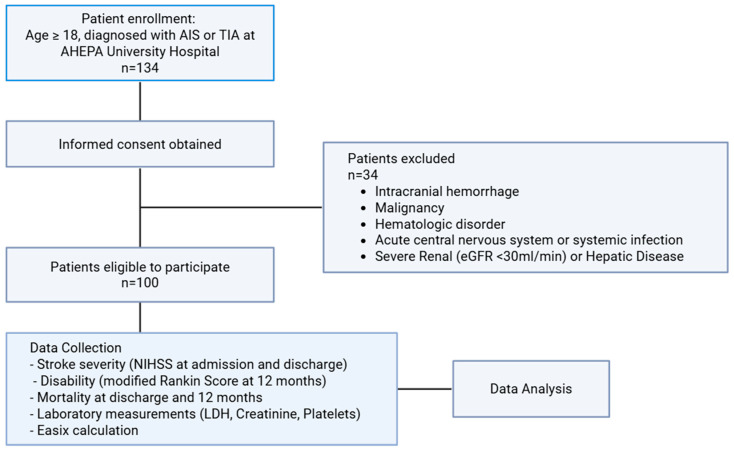 Figure 1
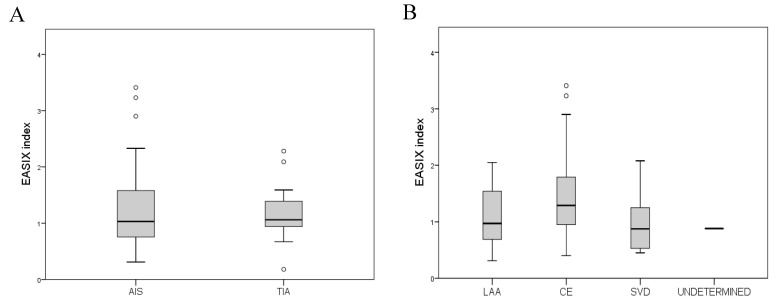 Figure 2
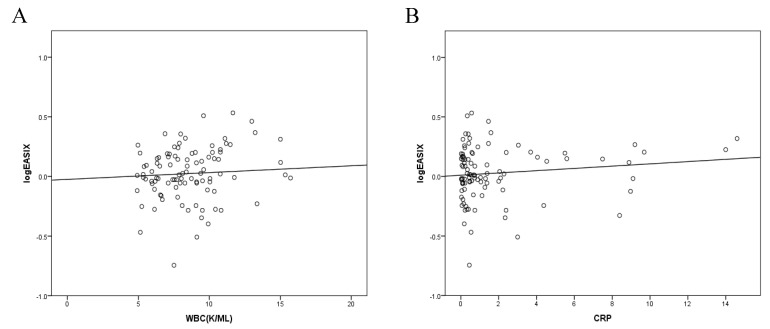 Figure 3
Peer Reviews
No public reviews on file for this paper yet. If you reviewed it on a platform where reviews are public (OpenReview, ICLR, NeurIPS, ICML), you can paste yours below so the community can read it here.
Videos
No videos yet. Explain this paper in a talk, walkthrough, or lecture? Add one.
Taxonomy
TopicsInflammation biomarkers and pathways · Neuroinflammation and Neurodegeneration Mechanisms · S100 Proteins and Annexins