The Evolving Role of Artificial Intelligence in Andrological Surgery: Current Landscape and Future Direction
Antonio Andrea Grosso, Francesca Conte, Luca Mazzola, Francesco Lupo Conte, Beatrice Giustozzi, Riccardo Ferretti, Marco Saladino, Daniele Paganelli, Luca Lambertini, Fabrizio Di Maida, Mattia Lo Re, Valeria Pizziconi, Gianni Vittori, Rino Oriti, Andrea Cocci, Andrea Mari

TL;DR
Artificial intelligence is transforming andrological surgery by improving diagnosis, surgical planning, and patient care, but more research and ethical guidelines are needed.
Contribution
This review synthesizes current AI applications in andrological surgery and highlights future directions for precision medicine and ethical integration.
Findings
AI models improve risk prediction and diagnosis of erectile dysfunction and support individualized surgical candidate selection.
AI-driven tools enhance microsurgery through visualization and decision support, and monitor postoperative recovery and quality of life.
Standardized datasets and ethical frameworks are crucial for the safe integration of AI into andrological care.
Abstract
Background: With the rapid advancement of artificial intelligence (AI), its applications in andrology are expanding across diagnostic assessment, preoperative planning, intraoperative assistance, and postoperative management. This narrative review aims to synthesize current evidence regarding AI applications across the spectrum of andrological surgery. Methods: A comprehensive literature search was conducted using the PubMed, Scopus and Web of Science databases to identify relevant studies published between January 2020 and October 2025. The search strategy utilized combinations of keywords including “artificial intelligence,” “andrology,” “erectile dysfunction,” “male infertility,” “microsurgery,” and “robotic-assisted surgery.” Original research and review articles published in English were selected based on their clinical relevance to surgical practice. Results: AI has shown promise…
Genes, proteins, chemicals, diseases, species, mutations and cell lines named across the full text — each resolved to its canonical identifier and authoritative record.
Click any figure to enlarge with its caption.
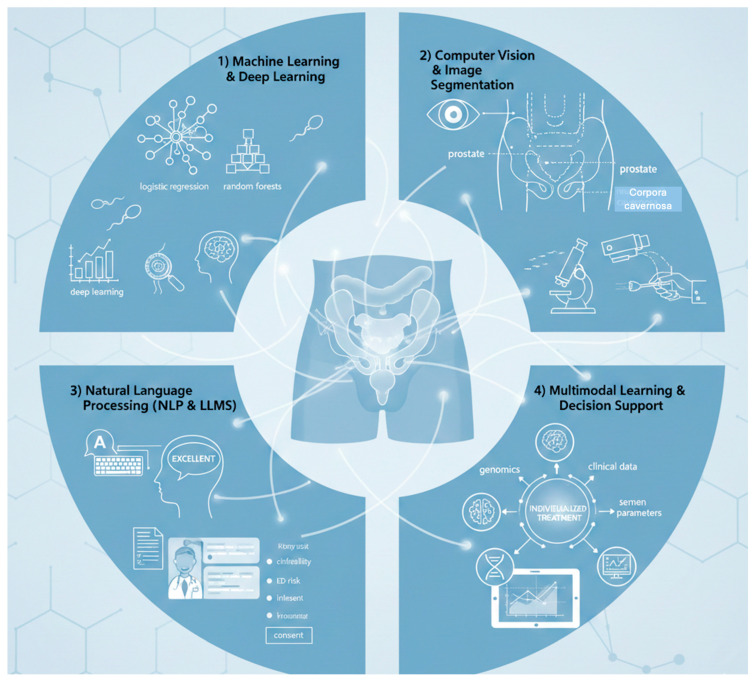 Figure 1
Peer Reviews
No public reviews on file for this paper yet. If you reviewed it on a platform where reviews are public (OpenReview, ICLR, NeurIPS, ICML), you can paste yours below so the community can read it here.
Videos
No videos yet. Explain this paper in a talk, walkthrough, or lecture? Add one.
Taxonomy
TopicsProstate Cancer Diagnosis and Treatment · Sexual function and dysfunction studies · Artificial Intelligence in Healthcare and Education