Comparative Effectiveness of Pessary Placement, Cervical Cerclage, or Expectant Management in Preventing Preterm Delivery in Twin Pregnancies
Christina Pagkaki, Nektaria Kritsotaki, Anastasia Bothou, Vasiliki Kourti, Georgios Tsatsaris, Barbara Niesigk, Efthymios Oikonomou, Nikolaos Machairiotis, Nikolaos Tsikouras, Spyridon Michalopoulos, Anastasia Grapsa, Angeliki Gerede, Nikoletta Koutlaki

TL;DR
This study compares pessary placement, cervical cerclage, and expectant management in twin pregnancies to see which method best prevents early preterm birth.
Contribution
The study provides new evidence that pessary placement may be more effective than cerclage or expectant management in prolonging twin pregnancies.
Findings
Pessary placement was associated with longer gestational duration compared to cerclage or expectant management.
Multivariable analysis showed pessary use significantly reduced the hazard of early delivery compared to cerclage.
Expectant management showed a trend toward increased risk of early delivery, though not statistically significant.
Abstract
Objective: The objective of this study was to evaluate the association between cervical management strategies, specifically pessary placement, cervical cerclage, or expectant management, and gestational age at delivery in twin pregnancies and to assess the prognostic value of cervical characteristics for early preterm birth (<33 weeks). Methods: We conducted a retrospective cohort study including 120 twin pregnancies managed at a tertiary referral center between 2019 and 2024. Pregnancies with positive vaginal or cervical microbiological cultures or abnormal cervical cytology were excluded. The management strategy was selected based on cervical characteristics and clinical judgment. Gestational age at delivery was compared across intervention groups using descriptive statistics, kernel density plots, boxplots, and Kaplan–Meier survival analysis. Multivariable Cox proportional hazards…
Genes, proteins, chemicals, diseases, species, mutations and cell lines named across the full text — each resolved to its canonical identifier and authoritative record.
Click any figure to enlarge with its caption.
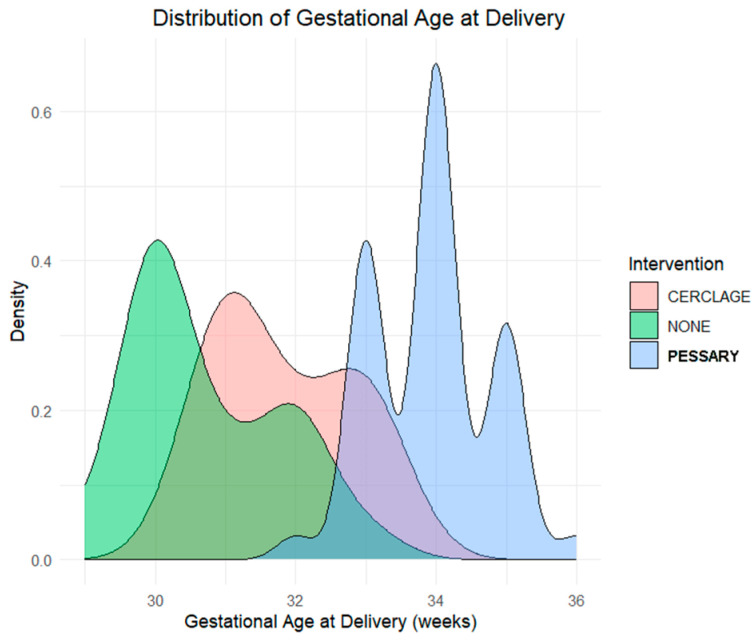 Figure 1
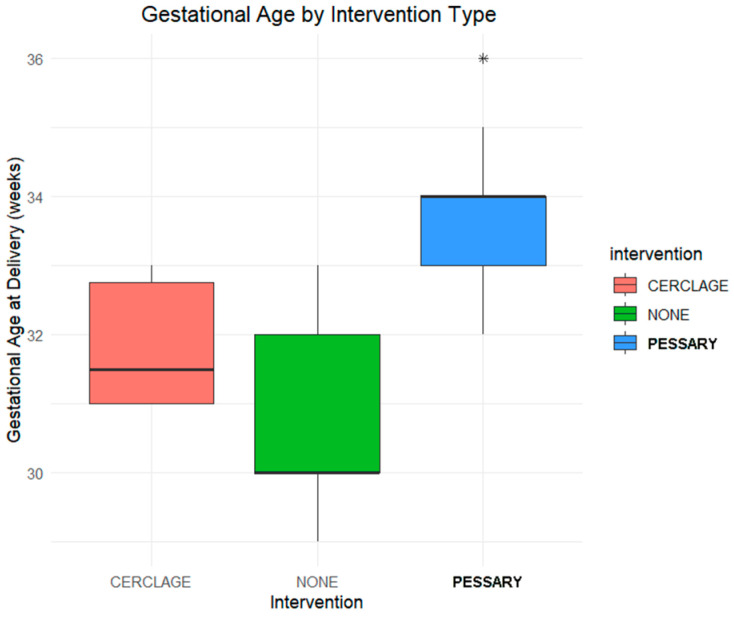 Figure 2
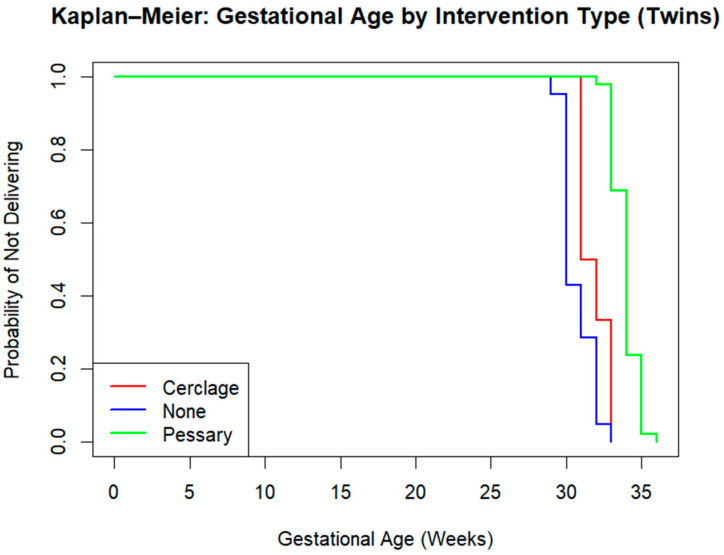 Figure 3
Peer Reviews
No public reviews on file for this paper yet. If you reviewed it on a platform where reviews are public (OpenReview, ICLR, NeurIPS, ICML), you can paste yours below so the community can read it here.
Videos
No videos yet. Explain this paper in a talk, walkthrough, or lecture? Add one.
Taxonomy
TopicsPreterm Birth and Chorioamnionitis · Reproductive tract infections research · Maternal and Perinatal Health Interventions