Beyond Survival: Factors Driving Textbook Outcome After Simultaneous Pancreas–Kidney Transplantation—A Retrospective Analysis
Anke Mittelstädt, Frederik Weber, Maximilian Brunner, Christian Krautz, Florian Struller, Hendrik Apel, Bernd Wullich, Katharina Heller, Mirian Opgenoorth, Mario Schiffer, Robert Grützmann, Georg F. Weber

TL;DR
This study identifies factors that influence successful outcomes after combined pancreas and kidney transplants, showing that younger donors and shorter organ transport times improve long-term survival.
Contribution
The study identifies donor age and kidney cold ischemia time as independent predictors of textbook outcomes in SPK transplantation.
Findings
52% of SPK recipients achieved the textbook outcome benchmark.
Donor age ≤ 37 years and kidney CIT ≤ 11.5 hours were optimal thresholds for achieving TO.
Patients achieving TO had significantly better 15-year survival rates.
Abstract
Background: Simultaneous pancreas–kidney transplantation (SPK) is the standard treatment for selected patients with type 1 diabetes mellitus and end-stage renal disease. Textbook Outcome (TO), a composite of perioperative and long-term quality indicators, provides a benchmark for optimal results. This study analyzed factors associated with failure to achieve TO after SPK. Methods: We retrospectively analyzed 119 SPK recipients (1980–2022). TO was defined according to IQTIG criteria: (i) patient survival ≥ 3 years, (ii) insulin independence at discharge, (iii) kidney function at discharge (GFR ≥ 20 mL/min), (iv) insulin-free survival ≥ 3 years, and (v) sustained kidney function ≥ 3 years. Predictors of TO failure were identified by logistic regression. Long-term survival was assessed by Kaplan–Meier analysis. Results: Ninety-two patients were eligible for TO assessment; 52% achieved TO.…
Genes, proteins, chemicals, diseases, species, mutations and cell lines named across the full text — each resolved to its canonical identifier and authoritative record.
Click any figure to enlarge with its caption.
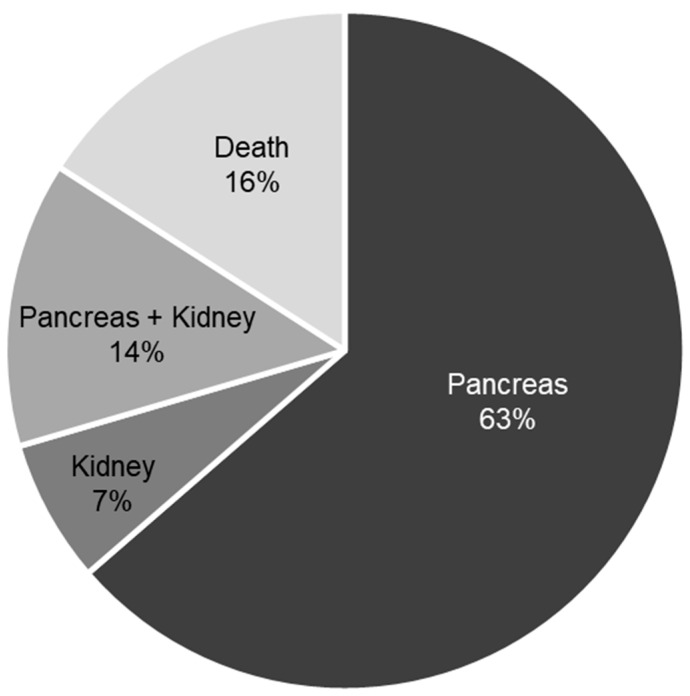 Figure 1
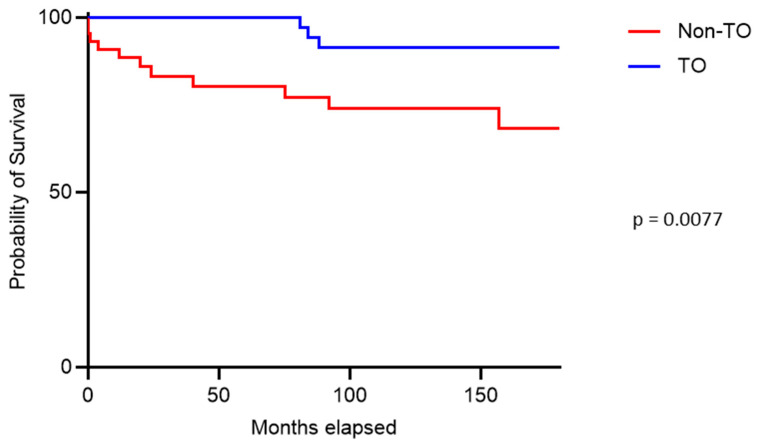 Figure 2
Peer Reviews
No public reviews on file for this paper yet. If you reviewed it on a platform where reviews are public (OpenReview, ICLR, NeurIPS, ICML), you can paste yours below so the community can read it here.
Videos
No videos yet. Explain this paper in a talk, walkthrough, or lecture? Add one.
Taxonomy
TopicsRenal Transplantation Outcomes and Treatments · Organ Transplantation Techniques and Outcomes · Organ Donation and Transplantation