PAXIS: A Randomized, Double-Blind, Placebo-Controlled, Dose-Finding Phase 2 Study (Part 1) Followed by an Open-Label Period (Part 2) to Assess the Efficacy and Safety of Pacritinib in Patients with VEXAS Syndrome
David B. Beck, Maël Heiblig, Sinisa Savic, Marcela A. Ferrada, Arsène Mekinian, Onima Chowdhury, Danielle Hammond, Lachelle D. Weeks, Carmelo Gurnari, Yohei Kirino, Sophie Georgin-Lavialle, Sarah A. Buckley, Raman Garcha, Bryan G. Harder, Matthew J. Koster

TL;DR
This study is the first clinical trial to test pacritinib, a drug targeting inflammation, in patients with VEXAS syndrome, a rare and severe disease.
Contribution
The PAXIS trial introduces a novel, prospective, randomized study design for VEXAS syndrome, a condition with no prior pharmacotherapeutic trials.
Findings
Pacritinib is being evaluated as a potential GC-sparing therapy for VEXAS syndrome.
The trial uses disease-specific endpoints to assess efficacy and safety of pacritinib.
This is the first randomized pharmacotherapeutic study in VEXAS syndrome patients.
Abstract
VEXAS (Vacuoles, E1 ubiquitin-activating enzyme, X-linked, Autoinflammatory, Somatic) syndrome is a systemic disorder characterized by an overlap of hematologic and inflammatory features. Most patients require chronic use of moderate-to-high doses of glucocorticoids (GCs) to maintain disease control. Data on GC-sparing therapies is limited, and there have been no prospective pharmacotherapeutic trials in VEXAS syndrome published to date. Pacritinib, an oral inhibitor of IRAK1, JAK2, and ACVR1, has emerged as a promising therapeutic option for VEXAS syndrome. The PAXIS trial is the first prospective, randomized pharmacotherapeutic study conducted in this rare and severe disease. Utilizing a novel study design and disease-specific endpoints, the trial will evaluate the efficacy and safety of two dose levels of pacritinib compared with placebo in patients with VEXAS syndrome (NCT06782373,…
Genes, proteins, chemicals, diseases, species, mutations and cell lines named across the full text — each resolved to its canonical identifier and authoritative record.
Click any figure to enlarge with its caption.
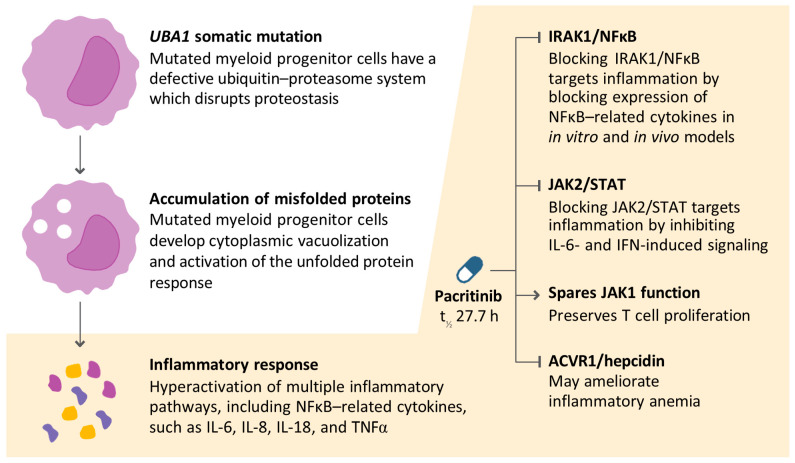 Figure 1
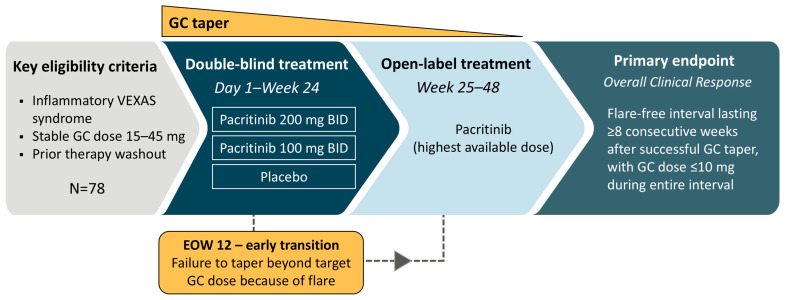 Figure 2
Peer Reviews
No public reviews on file for this paper yet. If you reviewed it on a platform where reviews are public (OpenReview, ICLR, NeurIPS, ICML), you can paste yours below so the community can read it here.
Videos
No videos yet. Explain this paper in a talk, walkthrough, or lecture? Add one.
Taxonomy
TopicsOtitis Media and Relapsing Polychondritis · Osteomyelitis and Bone Disorders Research · Vascular Anomalies and Treatments