Sleep Fragmentation, Not Nocturnal Hypoxemia, Is the Primary Correlate of Attentional Slowing in Obstructive Sleep Apnea
Márcio Luciano de Souza Bezerra, Sergio Luis Schmidt, Eelco van Duinkerken, Andreza Maia, Ana Luiza Caldas Coutinho, Kai-Uwe Lewandrowski

TL;DR
The study finds that sleep fragmentation, not low nighttime oxygen levels, is the main cause of attention problems in people with obstructive sleep apnea.
Contribution
This study identifies sleep fragmentation as a key cognitive vulnerability marker in obstructive sleep apnea, independent of hypoxemia.
Findings
OSA patients had significantly slower reaction times compared to controls.
Sleep stage shifts, not hypoxemia, were the strongest predictor of attentional slowing in OSA.
The apnea–hypopnea index (AHI) did not correlate with attentional performance in OSA patients.
Abstract
Background: Obstructive sleep apnea (OSA) is associated with slower response speed, yet conventional severity classification based on the apnea–hypopnea index (AHI) shows limited ability to predict cognitive outcomes. The AHI aggregates distinct pathophysiological processes, including intermittent hypoxemia and sleep fragmentation. Within emerging precision sleep medicine frameworks, disentangling these mechanisms is critical for improved phenotyping and personalized risk assessment. This study aimed to replicate prior findings using a Go/No-Go Continuous Visual Attention Test (CVAT) and to identify the most informative polysomnographic predictor of attentional performance in OSA. Methods: In this cross-sectional study, participants underwent full-night type I polysomnography and the CVAT. After exclusions, 84 patients with OSA and 22 polysomnographically normal controls were analyzed.…
Genes, proteins, chemicals, diseases, species, mutations and cell lines named across the full text — each resolved to its canonical identifier and authoritative record.
Click any figure to enlarge with its caption.
 Figure 1
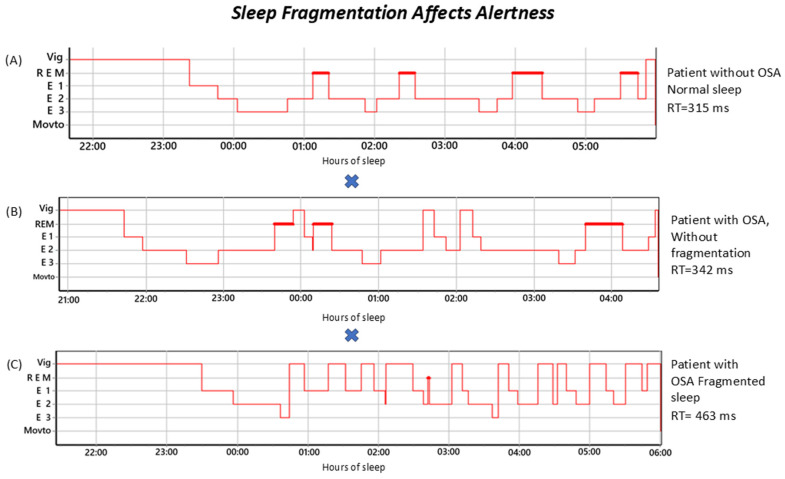 Figure 2
Peer Reviews
No public reviews on file for this paper yet. If you reviewed it on a platform where reviews are public (OpenReview, ICLR, NeurIPS, ICML), you can paste yours below so the community can read it here.
Videos
No videos yet. Explain this paper in a talk, walkthrough, or lecture? Add one.
Taxonomy
TopicsObstructive Sleep Apnea Research · Sleep and related disorders · Sleep and Wakefulness Research