Dupilumab-Related Hypereosinophilia in Patients Treated for Type 2 Diseases: Evidence from a 24-Month Prospective Real-Life Study
Ilaria Mormile, Daniele La Prova, Paolo Pezzella, Giuliano Di Caprio, Amato de Paulis, Elena Cantone, Aikaterini Detoraki

TL;DR
A 24-month study found that dupilumab treatment for type 2 diseases often causes mild, temporary eosinophilia in patients, with few cases of hypereosinophilia but no serious complications.
Contribution
This study provides long-term evidence on dupilumab's safety profile regarding eosinophilia in real-world patients with type 2 diseases.
Findings
40.9% of patients developed eosinophilia within six months of dupilumab treatment.
Eosinophilia was generally mild, transient, and resolved by 18 months in most patients.
15.15% of patients developed hypereosinophilia, but no organ damage or treatment discontinuation was needed.
Abstract
Background/Objectives: Dupilumab is a human monoclonal antibody that targets both IL-4 and IL-13 signaling. Eosinophilia has been reported as a potential adverse event in treated patients in randomized controlled trials and 12-month real-life studies. This real-life, 24-month prospective study investigated the prevalence of eosinophilia, its consequences, and the effectiveness of dupilumab in a cohort of patients with severe asthma, chronic rhinosinusitis with nasal polyps, and atopic dermatitis. Methods: A total of 66 adult patients treated with dupilumab were included in this study. ACT, SNOT-22, and Smell-VAS, EASI, and absolute blood eosinophil count (AEC) were assessed according to the type of diagnosis at baseline (T0), after 6 (T6), 12 (T12), 18 (T18), and 24 (T24) months post-dupilumab initiation. Results: All patients experienced significant improvement in both symptoms and…
Genes, proteins, chemicals, diseases, species, mutations and cell lines named across the full text — each resolved to its canonical identifier and authoritative record.
Click any figure to enlarge with its caption.
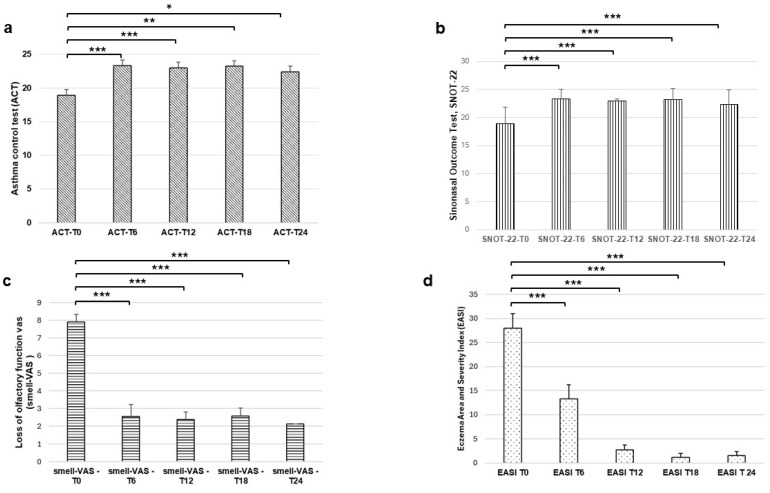 Figure 1
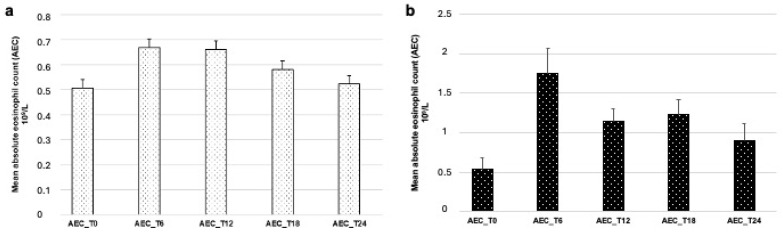 Figure 2
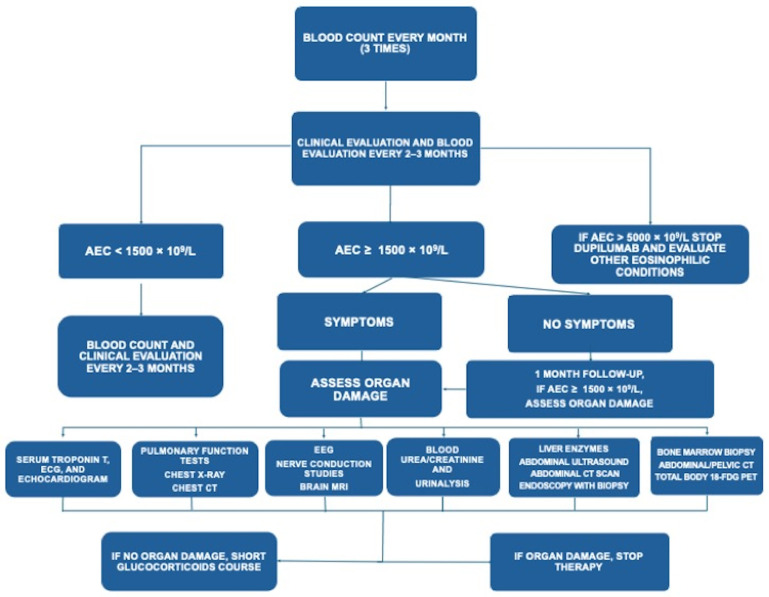 Figure 3
 Figure 4
Peer Reviews
No public reviews on file for this paper yet. If you reviewed it on a platform where reviews are public (OpenReview, ICLR, NeurIPS, ICML), you can paste yours below so the community can read it here.
Videos
No videos yet. Explain this paper in a talk, walkthrough, or lecture? Add one.
Taxonomy
TopicsSinusitis and nasal conditions · Drug-Induced Adverse Reactions · Asthma and respiratory diseases