Early versus late termination for fetal anomalies: Women's perspectives and psychological impact in a mixed methods study
Eline E. R. Lust, Kim Bronsgeest, Lidewij Henneman, Neeltje M. T. H. Crombag, Caterina M. Bilardo, Robert‐Jan H. Galjaard, Esther Sikkel, Audrey B. C. Coumans, Ayten Elvan‐Taşpınar, Sander Galjaard, Attie T. J. I. Go, Gwendolyn T. R. Manten, Eva Pajkrt, Elisabeth van Leeuwen

TL;DR
This study finds that terminating a pregnancy earlier due to fetal anomalies is linked to lower psychological impact compared to later termination, though both cause significant emotional distress.
Contribution
The study provides new insights into the psychological effects of early versus late termination of pregnancy for fetal anomalies using mixed methods.
Findings
Women who had late TOP showed higher depression and grief scores compared to those with early TOP.
Late TOP participants reported more fetal attachment and time pressure due to legal limits.
Both groups experienced significant emotional impact, but early TOP was associated with lower psychological distress.
Abstract
A frequently cited benefit of the first‐trimester anomaly scan (FTAS) is that it reduces psychological impact by enabling earlier termination of pregnancy (TOP). However, the impact of early versus late TOP due to fetal anomalies remains unclear. This study evaluates the psychological impact and perspectives associated with early versus late TOP. A prospective mixed methods study was conducted. The early group (TOP <18 weeks) included women with an abnormal FTAS; the late group (TOP 20–24 weeks) included women with an abnormal second‐trimester scan (SAS), abnormal FTAS, or normal FTAS followed by abnormal SAS. Women completed questionnaires 2 (T1) and 6 months (T2) postpartum addressing psychological impact using validated scales (State–Trait Anxiety Inventory, Edinburgh Depression Scale, Impact of Event Scale, Perinatal Grief Scale) and study‐specific questions. Semi‐structured…
Genes, proteins, chemicals, diseases, species, mutations and cell lines named across the full text — each resolved to its canonical identifier and authoritative record.
Click any figure to enlarge with its caption.
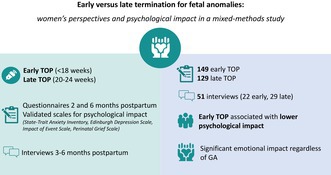 Figure 1
Peer Reviews
No public reviews on file for this paper yet. If you reviewed it on a platform where reviews are public (OpenReview, ICLR, NeurIPS, ICML), you can paste yours below so the community can read it here.
Videos
No videos yet. Explain this paper in a talk, walkthrough, or lecture? Add one.
Taxonomy
TopicsPrenatal Screening and Diagnostics · Grief, Bereavement, and Mental Health · Maternal Mental Health During Pregnancy and Postpartum