Risk of recurrent spontaneous preterm birth following preterm full dilatation cesarean delivery
Amrita Banerjee, Agnieszka Glazewska‐Hallin, Maria Ivan, Tatiana Nazarenko, Charlotte Colley, Natalie Suff, Lisa Story, Davide Casagrandi, Amos Tetteh, Natalie Greenwold, Manju Chandiramani, Jenny Carter, Raffaele Napolitano, Andrew H. Shennan, Anna L. David

TL;DR
Women who had a preterm full dilatation cesarean delivery face a higher risk of another early birth compared to other preterm delivery methods.
Contribution
This study reveals that preterm full dilatation cesarean delivery increases the risk of recurrent spontaneous preterm birth more than other preterm delivery modes.
Findings
Recurrent sPTB <37 weeks was 38.1% in preterm FDCD cases, significantly higher than vaginal or early CD cases.
Recurrent sPTB <34 weeks was 23.8% in preterm FDCD cases, much higher than in other groups.
Most CD scars in preterm FDCD cases were located within the cervix or near the internal cervical os.
Abstract
Term full dilatation cesarean delivery (FDCD) is associated with an increased risk of subsequent spontaneous preterm birth (sPTB). The impact of preterm FDCD on recurrent sPTB is unknown. We investigated the relationship between recurrent sPTB and the mode of prior sPTB. This is a retrospective cohort study of singleton pregnant women attending two high‐risk preterm birth surveillance clinics (University College London Hospital and St Thomas' Hospital London, UK), with one previous sPTB (24–36 + 6 weeks). Women were categorized according to their mode of birth in the index sPTB pregnancy: (1) preterm FDCD, (2) preterm vaginal birth and (3) preterm cesarean delivery at <10 cm cervical dilatation (CD < 10 cm). The primary outcome was recurrent sPTB <37 weeks of gestation. Secondary outcomes included sPTB <34 weeks, <28 weeks, spontaneous late miscarriage and short cervical length (≤25…
Genes, proteins, chemicals, diseases, species, mutations and cell lines named across the full text — each resolved to its canonical identifier and authoritative record.
Click any figure to enlarge with its caption.
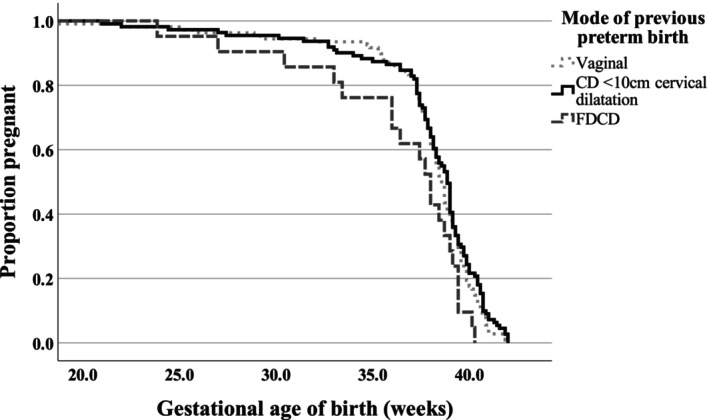 Figure 1
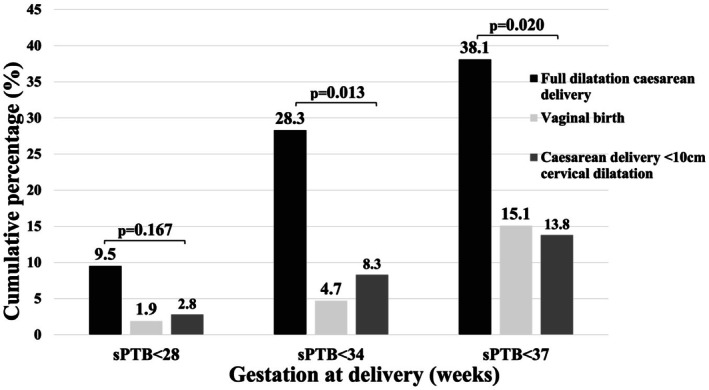 Figure 2
 Figure 3
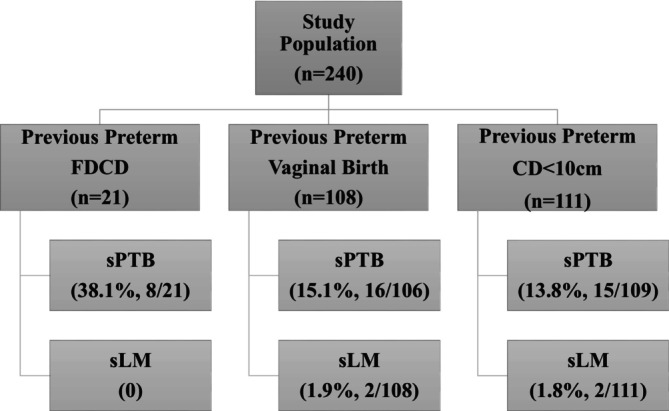 Figure 4
Peer Reviews
No public reviews on file for this paper yet. If you reviewed it on a platform where reviews are public (OpenReview, ICLR, NeurIPS, ICML), you can paste yours below so the community can read it here.
Videos
No videos yet. Explain this paper in a talk, walkthrough, or lecture? Add one.
Taxonomy
TopicsPreterm Birth and Chorioamnionitis · Maternal and Perinatal Health Interventions · Pelvic floor disorders treatments