Multifidelity Topology Optimization with Runtime Verification and Acceptance Control: Benchmark Study in 2D and 3D
Nikhil Tatke, Jarosław Kaczmarczyk

TL;DR
This paper introduces a new method for topology optimization that balances speed and accuracy by using both coarse and fine meshes.
Contribution
A novel multifidelity framework with runtime verification and acceptance control is proposed to manage discretization errors in topology optimization.
Findings
The framework effectively balances efficiency and accuracy through periodic verification of coarse designs on fine meshes.
Performance metrics like compliance, runtime, and acceptance rate show the framework's effectiveness on 2D and 3D benchmarks.
The cleanup phase and verification schedules help maintain optimizer robustness and prevent incorrect topology families.
Abstract
Topology optimization using density-based approaches often requires high-resolution meshes to achieve reliable compliance evaluation and robustness against mesh dependency. However, increasing the problem sizes—especially in 3D—results in prohibitively expensive computation times. Coarse-mesh approaches significantly accelerate runtimes; however, they also introduce discretization errors that can guide the optimizer towards incorrect topology families if left unregulated. To address this issue, a multifidelity framework with acceptance control was developed that enables runtime verification and explicitly manages the optimizer state. The main idea is to use coarse discretizations to generate new design proposals and transfer candidate designs to fine discretizations at periodic intervals for verification. Proposals are then accepted or rejected using a best-referenced criterion; if…
Genes, proteins, chemicals, diseases, species, mutations and cell lines named across the full text — each resolved to its canonical identifier and authoritative record.
Click any figure to enlarge with its caption.
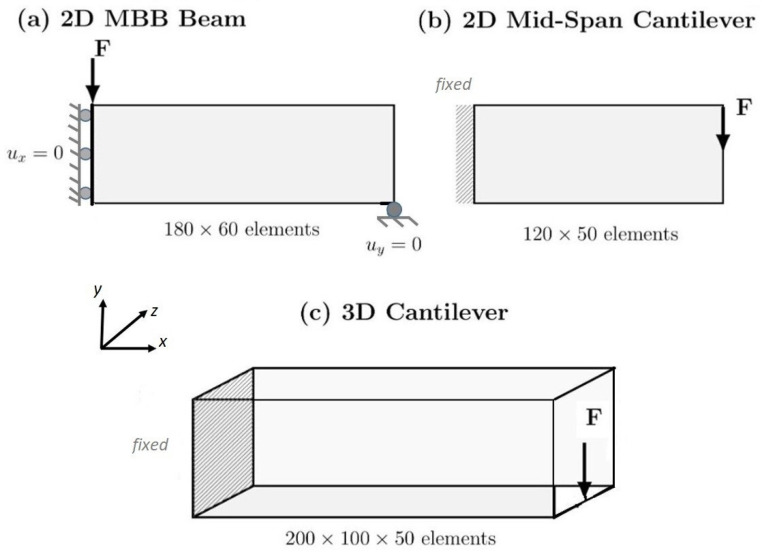 Figure 1
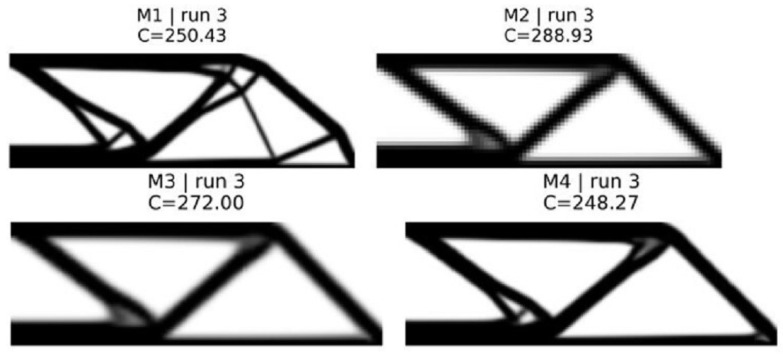 Figure 2
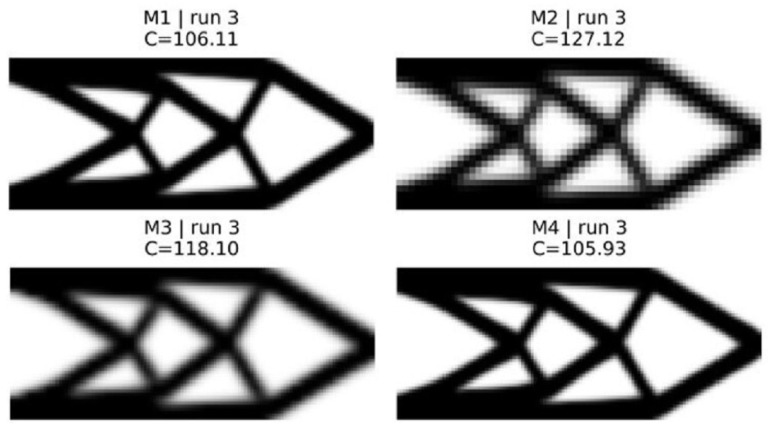 Figure 3
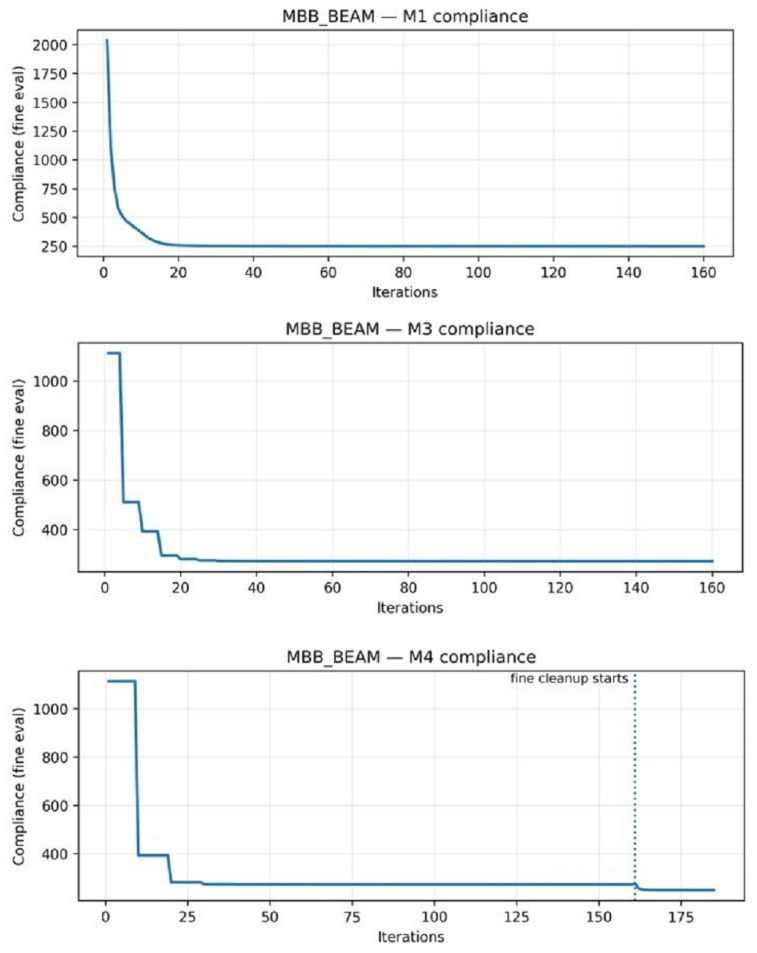 Figure 4
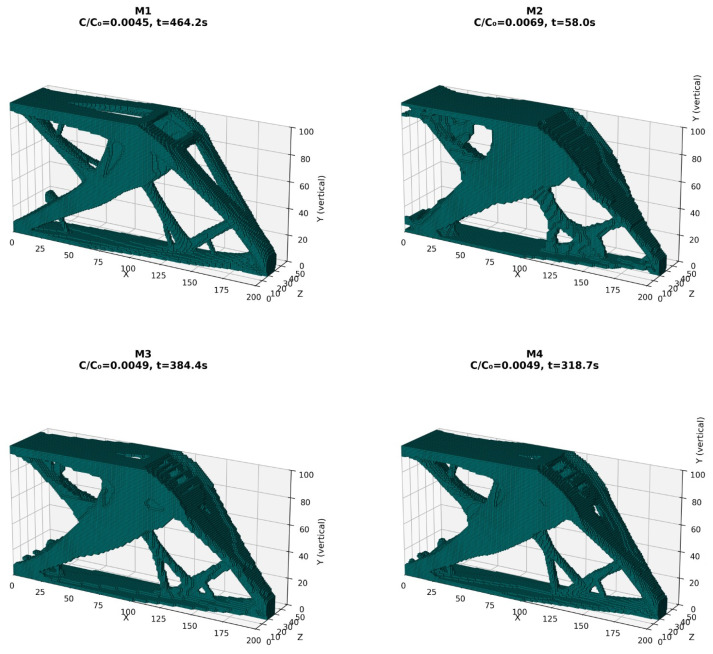 Figure 5
Peer Reviews
No public reviews on file for this paper yet. If you reviewed it on a platform where reviews are public (OpenReview, ICLR, NeurIPS, ICML), you can paste yours below so the community can read it here.
Videos
No videos yet. Explain this paper in a talk, walkthrough, or lecture? Add one.
Taxonomy
TopicsTopology Optimization in Engineering · VLSI and FPGA Design Techniques · Computational Geometry and Mesh Generation