Machine Learning-Identified Potential Interaction Between Clazosentan and Nicardipine in Patients with Subarachnoid Hemorrhage
Yusuke Inoue, Masahito Katsuki, Toshikazu Hidaka, Junichiro Ochiai, Yuichiro Kawamoto, Daizo Ishii, Katsumi Takizawa, Hirofumi Nakatomi, Masaki Chin, Motohiro Morioka, Hiroki Kurita, Kaima Suzuki, Takatoshi Sorimachi, Koreaki Irie, Ichiro Nakahara, Nobutaka Horie, Fusao Ikawa

TL;DR
The study suggests that clazosentan may reduce cerebral vasospasm and improve outcomes in subarachnoid hemorrhage patients, but its effectiveness could be reduced when used with nicardipine.
Contribution
Machine learning identified a potential interaction between clazosentan and nicardipine in subarachnoid hemorrhage patients.
Findings
Clazosentan use was associated with reduced odds of angiographic and symptomatic vasospasm.
Concomitant use of clazosentan and nicardipine was linked to higher odds of angiographic vasospasm.
Clazosentan was associated with improved 6-month functional outcomes in subarachnoid hemorrhage patients.
Abstract
Background/Objectives: Subarachnoid hemorrhage (SAH) is frequently complicated by cerebral vasospasm (VS). Clazosentan has reduced VS in Japanese studies but shown inconsistent efficacy in Western trials. We hypothesized that clinical and pharmacologic interactions may influence its effectiveness. Methods: We analyzed the multicenter “Database of Cohort Study for Outcome of SAH In Japan” (DCI Japan) registry, prospectively collected from 2020 to 2023, to assess associations between clazosentan use, VS prevention, functional outcomes, and potential interactions in adults with aneurysmal SAH (aSAH) treated by surgical clipping or endovascular coiling within 4 days of onset. Outcomes included angiographic VS (AVS), symptomatic VS (SVS), cerebral infarction, and modified Rankin Scale (mRS) scores at discharge and at 6 months. Predictors and interactions were first screened using univariable…
Genes, proteins, chemicals, diseases, species, mutations and cell lines named across the full text — each resolved to its canonical identifier and authoritative record.
Click any figure to enlarge with its caption.
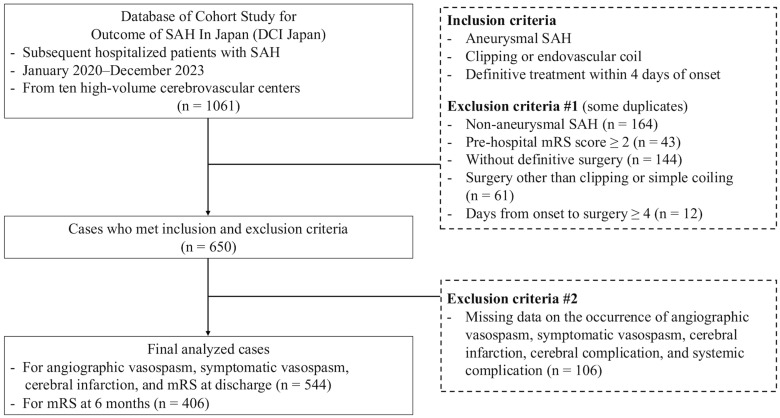 Figure 1
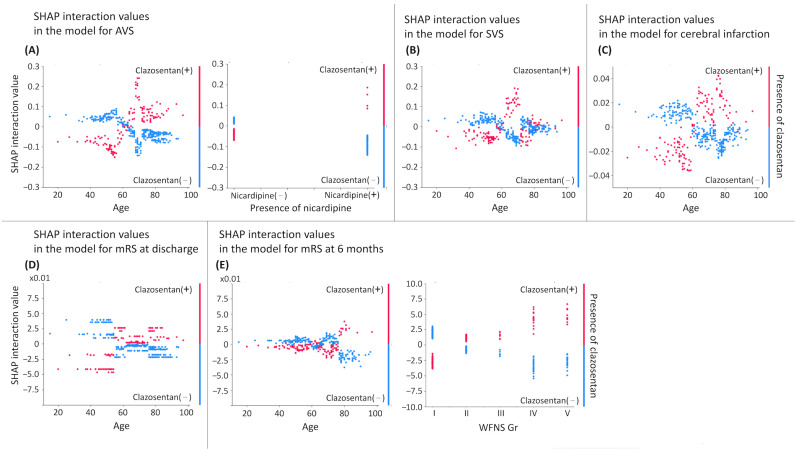 Figure 2
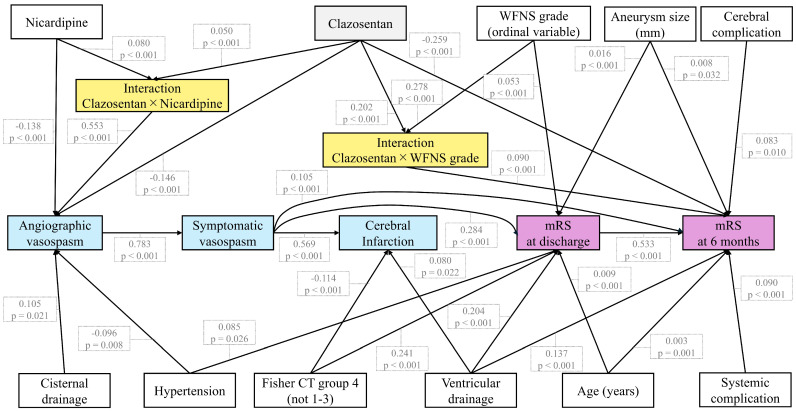 Figure 3
Peer Reviews
No public reviews on file for this paper yet. If you reviewed it on a platform where reviews are public (OpenReview, ICLR, NeurIPS, ICML), you can paste yours below so the community can read it here.
Videos
No videos yet. Explain this paper in a talk, walkthrough, or lecture? Add one.
Taxonomy
TopicsIntracranial Aneurysms: Treatment and Complications · Intracerebral and Subarachnoid Hemorrhage Research · Acute Ischemic Stroke Management