Comparison of Scrotal Orchiopexy Versus Traditional Inguinal Orchiopexy for Palpable Undescended and Retractile Testis in Children: Insights from a Greek Surgical Center
Maria Florou, Triantafyllia Koletsa, Sophia Tsokkou, Georgia Raptou, Antonia Syrnioti, Ioannis Spyridakis, Christos Kaselas

TL;DR
This study compares two surgical techniques for treating undescended or retractile testes in children and finds that the single-scrotal approach has fewer complications.
Contribution
The study provides new insights into the safety and effectiveness of scrotal orchiopexy compared to traditional inguinal orchiopexy in a single pediatric center.
Findings
Scrotal orchiopexy had fewer postoperative complications compared to the two-incision inguinal approach.
Congenital cryptorchidism was identified as a risk factor for surgical complications.
Single-scrotal orchiopexy is suggested as a safer option for palpable undescended testes.
Abstract
Introduction/Purpose: Congenital cryptorchidism and retractile testis represent the most commonly presented abnormalities of the male genitourinary system. Orchiopexy is the surgical treatment for both conditions and can be performed either via the conventional two-incision surgical approach or via a singular scrotal incision. The present study firstly investigated the complications associated with each orchiopexy approach in a single-center pediatric surgical department and secondly compared the surgical outcomes in children with congenital cryptorchidism or retractile testes. Methodology: A retrospective analysis was conducted in pediatric patients with either congenital cryptorchidism or retractile testes who underwent orchiopexy from 2015 to 2019. Data collected during the study included diagnosis, surgical technique and both short- and long-term complications. Patient…
Genes, proteins, chemicals, diseases, species, mutations and cell lines named across the full text — each resolved to its canonical identifier and authoritative record.
Click any figure to enlarge with its caption.
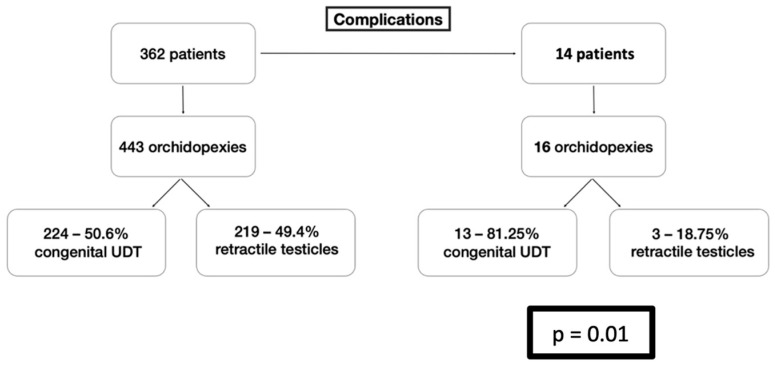 Figure 1
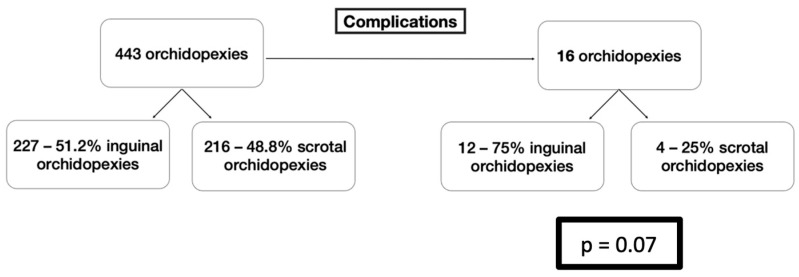 Figure 2
Peer Reviews
No public reviews on file for this paper yet. If you reviewed it on a platform where reviews are public (OpenReview, ICLR, NeurIPS, ICML), you can paste yours below so the community can read it here.
Videos
No videos yet. Explain this paper in a talk, walkthrough, or lecture? Add one.
Taxonomy
TopicsTesticular diseases and treatments · Male Reproductive Health Studies · Urologic and reproductive health conditions