Upper Extremity Motor Evoked Potentials and Hand Function in Elderly Stroke Survivors: A Correlational Study
Woo-Hwa Choi, Jae-Eun Park, Seong Jin, Hyun-Ah Lee, Jong-Hu Jeon, Byeong-Wook Lee, Ji-Yeon Oh, Eui-Jin An, Ho-Yong Jeong, Ji-Su Choi, Young Lee

TL;DR
This study finds that MEP latency, not amplitude, better predicts upper extremity recovery in elderly stroke survivors, suggesting a need for updated prognostic tools.
Contribution
The study identifies MEP latency as a more reliable predictor of upper extremity function recovery in older stroke patients compared to existing measures.
Findings
MEP latency was significantly associated with grip strength and the Box and Block Test in elderly stroke survivors.
Initial upper extremity parameters were significantly linked to K-MBI and HFT outcomes.
Larger MEP amplitude and faster latency correlated with better upper extremity function in both early and late assessment groups.
Abstract
Background/Objectives: The impact of stroke on upper extremity function in the older adult population underscores the need for accurate recovery prediction. Motor evoked potential (MEP) has been explored as a predictor of upper extremity function recovery in patients with stroke. However, research specifically targeting the geriatric population remains limited. Therefore, this study focused specifically on patients aged 65 years and older to investigate correlations between MEP parameters and upper extremity function. This study investigates correlations between MEP parameters (amplitude and latency) and upper extremity function-related measures, including Medical Research Council (MRC) scale, the Korean version of the Modified Barthel Index (K-MBI), and the Hand Function Test (HFT), including grip strength, pinch strength, the Box and Block Test, and the 9-Hole Peg Test, in older…
Genes, proteins, chemicals, diseases, species, mutations and cell lines named across the full text — each resolved to its canonical identifier and authoritative record.
Click any figure to enlarge with its caption.
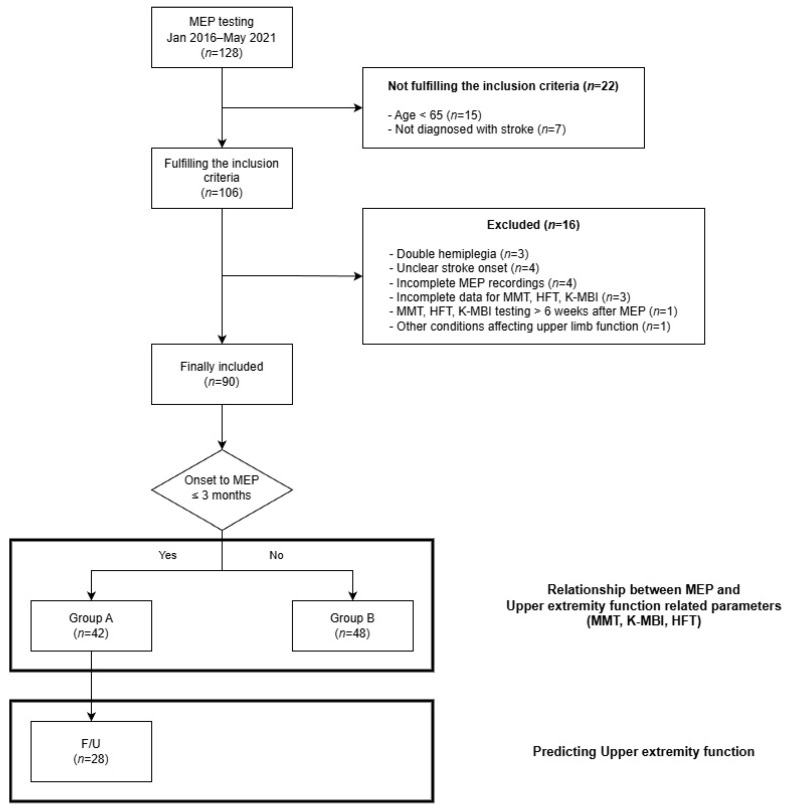 Figure 1
Peer Reviews
No public reviews on file for this paper yet. If you reviewed it on a platform where reviews are public (OpenReview, ICLR, NeurIPS, ICML), you can paste yours below so the community can read it here.
Videos
No videos yet. Explain this paper in a talk, walkthrough, or lecture? Add one.
Taxonomy
TopicsStroke Rehabilitation and Recovery · Muscle activation and electromyography studies · Intraoperative Neuromonitoring and Anesthetic Effects