Extracorporeal Carbon Dioxide Removal in Acute Respiratory Distress Syndrome: Physiologic Rationale and Phenotype-Based Perspectives
Raffaele Merola, Denise Battaglini, Silvia De Rosa

TL;DR
Extracorporeal carbon dioxide removal (ECCO2R) may help certain ARDS patients by reducing lung injury from mechanical ventilation, but it is not suitable for everyone.
Contribution
The paper proposes that ECCO2R should be used selectively based on patient phenotypes rather than as a universal treatment.
Findings
ECCO2R allows ultra-protective ventilation by removing CO2 independently from lung mechanics.
ARDS patients with high driving pressures or hyperinflammatory phenotypes may benefit most from ECCO2R.
Technological improvements have enhanced ECCO2R safety but it remains complex and resource-intensive.
Abstract
Acute respiratory distress syndrome (ARDS) is a major cause of morbidity and mortality despite decades of progress in ventilatory support. Mechanical ventilation, while essential for oxygenation, may exacerbate lung injury through excessive mechanical power delivery, even when using lung-protective strategies. Extracorporeal carbon dioxide removal (ECCO2R) was conceived to enable “ultra-protective” ventilation, allowing for further reductions in tidal volume and respiratory rate by selectively removing CO2 at low extracorporeal blood flows, typically between 0.3 and 1.0 L/min. This physiological decoupling of ventilation and gas exchange aims to mitigate ventilator-induced lung injury (VILI) while maintaining adequate acid–base homeostasis. Although early physiological studies demonstrated feasibility, large, randomized trials have failed to show a survival benefit and have raised…
Genes, proteins, chemicals, diseases, species, mutations and cell lines named across the full text — each resolved to its canonical identifier and authoritative record.
Click any figure to enlarge with its caption.
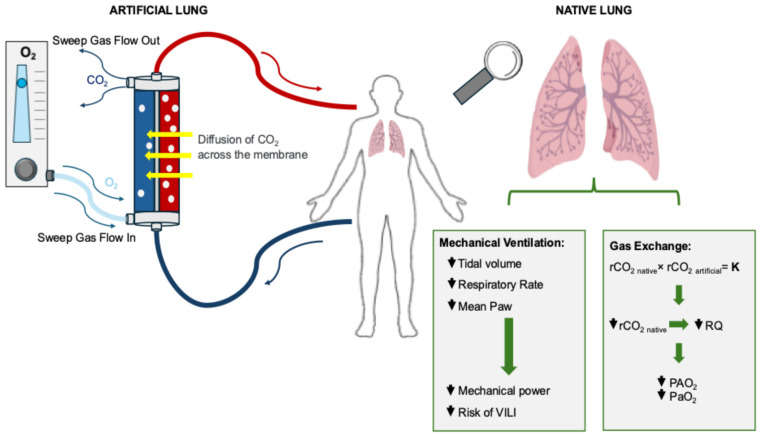 Figure 1
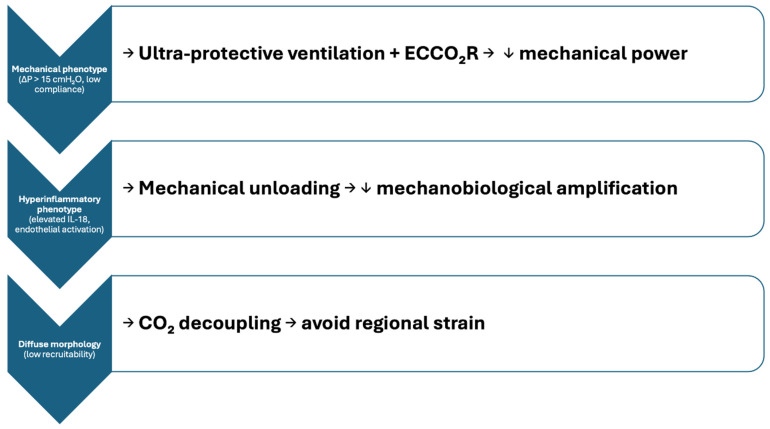 Figure 2
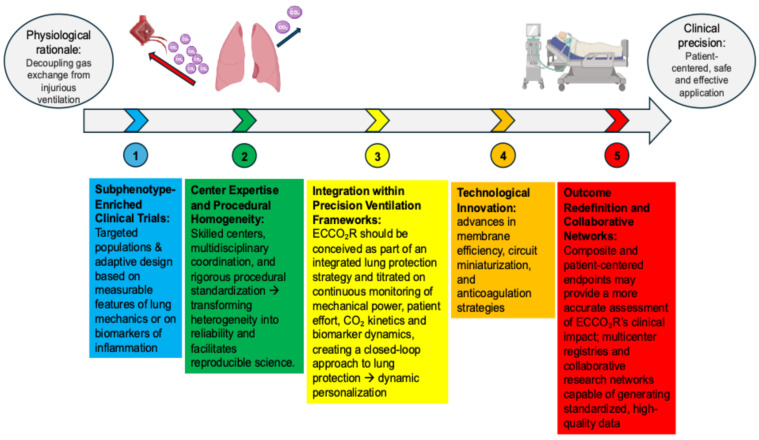 Figure 3
Peer Reviews
No public reviews on file for this paper yet. If you reviewed it on a platform where reviews are public (OpenReview, ICLR, NeurIPS, ICML), you can paste yours below so the community can read it here.
Videos
No videos yet. Explain this paper in a talk, walkthrough, or lecture? Add one.
Taxonomy
TopicsRespiratory Support and Mechanisms · Mechanical Circulatory Support Devices · Nosocomial Infections in ICU