Genetic Burden and APOE Methylation in a Korean Multi-Generational Alzheimer’s Disease Family: An Exploratory Multi-Omics Case Study
Je-Hyun Eom, Mu-Yeol Cho, Ji-Won Kim, Yunwoo Kim, Seung-Jo Yang, Jiyoung Hwang, Dahye Lee, Hye-Sung Kim, Young-Youn Kim, Hanseung Baek

TL;DR
This study explores genetic and methylation patterns in a Korean family with Alzheimer's disease to better understand individual risk factors.
Contribution
The study presents an exploratory multi-omics analysis of a multi-generational Alzheimer's family, linking genetic burden and APOE methylation.
Findings
An affected family member had the lowest genetic burden score but lower APOE methylation compared to healthy relatives.
CR1 contributed the most risk alleles in the family, followed by PICALM.
The findings suggest that methylation patterns may influence Alzheimer's risk but cannot establish causality from this single case.
Abstract
Background/Objectives: Alzheimer’s disease (AD) exhibits high heritability (60–80%), yet individual-level genetic risk prediction remains challenging. While APOE ε4 is the strongest genetic risk factor, incomplete penetrance complicates risk assessment. Methods: We analyzed seven blood-related members across three generations using the Korean Chip v2.0 genotyping (~1.2 M SNPs) and Illumina EPICv2 DNA methylation profiling. Genetic burden score (GBS) was calculated by summing risk alleles across 320 variants in six AD-associated genes (APOE, PICALM, CLU, CR1, BIN1, and ABCA7). Results: An unexpected pattern was observed in this family: the affected individual (J-003) had the lowest GBS (39 alleles), while individuals with higher genetic burden (51–61 alleles) remained cognitively healthy. J-003 also exhibited lower APOE methylation (β = 0.495) compared to the family mean (β = 0.523). CR1…
Genes, proteins, chemicals, diseases, species, mutations and cell lines named across the full text — each resolved to its canonical identifier and authoritative record.
Click any figure to enlarge with its caption.
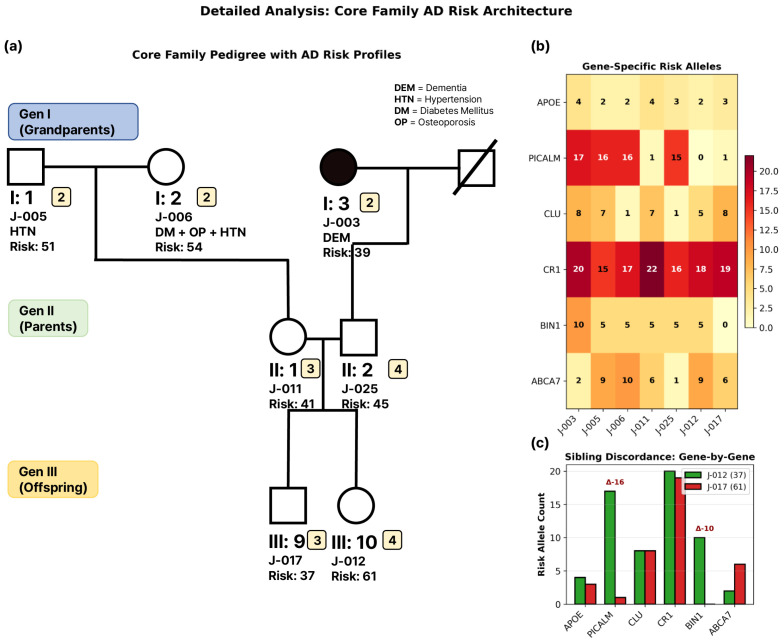 Figure 1
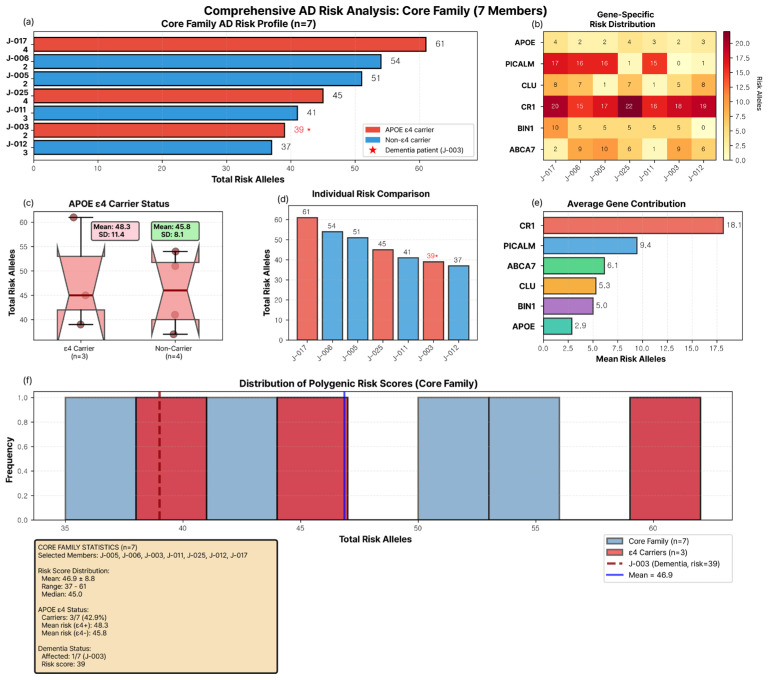 Figure 2
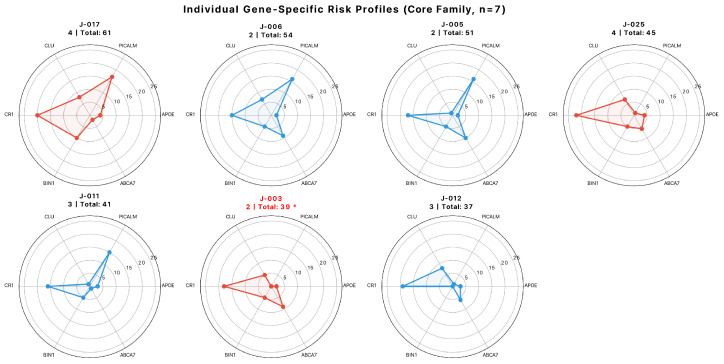 Figure 3
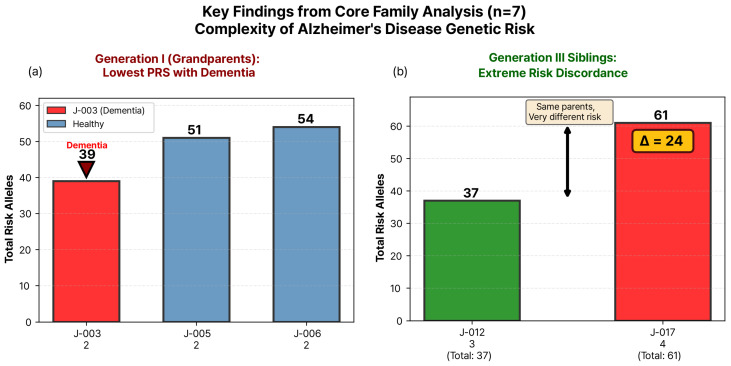 Figure 4
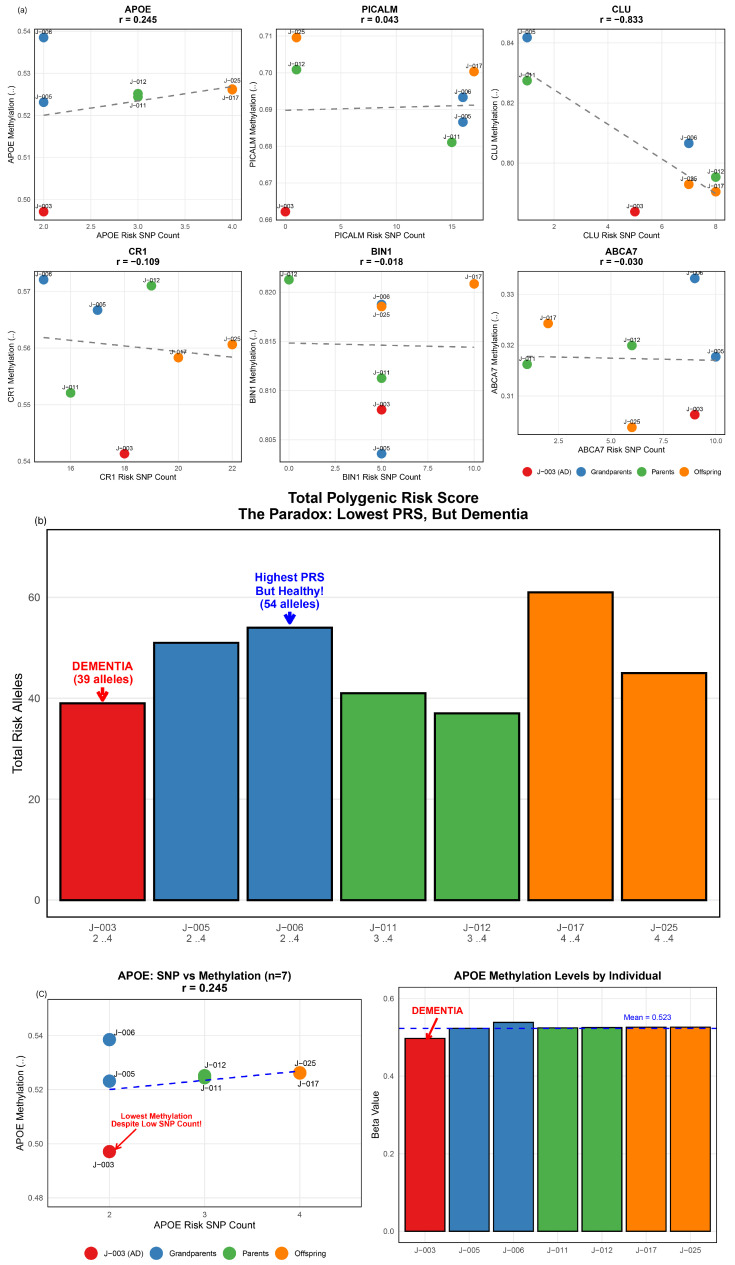 Figure 5
Peer Reviews
No public reviews on file for this paper yet. If you reviewed it on a platform where reviews are public (OpenReview, ICLR, NeurIPS, ICML), you can paste yours below so the community can read it here.
Videos
No videos yet. Explain this paper in a talk, walkthrough, or lecture? Add one.
Taxonomy
TopicsEpigenetics and DNA Methylation · Genetic Associations and Epidemiology · Alzheimer's disease research and treatments