Can Non-Conventional Blood Biomarkers Improve Running Performance Prediction? A Proof of Concept
Matija Dvorski, Marija Rakovac, Tomislav Kelava, Nataša Kovačić, Darja Flegar, Sara Aničić, Ivo Krešić, Ljiljana Ćulibrk, Filip Koražija, Damjan Dimnjaković, Alan Šućur

TL;DR
This study explores if blood biomarkers like decorin can improve predictions of running performance beyond traditional measures like VO2max.
Contribution
The study introduces the potential of non-conventional blood biomarkers to enhance performance prediction in runners.
Findings
The Cooper test caused significant changes in decorin, hypoxanthine, and BDNF.
Higher post-test decorin and hypoxanthine were linked to faster Cooper test performance.
Adding decorin to conventional predictors slightly reduced 10 km race time prediction error.
Abstract
Conventional measures such as maximal oxygen uptake (V˙O2max), although widely regarded as the gold standard, do not fully capture endurance performance. Therefore, this study investigated whether a 2.4 km Cooper test elicits measurable changes in blood-based biomarkers (decorin, hypoxanthine, N-terminal pro-B-type natriuretic peptide (NT-proBNP), brain-derived neurotrophic factor (BDNF)) and whether integrating these markers may improve performance prediction in a heterogeneous sample of runners. In this cross-sectional observational proof-of-concept study, thirty-three participants completed the 2.4 km Cooper test, with venous blood samples collected at baseline and post-test. Non-parametric statistical tests were used to assess biomarker changes (α = 0.05), with exploratory correlations evaluated using Spearman’s ρ. To examine whether blood-based biomarkers provide information beyond…
Genes, proteins, chemicals, diseases, species, mutations and cell lines named across the full text — each resolved to its canonical identifier and authoritative record.
Click any figure to enlarge with its caption.
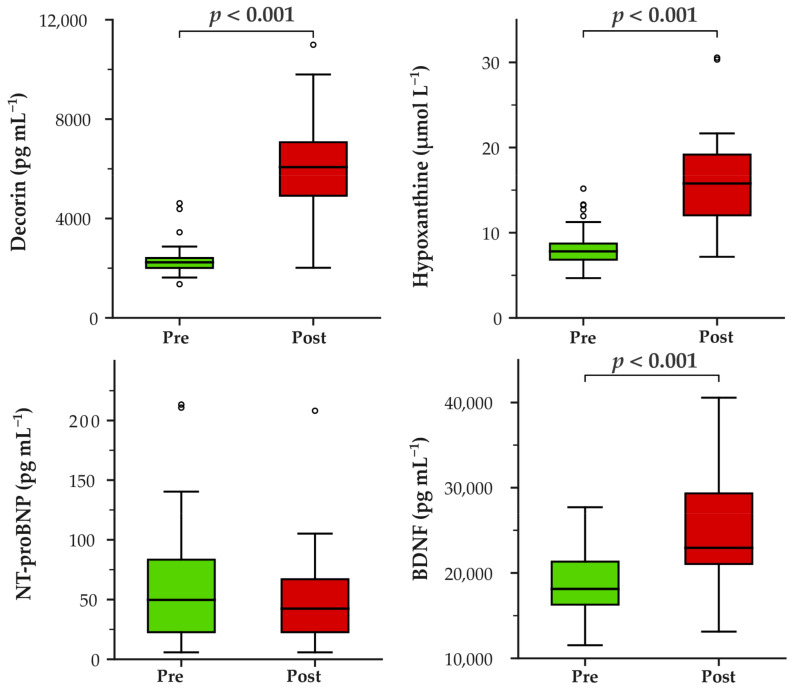 Figure 1
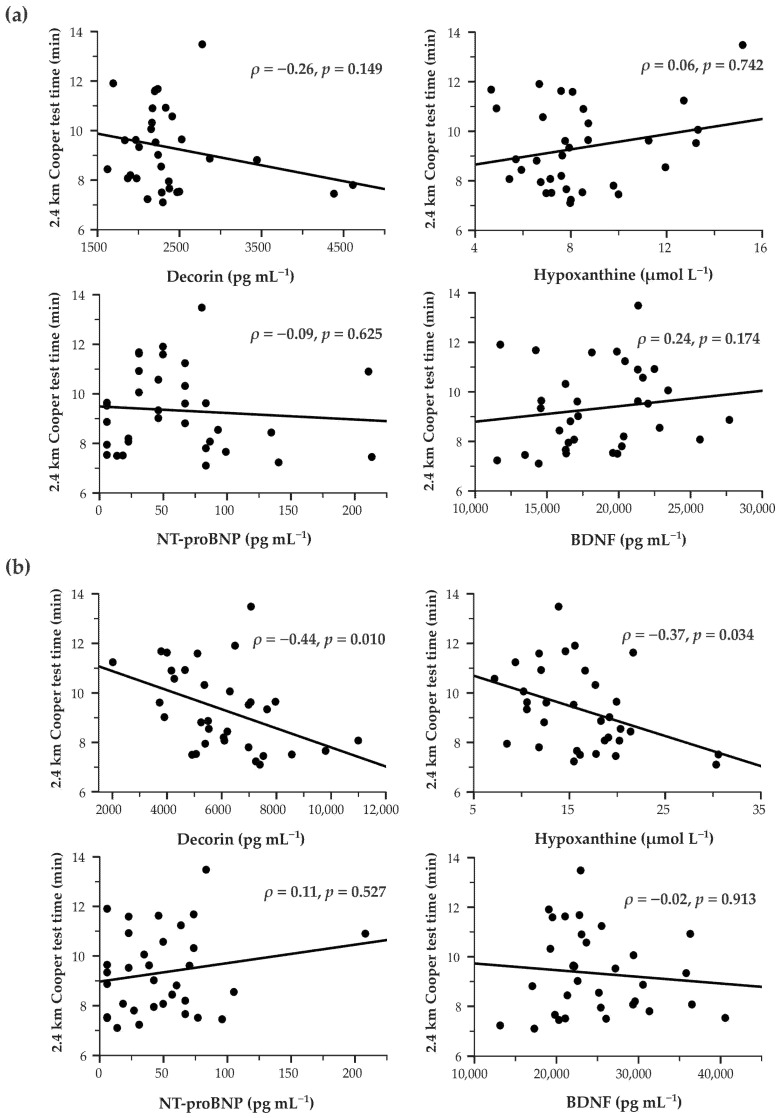 Figure 2
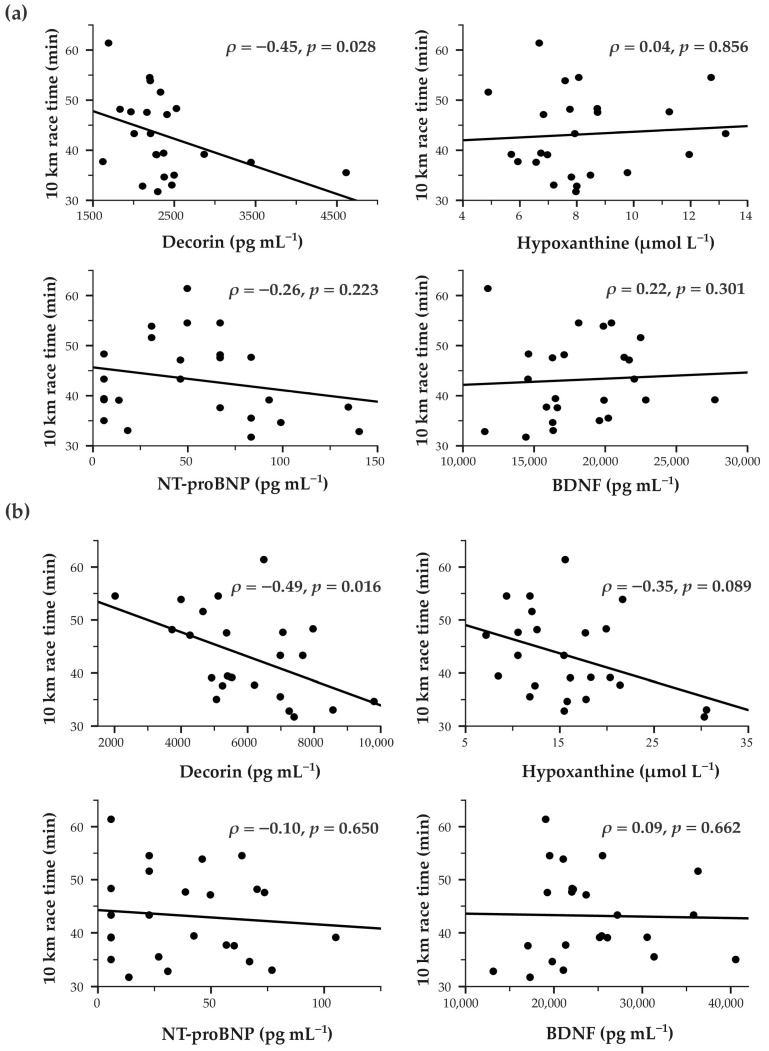 Figure 3
 Figure 4
Peer Reviews
No public reviews on file for this paper yet. If you reviewed it on a platform where reviews are public (OpenReview, ICLR, NeurIPS, ICML), you can paste yours below so the community can read it here.
Videos
No videos yet. Explain this paper in a talk, walkthrough, or lecture? Add one.
Taxonomy
TopicsGenetics and Physical Performance · Cardiovascular Effects of Exercise · Cardiovascular and exercise physiology