Factors Associated with Difficult-to-Treat Rheumatoid Arthritis (D2T-RA): Real-World Evidence from a Single-Center Cross-Sectional Study
Maurizio Benucci, Francesca Li Gobbi, Emanuele Antonio Maria Cassarà, Riccardo Terenzi, Elisa Cioffi, Christian D’Elia, Sabrina Aliberti, Serena Guiducci, Edda Russo, Barbara Lari, Valentina Grossi, Maria Infantino, Mariangela Manfredi

TL;DR
This study identifies factors linked to difficult-to-treat rheumatoid arthritis, including disease duration and treatment history, and suggests JAK inhibitors may help patients who don't respond to other therapies.
Contribution
The study provides real-world evidence on clinical and therapeutic factors associated with D2T-RA and highlights the potential role of JAK inhibitors in managing treatment-resistant RA.
Findings
Female sex, longer disease duration, and higher RF/ACPA titers were associated with D2T-RA.
JAK inhibitors like Filgotinib and Upadacitinib were more common in D2T-RA patients and linked to clinical stabilization.
A greater number of failed advanced therapies was a significant factor in D2T-RA.
Abstract
Background: Rheumatoid arthritis (RA) is a chronic, systemic autoimmune disease characterized by persistent synovial inflammation and progressive joint destruction. Despite the implementation of the treat-to-target (T2T) strategy and the introduction of several classes of biologic and targeted synthetic disease-modifying antirheumatic drugs (b/tsDMARDs), a considerable proportion of patients continues to exhibit active, refractory disease. In 2021, the European Alliance of Associations for Rheumatology (EULAR) defined this condition as Difficult-to-Treat Rheumatoid Arthritis (D2T-RA). This study aimed to identify clinical, laboratory, and therapeutic factors associated with D2T-RA. Methods: A total of 344 patients with established RA were retrospectively evaluated. Among them, 164 fulfilled the 2021 EULAR criteria for D2T-RA (D2T group), while 180 did not (NO-D2T group). Clinical (age,…
Genes, proteins, chemicals, diseases, species, mutations and cell lines named across the full text — each resolved to its canonical identifier and authoritative record.
Click any figure to enlarge with its caption.
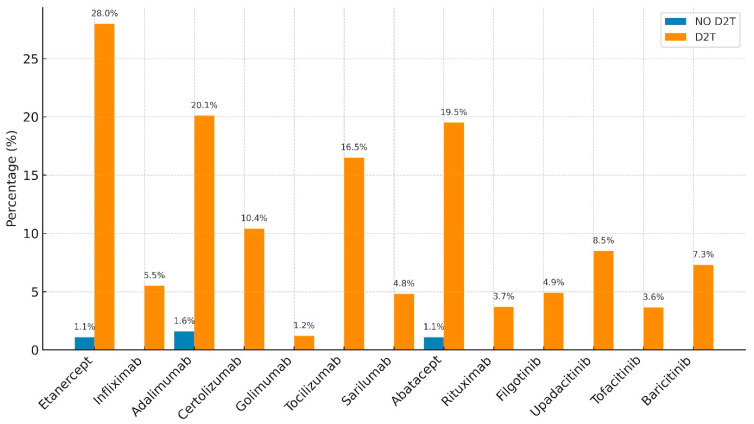 Figure 1
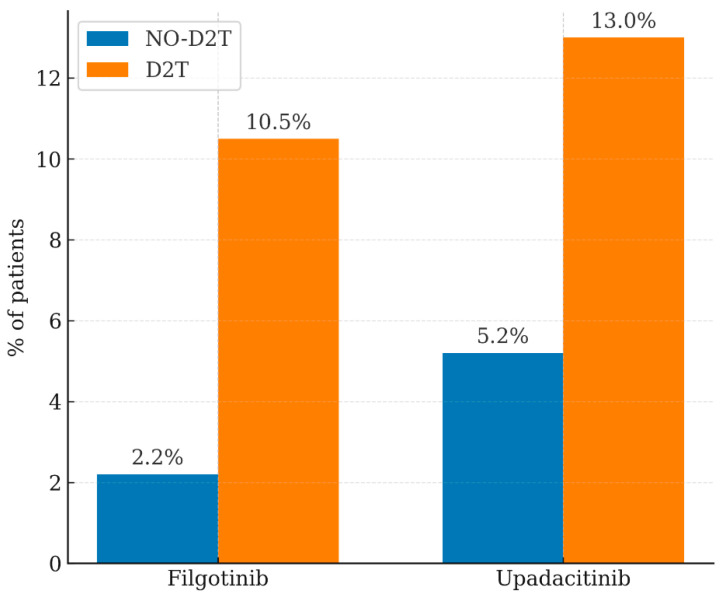 Figure 2
Peer Reviews
No public reviews on file for this paper yet. If you reviewed it on a platform where reviews are public (OpenReview, ICLR, NeurIPS, ICML), you can paste yours below so the community can read it here.
Videos
No videos yet. Explain this paper in a talk, walkthrough, or lecture? Add one.
Taxonomy
TopicsRheumatoid Arthritis Research and Therapies · Biosimilars and Bioanalytical Methods · Autoimmune and Inflammatory Disorders Research