Arteriolar Collapse and Haemodynamic Incoherence in Shock: Rethinking Critical Closing Pressure
Ashley Miller, Philippe Rola, Rory Spiegel, Korbin Haycock

TL;DR
This paper redefines critical closing pressure in shock, showing it as a binary threshold for vessel collapse rather than a continuous pressure, explaining why traditional metrics like MAP can be misleading.
Contribution
The paper reframes critical closing pressure as a binary collapse threshold, resolving contradictions in shock physiology and offering a new model for personalized perfusion management.
Findings
Critical closing pressure is a threshold for vessel collapse, not a continuous downstream pressure.
Perfusion becomes heterogeneous as different vascular beds collapse at different pressures.
Systemic variables like MAP may appear normal even when tissues are under-perfused, causing haemodynamic incoherence.
Abstract
Critical closing pressure (CCP) and the vascular waterfall have long been used to explain perfusion failure in shock, yet their physiological meaning has been inconsistently interpreted. CCP is frequently treated as a continuous downstream pressure and inserted into formulas such as mean arterial pressure (MAP) − CCP, implying that a collapse threshold behaves like an opposing pressure even when vessels remain open. Drawing on classical vascular mechanics, whole-bed flow studies, microvascular models, and contemporary clinical physiology, we show that this interpretation is incorrect. Tone-dependent arteriolar collapse does not behave as a Starling resistor: CCP is a threshold at which smooth-muscle tension exceeds intraluminal pressure and vessels close, not a pressure governing flow in patent vessels. Perfusion becomes heterogeneous because different vascular beds reach their collapse…
Genes, proteins, chemicals, diseases, species, mutations and cell lines named across the full text — each resolved to its canonical identifier and authoritative record.
Click any figure to enlarge with its caption.
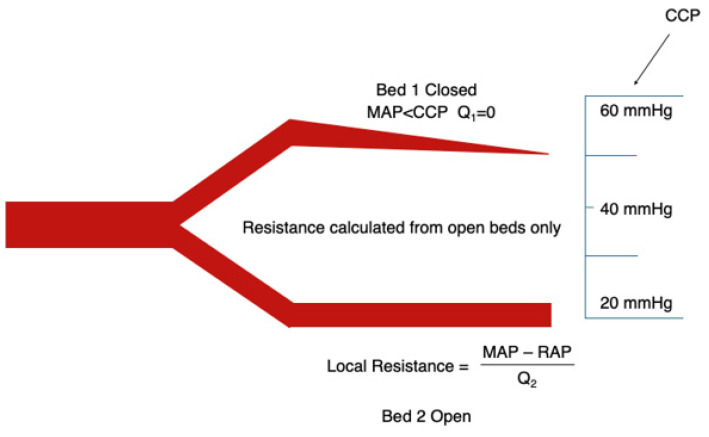 Figure 1
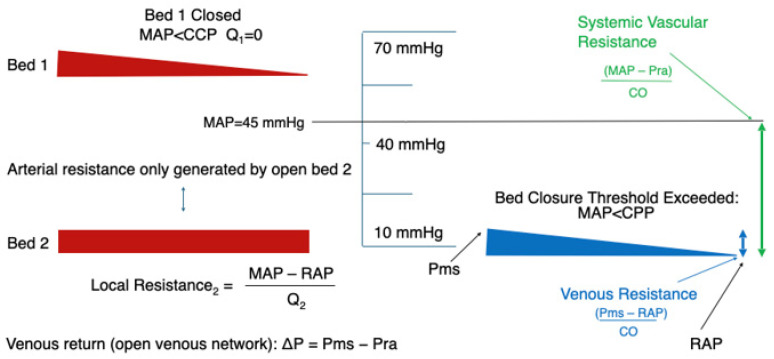 Figure 2
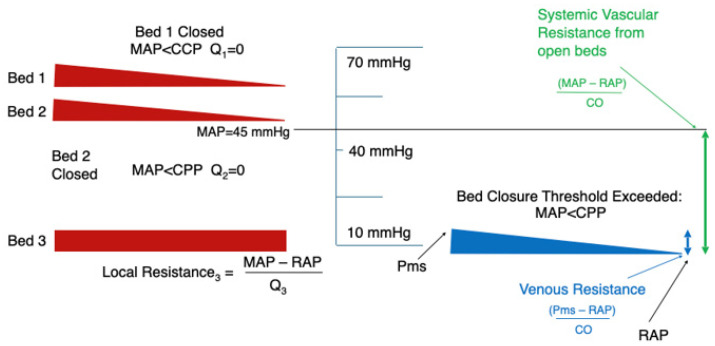 Figure 3
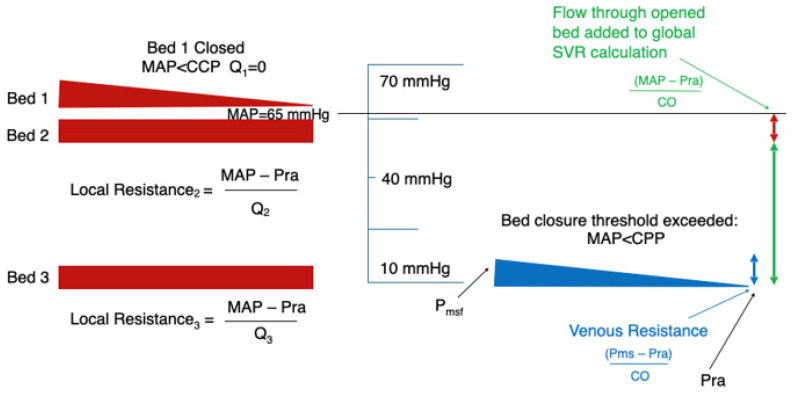 Figure 4
Peer Reviews
No public reviews on file for this paper yet. If you reviewed it on a platform where reviews are public (OpenReview, ICLR, NeurIPS, ICML), you can paste yours below so the community can read it here.
Videos
No videos yet. Explain this paper in a talk, walkthrough, or lecture? Add one.
Taxonomy
TopicsTrauma, Hemostasis, Coagulopathy, Resuscitation · Hemodynamic Monitoring and Therapy · Sepsis Diagnosis and Treatment