Early Prediction of 90-Day Periprosthetic Joint Infection After Hip Arthroplasty for Proximal Femur Fracture Using Machine Learning: Development and Temporal Validation of a Predictive Model
Nicolò Giuseppe Biavardi, Francesco Pezone, Federico Morlini, Mattia Alessio-Mazzola, Valerio Pace, Pierluigi Antinolfi, Giacomo Placella, Vincenzo Salini

TL;DR
This study uses machine learning to predict joint infections after hip surgery for femur fractures, achieving high accuracy and stable performance over time.
Contribution
A machine learning model (XGBoost) was developed and validated for early prediction of periprosthetic joint infection after hip arthroplasty, with high sensitivity and stable performance in temporal validation.
Findings
The XGBoost model achieved an AUC of 0.889 in predicting 90-day periprosthetic joint infection.
The model demonstrated 100% sensitivity and 99.1% NPV in temporal validation with a 2023 cohort.
Postoperative C-reactive protein, operative duration, BMI, ASA class, and serum sodium were key predictors identified via SHAP.
Abstract
Background: Periprosthetic joint infection (PJI) after hip arthroplasty for proximal femur fracture is a severe complication, and early postoperative identification remains challenging. This study developed and validated machine learning (ML) models for the early prediction of 90-day EBJIS 2021 “confirmed” PJI using routinely available perioperative data. Methods: We performed a single-center retrospective study including 1182 consecutive adults undergoing primary hip arthroplasty for proximal femur fracture (2015–2022). Forty-seven perioperative candidate predictors were extracted, including early postoperative laboratory values (postoperative day 1–2 and maxima within 72 h). Six algorithms were trained and compared (logistic regression, random forest, support vector machine, multilayer perceptron, XGBoost, and stacking ensemble) using a stratified 80/20 training–test split with…
Genes, proteins, chemicals, diseases, species, mutations and cell lines named across the full text — each resolved to its canonical identifier and authoritative record.
Click any figure to enlarge with its caption.
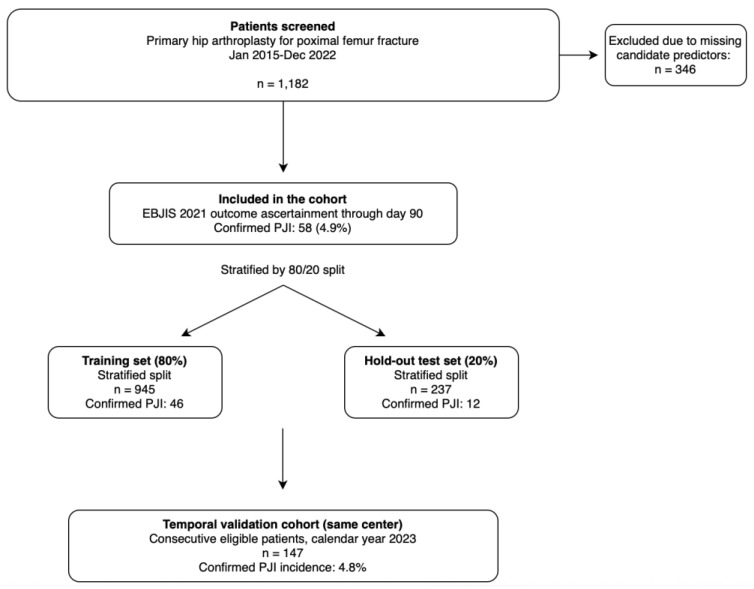 Figure 1
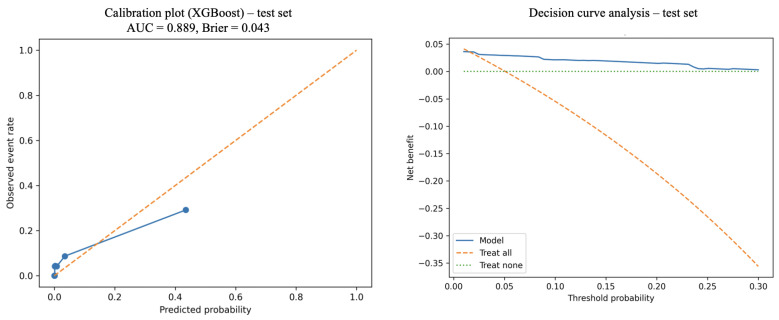 Figure 2
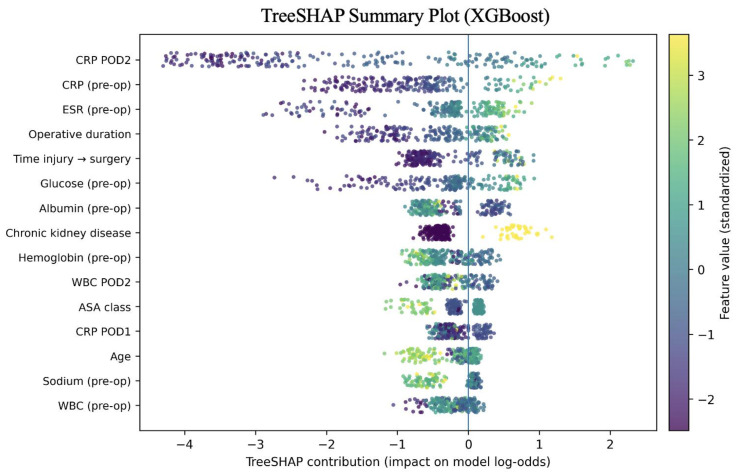 Figure 3
Peer Reviews
No public reviews on file for this paper yet. If you reviewed it on a platform where reviews are public (OpenReview, ICLR, NeurIPS, ICML), you can paste yours below so the community can read it here.
Videos
No videos yet. Explain this paper in a talk, walkthrough, or lecture? Add one.
Taxonomy
TopicsOrthopedic Infections and Treatments · Orthopaedic implants and arthroplasty · Total Knee Arthroplasty Outcomes